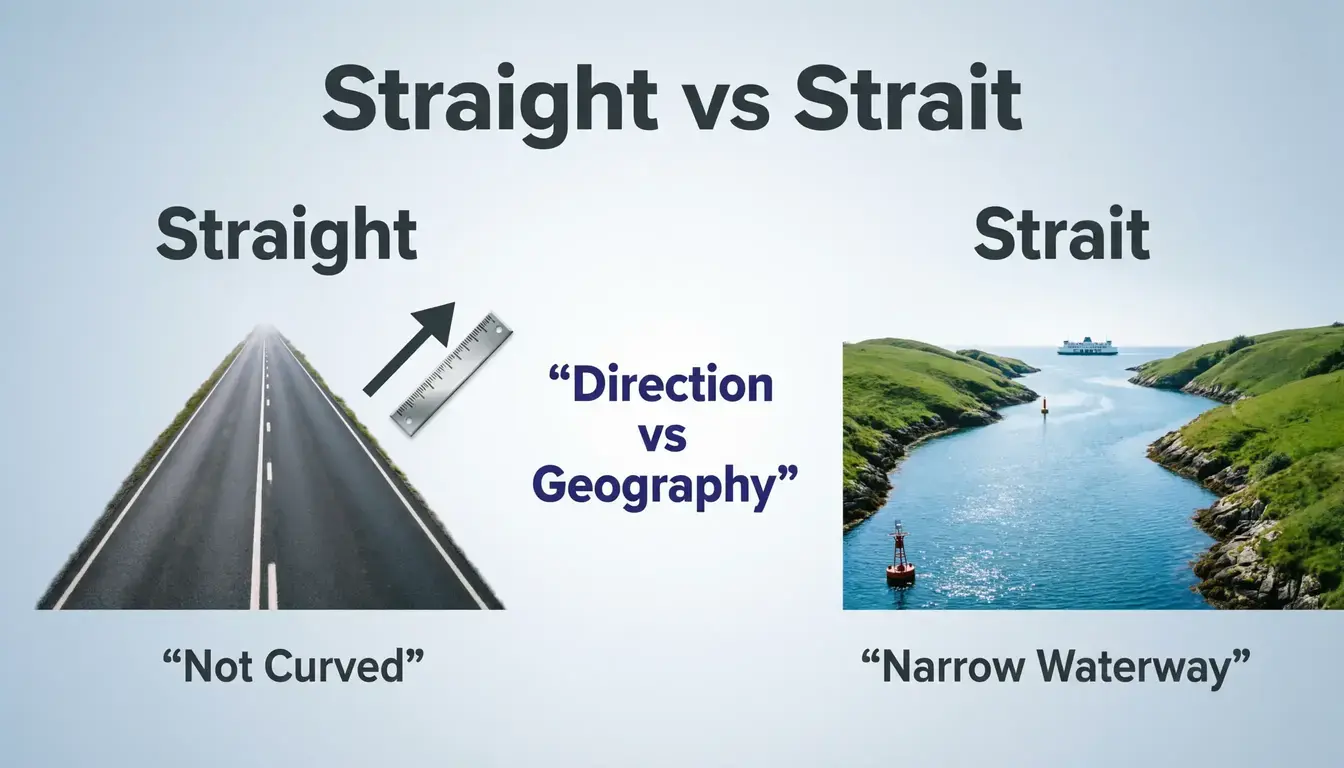
“Straight” usually means not curved, direct, or honest, while “strait” is a noun referring to a narrow water passage connecting two larger bodies of water or an adjective meaning strict or difficult in certain expressions.
Many English words sound exactly the same but have very different meanings. One common example is straight vs strait. Since both words are pronounced alike, many writers accidentally use the wrong spelling. This mistake appears in emails, school assignments, news articles, and even professional documents.
People often search for straight vs strait because they want to know which spelling is correct in a specific sentence. Are you talking about a direct line? Or are you referring to a narrow water passage between two land areas? The answer determines which word you should use.
Understanding the difference is important because these words are not interchangeable. Using the wrong one can confuse readers and make your writing look less professional. The good news is that the distinction is simple once you learn it.
In this guide, you will learn the meaning of each word, their origins, common mistakes, real-world examples, spelling differences, and practical tips for choosing the correct form every time.
Straight vs Strait – Quick Answer
The difference is simple:
| Word | Meaning | Example |
| Straight | Not curved, direct, honest, or in a line | “Drive straight for two miles.” |
| Strait | A narrow passage of water connecting two larger bodies of water | “The ship crossed the strait.” |
Examples
Straight
- The road goes straight to the airport.
- Please give me a straight answer.
- She stood up straight.
Strait
- The ferry crossed the strait between the islands.
- The strait connects two seas.
Quick Tip: If you’re talking about direction, shape, or honesty, use straight. If you’re talking about geography and water, use strait.
The Origin of Straight vs Strait
Although these words sound alike today, they come from different historical roots.
Origin of Straight
The word straight comes from Old English streht or streccan, meaning “to stretch out” or “extend in a direct line.” Over time, it developed meanings related to:
- Directness
- Alignment
- Honesty
- Lack of curves
This is why we say:
- Straight road
- Straight line
- Straight answer
- Straight posture
Origin of Strait
The word strait comes from Latin strictus, meaning “drawn tight” or “narrow.” It entered English through Old French and came to describe narrow waterways squeezed between land masses.
Examples include:
- Strait of Gibraltar
- Bering Strait
- Strait of Hormuz
The spelling difference exists because the words evolved from separate language roots despite having similar pronunciations.
British English vs American English Spelling
Unlike many English words, straight and strait are spelled the same way in both British and American English.
The confusion is not regional. Instead, it comes from pronunciation.
Comparison Table
| Usage | British English | American English |
| Direct line | Straight | Straight |
| Honest answer | Straight | Straight |
| Narrow waterway | Strait | Strait |
| Geographic name | Strait | Strait |
| Pronunciation | Same | Same |
Examples
British English
- Continue straight ahead.
- The ship entered the strait.
American English
- Go straight down the street.
- The strait connects the two oceans.
There are no spelling variations between the two major forms of English.
Which Spelling Should You Use?
The correct choice depends entirely on meaning.
Use “Straight” When:
You mean:
- Direct
- Not curved
- Honest
- Properly aligned
Examples
- Walk straight home.
- Give me a straight answer.
- Keep the picture straight.
Use “Strait” When:
You mean:
- A narrow channel of water
- A geographic feature
Examples
- The vessel crossed the strait.
- The strait separates the two countries.
Audience-Based Advice
| Audience | Recommended Usage |
| US readers | Use straight for direction and strait for waterways |
| UK readers | Same rule applies |
| Australia & Canada | Same rule applies |
| Global audience | Follow the meaning-based distinction |
Because the spelling rule is universal, the audience does not affect your choice.
Common Mistakes with Straight vs Strait
These words are often confused because they are homophones.
Mistake #1
❌ The boat crossed the straight.
✅ The boat crossed the strait.
Why? A water passage is a strait, not a straight.
Mistake #2
❌ Go strait for two miles.
✅ Go straight for two miles.
Why? Directions use straight.
Mistake #3
❌ She gave a strait answer.
✅ She gave a straight answer.
Why? Honest and direct responses are straight answers.
Mistake #4
❌ The straight connects two seas.
✅ The strait connects two seas.
Why? Geographic waterways are strait.
Easy Memory Trick
Straight = Line
Both contain the letter g, helping you remember roads, lines, and directions.
Strait = Water
Think of famous waterways like the Strait of Gibraltar.
Straight vs Strait in Everyday Examples
Understanding real-world usage makes the difference easier to remember.
Emails
- Please send a straight response to the client.
- The shipping route passes through the strait.
News Articles
- Traffic continued straight through downtown.
- The navy monitored activity in the strait.
Social Media
- Just tell me the straight truth.
- Amazing views from the strait today.
In Academic Writing
- Researchers drew a straight line between the points.
- The strait serves as an important trade route.
In Business Writing
- We need a straight explanation of the issue.
- The company ships goods through the strait.
Straight vs Strait – Google Trends & Usage Data
Search behavior shows that straight is much more common than strait because it appears in everyday conversation and writing.
Straight
Common contexts:
- Directions
- Honesty
- Mathematics
- Design
- Communication
Popular in searches such as:
- straight line
- straight answer
- straight road
- straight hair
Strait
Common contexts:
- Geography
- Shipping
- International trade
- Navigation
- World news
Popular searches include:
- Strait of Gibraltar
- Bering Strait
- Strait of Hormuz
Usage by Country
| Country | More Common Term |
| United States | Straight |
| United Kingdom | Straight |
| Canada | Straight |
| Australia | Straight |
| Geography-related searches worldwide | Strait |
Because straight has many meanings, it appears far more frequently in books, websites, and everyday speech.
Straight vs Strait Comparison Table
| Feature | Straight | Strait |
| Part of Speech | Adjective, adverb, noun | Noun |
| Meaning | Direct, not curved, honest | Narrow water passage |
| Everyday Usage | Very common | Less common |
| Used for Directions | Yes | No |
| Used for Geography | No | Yes |
| Example | Go straight ahead | Cross the strait |
| Pronunciation | Same as strait | Same as straight |
FAQs
Is it straight or strait ahead?
The correct phrase is straight ahead because it refers to direction.
Why do straight and strait sound the same?
They are homophones, meaning they share the same pronunciation but have different meanings and spellings.
What is a strait in geography?
A strait is a narrow body of water connecting two larger bodies of water.
Is the Strait of Gibraltar spelled with “strait”?
Yes. Geographic waterways use strait.
What does a straight answer mean?
A straight answer means an honest, direct, and clear response.
Can straight and strait be used interchangeably?
No. They have completely different meanings.
Is “go strait ahead” correct?
No. The correct phrase is go straight ahead.
Is strait only used for water?
Mostly yes. It is primarily a geographic term for waterways.
Which word is more common?
Straight is much more common in everyday English.
Conclusion
The difference between straight vs strait is easy to understand once you focus on meaning. Straight refers to something direct, not curved, aligned, or honest. It appears frequently in everyday communication, directions, education, and business writing. Phrases like “go straight,” “stand up straight,” and “give a straight answer” are common examples.
Strait, on the other hand, is a specialized geographic term. It refers to a narrow passage of water connecting two larger bodies of water. Famous examples include the Strait of Gibraltar and the Bering Strait. Because it is mainly used in geography and navigation, it appears less often in daily conversation.
The key point is that pronunciation cannot help you choose the correct spelling because both words sound identical. Instead, think about the context. If you are discussing direction, shape, or honesty, choose straight. If you are referring to a waterway between land masses, choose strait.
By remembering this simple distinction, you can avoid a common spelling mistake and write with greater confidence and accuracy.
Overview:
Many learners also search for topics such as straight vs strait synonyms, straight vs strait meaning, and straight vs strait examples to better understand the difference between these commonly confused words. Questions about strait vs straight pronunciation are also popular because the two words sound exactly the same.
Related searches like strait or straightforward, straight or straitjacket, and strait vs channel help users see how each term is used in different contexts. Some people even look up strait vs Straits of Hormuz to understand how the word strait is used in geography, where it refers to a narrow water passage connecting two larger bodies of water.

I hold a degree in English Literature and Linguistics and have worked extensively on educational blogs, comparison websites, and digital learning platforms. My writing focuses on simplifying complex language rules, highlighting British vs American English differences, and providing practical examples for everyday usage.