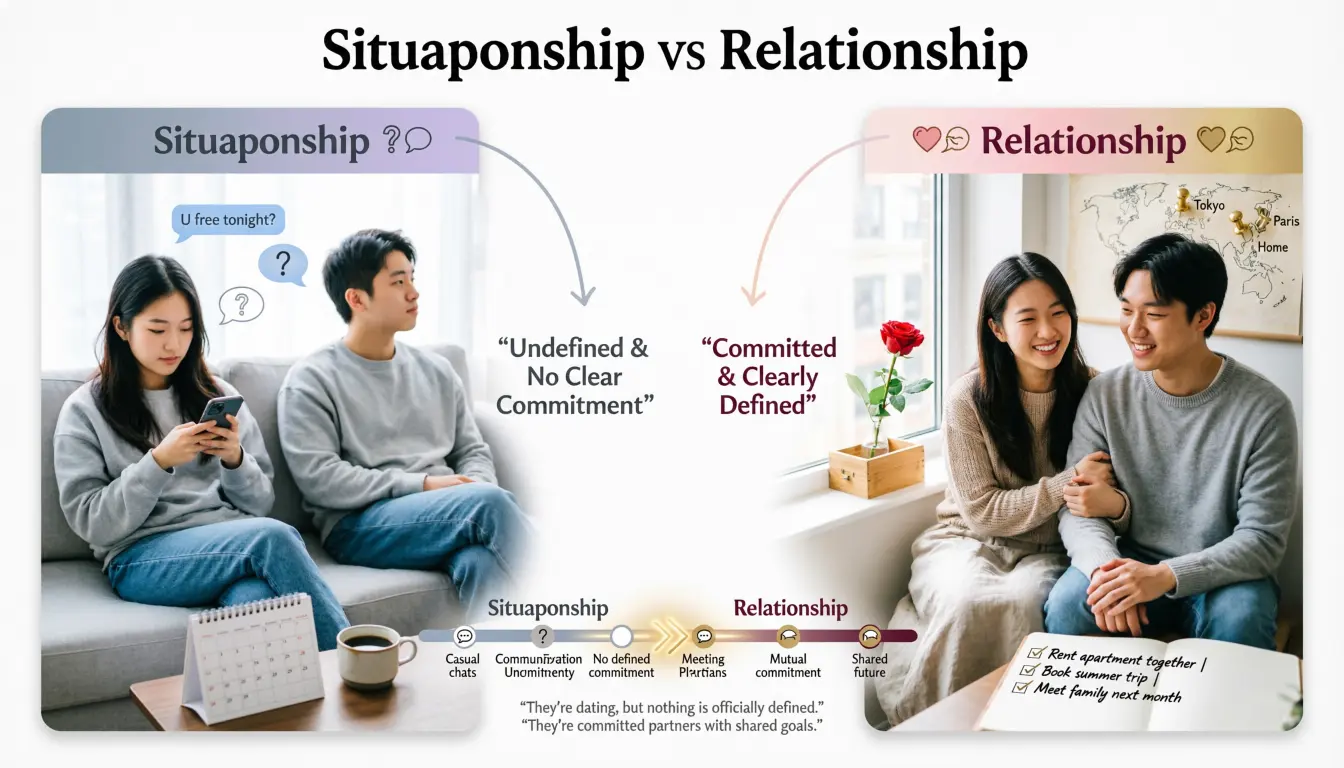
“Situationship” and “relationship” both describe romantic connections, but they differ in commitment and clarity. A situationship is an informal romantic or emotional connection without clearly defined expectations or commitment, while a relationship is a committed partnership in which both people generally have shared expectations, communication, and mutual understanding
Modern dating has changed a lot over the past decade. Many people spend weeks or even months talking, texting, and going on dates without ever defining what they are. This has made the term situationship more common than ever. Because of this, many people search for situationship vs relationship to understand the difference and avoid confusion.
A situationship and a relationship may look similar at first. Both can include dates, emotional connection, and physical intimacy. However, the biggest difference is commitment. A situationship usually has no clear label or long-term plan, while a relationship is based on mutual commitment, trust, and shared goals.
This guide explains the meaning of situationship vs relationship, their origins, major differences, warning signs, everyday examples, and expert advice.
By the end, you’ll know how to recognize each type of connection and decide which one best matches your goals.
Situationship vs Relationship – Quick Answer
A situationship is a romantic connection without clear commitment, labels, or future plans. A relationship is a committed partnership where both people openly define their connection and usually plan a future together.
Examples
Situationship
- You text every day.
- You spend weekends together.
- You never discuss being exclusive.
- Neither person uses labels like boyfriend or girlfriend.
Relationship
- You call each other partners.
- Friends and family know about your relationship.
- You plan holidays and future goals together.
- Both people agree to be committed.
In simple words, a situationship is uncertain, while a relationship offers clarity and commitment.
The Origin of Situationship vs Relationship
The word relationship has existed for centuries. It comes from the word relation, which traces back to the Latin relatio, meaning “to bring back” or “to connect.”
The word situationship is much newer. It combines the words situation and relationship. The term became popular during the late 2000s and exploded on social media in the 2010s. Dating apps and changing relationship habits helped make it a common expression.
Unlike traditional relationships, a situationship describes a romantic connection that exists without clearly defined expectations. Today, it is widely used in dating advice, podcasts, and online discussions.
Situationship vs Relationship: Key Differences
Although both involve romantic feelings, they are built on different foundations.
| Feature | Situationship | Relationship |
| Commitment | Unclear | Clearly defined |
| Labels | Usually none | Boyfriend, girlfriend, partner |
| Exclusivity | Often uncertain | Usually exclusive |
| Future plans | Rarely discussed | Frequently discussed |
| Communication | Can be inconsistent | Usually consistent |
| Emotional security | Less stable | More secure |
| Long-term goals | Not always shared | Shared by both partners |
The biggest difference is certainty. Healthy relationships remove guesswork, while situationships often leave one or both partners wondering where they stand.
Signs You’re in a Situationship
Sometimes it is difficult to know whether your connection is becoming serious. Here are common signs.
There Is No Label
Months may pass without either person defining the relationship.
Plans Are Last Minute
Instead of planning weeks ahead, you mostly make spontaneous plans.
Communication Is Inconsistent
Some days you talk constantly. Other days there is little or no contact.
Future Conversations Are Avoided
Whenever the future comes up, the topic changes quickly.
You Feel Confused
You often ask yourself:
- What are we?
- Are they dating someone else?
- Where is this going?
If these questions happen often, you may be in a situationship.
Signs You’re in a Relationship
Healthy relationships share several qualities.
Clear Commitment
Both partners know they are together.
Honest Communication
Problems are discussed instead of ignored.
Emotional Support
Each person feels respected and valued.
Future Planning
You make plans for birthdays, holidays, travel, or even living together.
Trust
Neither partner constantly worries about where they stand.
Which One Should You Choose?
The answer depends on your personal goals.
Choose a situationship if:
- You are not ready for commitment.
- You want flexibility.
- Both people agree on keeping things casual.
Choose a relationship if:
- You want emotional security.
- You value stability.
- You hope to build a long-term future.
- You prefer exclusivity.
Neither option is automatically better. The healthiest choice is one where both people want the same thing.
Common Mistakes with Situationships
Many people experience unnecessary stress because of these common mistakes.
Assuming It Will Become Serious
Never assume commitment without discussing it.
Ignoring Red Flags
Mixed signals and inconsistent communication should not be ignored.
Avoiding Difficult Conversations
Many people fear asking, “What are we?” Waiting too long often creates more confusion.
Staying Out of Fear
Some people remain in situationships because they fear being alone, even when they are unhappy.
Situationship vs Relationship in Everyday Examples
Situationship
“Want to meet after work if you’re free?”
Relationship
“I booked our anniversary dinner for Saturday.”
Social Media
Situationship:
“No relationship status.”
Relationship:
Photos together, anniversary posts, and shared memories.
News
“Writers say situationships are becoming more common among young adults.”
Formal Writing
Researchers often describe situationships as a growing trend influenced by dating apps and changing social expectations.
Situationship vs Relationship – Google Trends & Usage Data
Search interest in situationship has grown rapidly since 2021. The term became especially popular on TikTok, Instagram, and dating podcasts.
Countries with high search interest include:
- United States
- Canada
- United Kingdom
- Australia
- New Zealand
The word relationship remains one of the most searched dating terms worldwide because it covers marriage, dating, communication, and emotional health.
| Search Term | Popularity |
| Relationship | Very High |
| Situationship | Rapidly Growing |
| Situationship vs Relationship | High among young adults |
Situationship vs Relationship in Academic Writing
Academic writing treats situationships as a modern social phenomenon. Researchers study how dating apps, delayed marriage, and changing social values influence these undefined relationships.
Relationships are widely studied in psychology, sociology, and family studies. Topics often include attachment, communication, conflict resolution, and relationship satisfaction.
When writing academically, define the term situationship before using it because it is newer and less formal than relationship.
Situationship vs Relationship in Business English
Business professionals rarely use the word situationship unless discussing workplace relationships, psychology, or modern culture.
In coaching, leadership, or HR writing, the idea of a situationship may be used to describe unclear expectations, while healthy business partnerships are often compared to committed relationships based on trust and accountability.
Common Style Guide Recommendations
- Define situationship the first time you use it.
- Use relationship for committed partnerships.
- Avoid slang in formal writing unless it is explained.
- Keep terminology consistent throughout the article.
- Match your tone to your audience.
Real Examples from Published Sources
Many well-known publications have discussed situationships.
- Cosmopolitan described a situationship as a romantic connection without commitment.
- Verywell Mind explains that unclear expectations often create emotional stress.
- BBC has reported that many young adults are choosing less traditional dating arrangements.
These examples show that the term has become part of mainstream discussions about modern dating.
Quiz: Are You in a Situationship?
1. Have you defined your relationship?
A. Yes
B. No
2. Do you make long-term plans together?
A. Yes
B. No
3. Have you met each other’s families?
A. Yes
B. No
4. Is your relationship exclusive?
A. Yes
B. No
Results
Mostly A answers: You are likely in a committed relationship.
Mostly B answers: You may be in a situationship.
Fill in the Blanks
- A __________ has no clear commitment. (situationship)
- A committed __________ includes trust and shared goals. (relationship)
- Good __________ helps avoid confusion. (communication)
- Healthy partners usually discuss their __________ together. (future)
- Mutual __________ builds stronger relationships. (trust)
FAQs
1. Can a situationship become a relationship?
Yes. Honest communication and mutual commitment can turn a situationship into a healthy relationship.
2. How long should a situationship last?
There is no fixed time, but if months pass without clarity and it causes stress, it may be time to talk or move on.
3. Is a situationship the same as friends with benefits?
No. Friends with benefits usually focus on physical intimacy, while situationships often include dating and emotional connection.
4. Why do people choose situationships?
Some people enjoy flexibility, while others are not ready for serious commitment.
5. Are situationships unhealthy?
Not always. They can work if both people want the same type of connection and communicate openly.
6. What is the biggest difference between a situationship and a relationship?
Commitment. Relationships have clear expectations, while situationships usually do not.
7. Should I ask, “What are we?”
Yes. Honest communication helps prevent misunderstandings and ensures both partners share similar expectations.
8. Can situationships last for years?
Some do, but many eventually end because one or both partners want greater clarity or commitment.
Conclusion
Understanding situationship vs relationship is important in today’s dating world because many romantic connections begin without clear labels. While both involve attraction, affection, and spending time together, the biggest difference is commitment. A situationship offers flexibility but often comes with uncertainty, while a relationship provides emotional security, trust, and shared goals.
Neither option is right or wrong. The best choice depends on what both people truly want. If you enjoy casual dating and both partners agree on the arrangement, a situationship can work well. However, if you are looking for stability, exclusivity, and a long-term future, a committed relationship is usually the better path.
The most important lesson is to communicate honestly. Don’t assume your partner shares your expectations. Ask questions, discuss your goals, and be willing to walk away if your needs are not being met. Clear communication leads to healthier relationships, fewer misunderstandings, and greater emotional well-being. If you choose a situationship or a relationship, clarity and mutual respect should always come first.

I hold a degree in English Literature and Linguistics and have worked extensively on educational blogs, comparison websites, and digital learning platforms. My writing focuses on simplifying complex language rules, highlighting British vs American English differences, and providing practical examples for everyday usage.