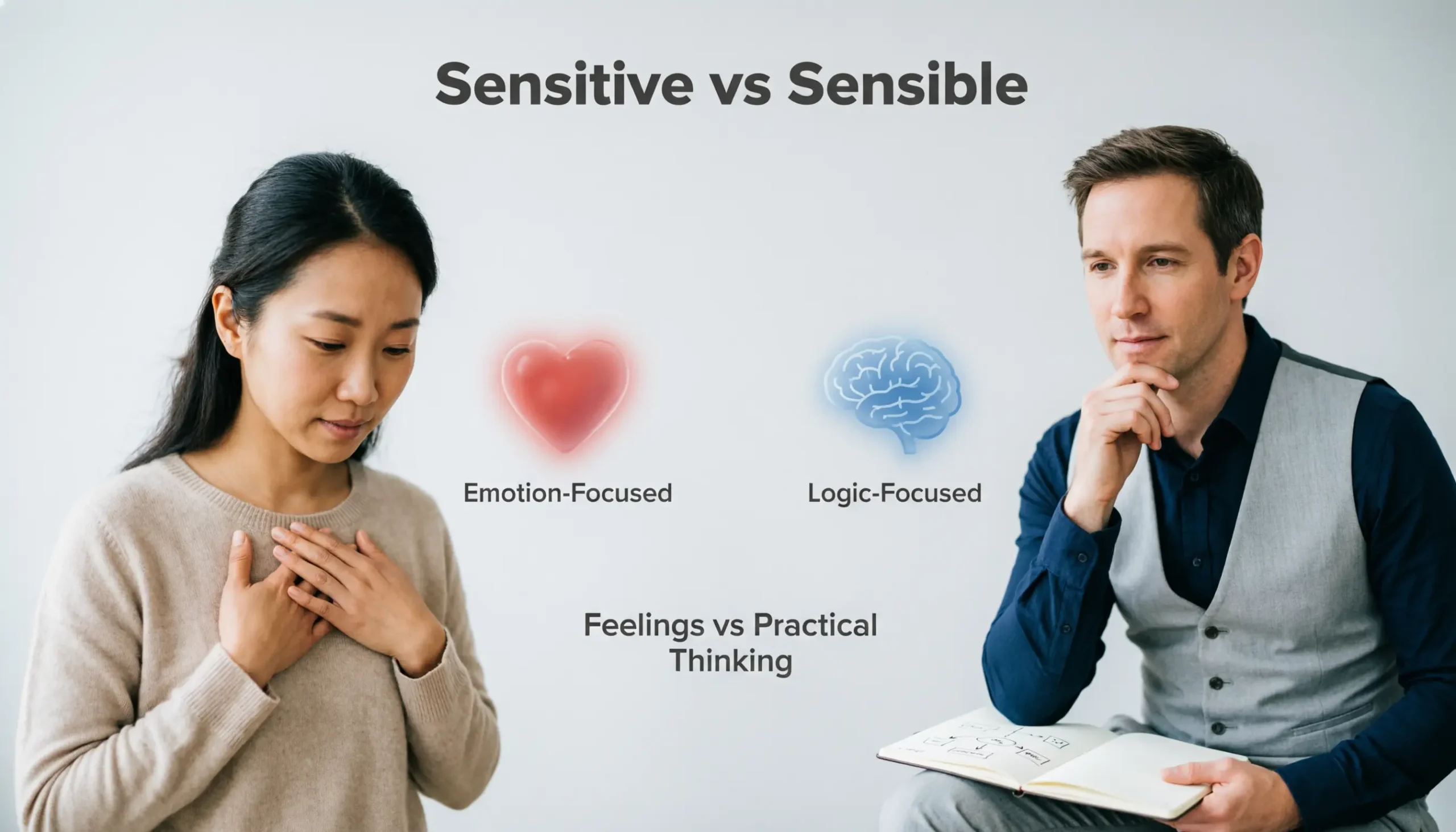
“Sensitive” means easily affected by emotions, feelings, or external conditions, while “sensible” means practical, reasonable, and showing good judgment.
Many English learners and native speakers confuse sensitive and sensible because the words look similar and are often used when describing people. However, they have very different meanings. Using the wrong one can completely change the message you want to share.
People often search for “sensitive vs sensible” when writing emails, school assignments, business documents, or social media posts. They want to know which word is correct and when to use each one. The confusion becomes even greater because both words describe personal qualities and are commonly used in everyday conversations.
The good news is that the difference is simple once you understand it.
A sensitive person easily notices emotions, feelings, or changes around them. A sensible person makes practical and wise decisions.
In this guide, you’ll learn the meanings, origins, examples, common mistakes, usage trends, and expert advice on choosing the correct word. By the end, you will never mix up sensitive and sensible again.
Sensitive vs Sensible – Quick Answer
The difference is simple:
| Word | Meaning | Example |
| Sensitive | Easily affected by feelings, emotions, or changes | Sarah is sensitive and gets hurt by criticism. |
| Sensible | Practical, wise, and reasonable | Mark made a sensible decision to save money. |
Quick Examples
✅ She is sensitive to other people’s feelings.
✅ He gave a sensible answer during the meeting.
A simple trick:
- Sensitive = emotional awareness
- Sensible = practical thinking
The Origin of Sensitive vs Sensible
Although these words look alike, they developed different meanings over time.
Sensitive
The word sensitive comes from the Latin word sensitivus, meaning “able to feel” or “responsive to sensations.”
Originally, it described physical reactions, such as being sensitive to heat or cold. Over time, it expanded to include emotional reactions.
Examples:
- Sensitive skin
- Sensitive emotions
- Sensitive information
Sensible
The word sensible comes from the Latin word sensibilis, meaning “perceptible” or “having sense.”
Over the centuries, English speakers began using it to describe people who show good judgment and practical thinking.
Examples:
- Sensible planning
- Sensible advice
- Sensible spending
Why the Confusion Exists
Both words come from Latin roots related to the senses. Their similar spelling causes many people to assume they have the same meaning.
However:
- Sensitive = feeling
- Sensible = reasoning
British English vs American English Spelling
Unlike many English word pairs, sensitive and sensible have the same spelling in both British and American English.
There is no spelling difference.
Comparison Table
| Feature | British English | American English |
| Sensitive | Sensitive | Sensitive |
| Sensible | Sensible | Sensible |
| Meaning Difference | Same | Same |
| Usage Rules | Same | Same |
Examples:
British English:
- She is very sensitive to criticism.
- That seems like a sensible solution.
American English:
- She is very sensitive to criticism.
- That sounds like a sensible plan.
Both versions of English use these words exactly the same way.
Which Spelling Should You Use?
Since both words have identical spelling worldwide, the real question is which word fits your sentence.
Use Sensitive When:
You are talking about:
- Feelings
- Emotions
- Reactions
- Awareness
- Physical sensitivity
Examples:
- My child is sensitive.
- This topic is sensitive.
- My eyes are sensitive to bright light.
Use Sensible When:
You are talking about:
- Logic
- Practical choices
- Good judgment
- Reasonable decisions
Examples:
- It is sensible to save money.
- She made a sensible recommendation.
- Wearing a seatbelt is sensible.
Audience-Based Advice
| Audience | Recommendation |
| US readers | Use the word that matches the meaning |
| UK readers | Use the word that matches the meaning |
| Australia, Canada, New Zealand | Same usage rules |
| Global audience | Follow meaning, not location |
Location does not affect the choice.
Common Mistakes with Sensitive vs Sensible
Many writers accidentally swap these words.
Mistake #1
❌ She made a sensitive decision.
✅ She made a sensible decision.
Reason: Decisions are usually judged by logic, not emotion.
Mistake #2
❌ He is sensible to criticism.
✅ He is sensitive to criticism.
Reason: Criticism affects feelings.
Mistake #3
❌ My skin is sensible to soap.
✅ My skin is sensitive to soap.
Reason: Physical reactions require “sensitive.”
Mistake #4
❌ It is sensitive to carry an umbrella.
✅ It is sensible to carry an umbrella.
Reason: Carrying an umbrella is a practical choice.
Easy Memory Trick
Think:
Sensitive = Sentiments (feelings)
Sensible = Sense (good judgment)
This trick helps many learners remember the difference instantly.
Sensitive vs Sensible in Everyday Examples
Emails
Sensitive:
Please handle this sensitive information carefully.
Sensible:
A sensible approach would be to review the report first.
News Articles
Sensitive:
The government discussed a sensitive national security issue.
Sensible:
Experts called the policy a sensible solution.
Social Media
Sensitive:
I’m sensitive about comments on my appearance.
Sensible:
It would be sensible to verify the facts before sharing.
Business Writing
Sensitive:
Customer data is highly sensitive.
Sensible:
The company adopted a sensible growth strategy.
In Daily Conversations
Sensitive:
She is very sensitive and cares deeply about others.
Sensible:
He is sensible and always thinks before acting.
Sensitive vs Sensible – Google Trends & Usage Data
Search data shows that people frequently look up sensitive vs sensible because both words are commonly used in schools, workplaces, and everyday conversations.
Where the Search Interest Comes From
The highest interest often comes from:
- United States
- United Kingdom
- Canada
- Australia
- India
These countries have large English-speaking populations and many English learners.
Usage Context
Sensitive Appears More Often In:
- Health discussions
- Mental health content
- Personal relationships
- Technology and security
- Customer service
Examples:
- Sensitive skin
- Sensitive data
- Sensitive topics
Sensible Appears More Often In:
- Financial advice
- Education
- Business writing
- Parenting advice
- Decision-making content
Examples:
- Sensible investment
- Sensible choice
- Sensible solution
Usage Comparison Table
| Feature | Sensitive | Sensible |
| Emotional meaning | Yes | No |
| Practical meaning | No | Yes |
| Used for feelings | Yes | Rarely |
| Used for decisions | Rarely | Yes |
| Used for physical reactions | Yes | No |
| Used in business advice | Sometimes | Often |
Frequently Asked Questions
Is sensitive the same as sensible?
No. Sensitive relates to feelings or reactions, while sensible relates to practical thinking and good judgment.
Can a person be both sensitive and sensible?
Yes. Someone can be emotionally aware and still make wise decisions.
Is sensitive positive or negative?
It can be either. Being sensitive can mean caring and empathetic, but it can also mean easily hurt.
Is sensible always positive?
Usually yes. Being sensible generally means making good and reasonable choices.
What is a sensible person?
A sensible person thinks carefully and makes practical decisions.
What is a sensitive person?
A sensitive person notices emotions, feelings, and changes more strongly than others.
Can I say “sensible skin”?
No. The correct phrase is sensitive skin.
Can I say “sensitive advice”?
Usually no. Advice is typically described as sensible advice.
Which word is more common?
Both are common, but they appear in different situations. Sensitive is common in emotional and physical contexts, while sensible is common in decision-making contexts.
Conclusion
Understanding the difference between sensitive vs sensible is easier than many people think. While the words look similar and share historical roots, they describe completely different ideas.
A sensitive person responds strongly to emotions, feelings, or physical changes. The word is often used when discussing relationships, emotions, health conditions, personal experiences, and topics that require care. You can also use it for things like sensitive skin, sensitive information, or sensitive issues.
A sensible person, on the other hand, makes practical, logical, and wise decisions. The word is commonly used when talking about planning, money, safety, business decisions, and everyday problem-solving. Sensible choices are usually thoughtful and reasonable.
When deciding which word to use, ask yourself a simple question: Are you talking about feelings or good judgment? If it is about emotions or reactions, choose sensitive. If it is about practical thinking and wise decisions, choose sensible.
Overview:
The difference between sensitive vs sensible is often confusing, but it becomes clear with simple examples. In basic sensitive vs sensible meaning, “sensitive” means easily affected by emotions, feelings, or situations, while “sensible” means practical, logical, and making good decisions.
In sensitive vs sensible psychology, a sensitive person may react strongly to emotions, whereas a sensible person stays calm and thinks logically. For a sensible and sensitive example, a sensitive friend may get hurt by a small comment, but a sensible friend will understand the intention before reacting.
You can also test yourself using a sensitive vs sensible quiz to check understanding. Some people compare sensitive vs sensible vs practical, where “practical” is closer to real-life useful actions, while sensible focuses on wise thinking. In daily life, we also hear terms like sensible or sensitive information, which means information that should be handled carefully or logically, and sensitive or sensible skin, where “sensitive skin” is the correct term for easily irritated skin.
Overall, sensitive vs sensible examples help you clearly see how emotion-based reactions differ from logical decision-making.

I am an Emily Carter Brooks U.S.A based linguistics writer known for my clear, reader-friendly explanations of English grammar and vocabulary differences. I have contributed to multiple online language resources and specializes in spelling variations, pronunciation confusion, and British vs American English comparisons. I’m passionate about helping learners improve their English through practical, everyday communication. engaging, and stress-free.