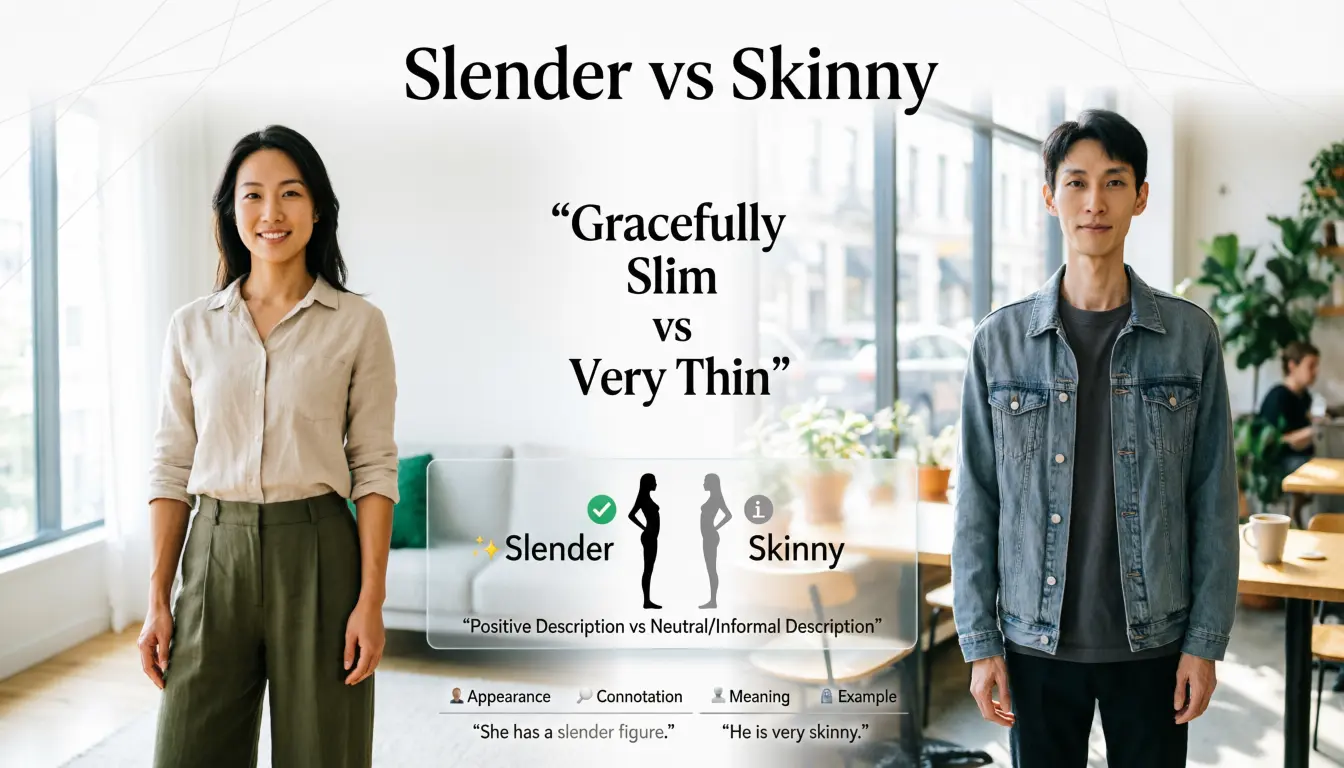
“Slender” and “skinny” both describe a thin body shape, but they have different connotations. “Slender” usually has a positive or complimentary meaning, suggesting a graceful, healthy, and attractively slim figure, while “skinny” often has a negative or neutral meaning, implying someone is very thin, sometimes excessively so.
Have you ever wondered if you should describe someone as slender or skinny? At first, both words seem to mean the same thing because they describe a thin body. However, they carry very different feelings and meanings.
Many English learners, writers, and even native speakers search for slender vs skinny because choosing the wrong word can accidentally sound rude or insulting. For example, calling someone slender is usually a compliment, while calling someone skinny may sound negative unless used in a casual or friendly way.
Understanding the difference helps you communicate clearly in conversations, business writing, social media posts, and academic work. It also helps you avoid misunderstandings when describing people’s appearance.
In this guide, you’ll learn the meaning of each word, where they came from, when to use them, common mistakes to avoid, and plenty of real-life examples. By the end, you’ll know exactly which word fits every situation.
Slender vs Skinny – Quick Answer
Quick Answer:
- Slender means gracefully thin, attractive, or well-proportioned. It is usually positive.
- Skinny means very thin, often too thin. It can sound negative or critical.
Simple Examples
| Word | Meaning | Tone | Example |
| Slender | Thin in an attractive way | Positive | She has a slender figure. |
| Skinny | Very thin, sometimes unhealthy | Neutral or Negative | He looks too skinny after being sick. |
Compare These Sentences
✅ She has a slender neck.
✅ The model has a slender waist.
⚠️ The child became skinny after the illness.
⚠️ Don’t call someone skinny unless you’re sure they won’t be offended.
Easy Way to Remember
- Slender = Elegant + Thin
- Skinny = Very Thin (sometimes unhealthy)
The Origin of Slender vs Skinny
Learning where these words came from helps explain why they have different meanings today.
Origin of “Slender”
The word slender entered English during the Middle Ages. It comes from Middle Dutch slinder, meaning thin or narrow.
Over time, English speakers began using slender to describe people or objects that are thin in a beautiful, graceful, or elegant way.
Today, it is commonly used in:
- Fashion
- Literature
- Beauty writing
- Formal descriptions
- Examples:
- a slender woman
- slender fingers
- a slender tree
- a slender vase
Notice that slender often describes beauty, elegance, or style.
Origin of “Skinny”
The word skinny comes from the noun skin.
Originally, it described someone whose bones seemed close to the skin because they had very little body fat.
That history explains why the word often suggests:
- underweight
- unhealthy
- lacking muscle
- extremely thin
Modern English speakers sometimes use it positively in fashion or fitness, but many people still hear it as criticism.
Examples:
- skinny jeans
- skinny arms
- skinny child
The meaning depends heavily on context.
Why These Words Feel Different
Although both describe thin people, their emotional meaning is different.
| Slender | Skinny |
| Elegant | Often harsh |
| Attractive | Can sound unhealthy |
| Positive | Sometimes negative |
| Polite | Informal |
| Complimentary | May offend |
That’s why magazines usually describe models as slender, not skinny.
British English vs American English Usage
Unlike words such as colour/color or analysed/analyzed, slender and skinny have the same spelling in both British and American English.
The difference is not spelling it is meaning and tone.
Comparison Table
| Feature | Slender | Skinny |
| British spelling | Slender | Skinny |
| American spelling | Slender | Skinny |
| Meaning | Gracefully thin | Very thin |
| Tone | Positive | Neutral or Negative |
| Formal writing | Common | Less common |
| Everyday speech | Yes | Yes |
| Fashion writing | Very common | Less common |
British English Examples
- She has a slender figure.
- The tree has a slender trunk.
- He looked skinny after the winter.
American English Examples
- She’s tall and slender.
- My brother is naturally skinny.
- The athlete stayed slender through regular exercise.
Both countries understand these words the same way.
Which Word Should You Use?
The best choice depends on what you want to say.
Use “Slender” When You Want to Compliment
Choose slender if you’re describing someone positively.
Examples:
- She has a slender build.
- The actress has a slender frame.
- The dancer remained slender through training.
This sounds respectful and polite.
Use “Skinny” Carefully
Use skinny only when:
- someone describes themselves that way
- you’re talking casually with close friends
- you’re discussing health or body weight
- you’re describing clothing like skinny jeans
Examples:
- He’s naturally skinny.
- I was skinny as a child.
- Skinny jeans became popular again.
Avoid saying:
❌ You’re so skinny!
Some people may find this offensive.
Audience-Based Advice
| Audience | Best Choice |
| Academic writing | Slender |
| Business writing | Slender |
| Health articles | Depends on context |
| Fashion magazines | Slender |
| Friendly conversation | Either, depending on meaning |
| Professional communication | Slender |
Global English Tip
If you’re writing for an international audience, slender is usually the safest and most professional choice.
Common Mistakes with Slender vs Skinny
Many learners make these mistakes.
Mistake 1: Thinking They Mean Exactly the Same
❌ She is skinny, so everyone admired her beauty.
✅ She is slender, so everyone admired her beauty.
Mistake 2: Using Skinny as a Compliment
Not everyone likes being called skinny.
Better:
✅ You look slender.
✅ You look elegant.
Mistake 3: Using Slender for Someone Who Is Unhealthy
If someone has lost weight because of illness, skinny may describe the situation more accurately.
Example:
After the illness, he became very skinny.
Mistake 4: Forgetting Tone
Remember:
- Slender = praise
- Skinny = may sound critical
Always think about how the listener may feel.
Slender vs Skinny in Everyday Examples
The difference between slender and skinny becomes much clearer when you see how people use them in real life.
In Emails
Professional Email
The company is looking for a slender design that saves space and looks modern.
Casual Email
I used to be really skinny in high school, but now I’m healthier.
In News Articles
Journalists often choose slender because it sounds more neutral and respectful.
Examples:
- The actress appeared in a slender black dress.
- The building features a slender glass tower.
News reports may use skinny when discussing health or fashion.
Examples:
- Doctors warned that the child had become too skinny.
- Skinny jeans remain popular among young shoppers.
On Social Media
People use both words, but the tone changes.
Examples:
- I finally reached my fitness goal and feel slender again.
- I was so skinny when I was sixteen!
- This dress makes me look slender.
- Those skinny jeans still fit!
In Formal Writing
Formal writing usually prefers slender because it sounds more objective and polite.
Examples::
- The architect designed a slender tower.
- The model has a slender silhouette.
Avoid using skinny in formal reports unless discussing health, medicine, or direct quotations.
Slender vs Skinny – Google Trends & Usage Data
Search interest shows that both words are popular, but people search for them in different situations.
“Slender”
People commonly search for:
- slender meaning
- slender body
- slender figure
- slender build
- slender woman
These searches are often related to:
- fashion
- beauty
- writing
- fitness
- body descriptions
“Skinny”
People commonly search for:
- skinny meaning
- skinny jeans
- skinny person
- why am I skinny
- skinny vs slim
These searches are often connected with:
- health
- clothing
- fitness
- body image
Popularity by Country
| Country | More Common Usage |
| United States | Both words are common |
| United Kingdom | Both words are common |
| Canada | Slender in formal writing |
| Australia | Similar usage |
| India | Slender is often preferred in writing |
Overall, slender appears more often in professional and descriptive writing, while skinny is common in everyday conversation and fashion.
Slender vs Skinny Comparison Table
| Feature | Slender | Skinny |
| Meaning | Gracefully thin | Very thin |
| Tone | Positive | Neutral or Negative |
| Sounds Polite | Yes | Not always |
| Formal Writing | Excellent | Limited |
| Everyday Conversation | Common | Very Common |
| Fashion Writing | Frequently used | Mostly for clothing |
| Health Discussions | Sometimes | Frequently |
| May Sound Offensive | Rarely | Sometimes |
Slender vs Skinny in Academic Writing
Academic writing values precise and neutral language. Because of this, slender is usually the better choice when describing appearance in literature, art, or design.
Preferred Examples
- The sculpture depicts a slender human figure.
- The painting shows a slender woman standing by the window.
- The tower has a slender architectural design.
When discussing medical conditions or nutrition, skinny is usually avoided unless it appears in participant quotes or informal language.
Instead, writers often use terms such as:
- underweight
- low body weight
- thin
Academic Recommendation
| Situation | Better Choice |
| Literature analysis | Slender |
| Architecture | Slender |
| Scientific writing | Thin or underweight |
| Medical research | Underweight rather than skinny |
Slender vs Skinny in Business English
Business writing should remain professional and respectful.
Use “Slender”
Examples:
- The new smartphone has a slender profile.
- The product features a slender design.
- The furniture has a slender frame.
Avoid Using “Skinny” for People
Poor example:
We are looking for skinny models.
Better:
We are looking for models with a slender build.
Business Writing Examples
| Industry | Preferred Word |
| Fashion | Slender |
| Marketing | Slender |
| Product Design | Slender |
| Healthcare | Depends on context |
| Advertising | Usually slender |
Common Style Guide Recommendations
Most major English style guides do not have separate rules for slender and skinny, but they encourage writers to choose words that are accurate, respectful, and appropriate for the audience.
Here are general recommendations followed by editors:
| Style Guide | Recommendation |
| AP Style | Use respectful, accurate descriptions. Avoid unnecessary comments about appearance. |
| Chicago Manual of Style | Choose words that match the intended tone and context. |
| MLA Style | Use neutral language unless quoting a source. |
| APA Style | Prefer objective, non-judgmental descriptions, especially in health-related writing. |
Best Practice
- Use slender when describing appearance positively.
- Use skinny only when the meaning is necessary or reflects informal speech.
- In medical or research writing, prefer thin or underweight over skinny.
Real Examples from Published Sources
Here are examples similar to those commonly found in books, newspapers, and magazines.
Examples with “Slender”
- The actress wore a gown that highlighted her slender figure.
- A slender bridge stretched across the river.
- The architect designed a slender skyscraper for the city skyline.
- The dancer’s slender arms added grace to the performance.
Notice that slender often describes elegance, design, or beauty.
Examples with “Skinny”
- The rescue dog was extremely skinny when it arrived.
- He was naturally skinny as a teenager.
- Skinny jeans became a fashion trend around the world.
- Doctors became concerned because the patient looked too skinny.
These examples show that skinny often relates to health, casual conversation, or clothing rather than compliments.
Slender vs Skinny Quiz
Test your understanding of slender vs skinny by choosing the correct word.
Question 1
She has a ______ figure and always looks elegant.
A. Skinny
B. Slender
Answer: B. Slender
Question 2
After being ill for several weeks, he became very ______.
A. Slender
B. Skinny
Answer: B. Skinny
Question 3
The architect designed a ______ tower with a modern appearance.
A. Slender
B. Skinny
Answer: A. Slender
Question 4
Those ______ jeans are still popular.
A. Slender
B. Skinny
Answer: B. Skinny
Question 5
Which word is usually considered more polite when describing a person’s appearance?
A. Skinny
B. Slender
Answer: B. Slender
Fill in the Blanks
Complete each sentence with slender or skinny.
- The model has a __________ figure.
- After the long illness, he became very __________.
- The new smartphone has a __________ design.
- My old __________ jeans still fit perfectly.
- The dancer’s __________ arms moved gracefully.
Answers
- slender
- skinny
- slender
- skinny
- slender
FAQs
1. What is the main difference between slender and skinny?
Slender describes someone who is thin in an attractive, graceful, or healthy-looking way. Skinny describes someone who is very thin and may suggest they are underweight or unhealthy.
2. Is “skinny” rude?
Sometimes. It depends on the situation and the person’s feelings. Some people don’t mind the word, while others see it as a criticism. When in doubt, slender or thin is usually a safer choice.
3. Is “slender” always a compliment?
Most of the time, yes. Calling someone slender usually suggests elegance, balance, and attractiveness rather than simply being thin.
4. Can I use both words for objects?
Not usually.
Slender is commonly used for objects such as:
- slender tree
- slender tower
- slender vase
- slender design
Skinny is mainly used for people, animals, or certain clothing styles like skinny jeans.
5. Which word is better in professional writing?
Slender is the better choice because it sounds more formal, respectful, and objective.
6. Are “slim” and “slender” the same?
They are similar but not identical.
- Slim means pleasantly thin and is common in everyday speech.
- Slender often sounds more elegant and literary.
Both are generally positive.
7. Why are skinny jeans called “skinny”?
They are called skinny jeans because they fit tightly against the legs, almost like a second skin. Here, skinny describes the style of the clothing rather than a person’s body.
8. Which word should English learners use?
If you’re unsure, choose slender when describing someone’s appearance positively. It is polite, widely accepted, and suitable for both formal and informal writing.
Conclusion
Although slender and skinny both describe someone who is thin, they are not true synonyms. The biggest difference lies in their tone. Slender has a positive meaning and often suggests elegance, beauty, and a healthy appearance. It is the preferred choice in formal writing, professional communication, literature, and fashion because it sounds respectful and complimentary.
Skinny, on the other hand, simply means very thin. Depending on the context, it may suggest that someone is underweight or unhealthy, which is why it can sometimes sound negative or insensitive. However, it is still widely used in casual conversations and in fixed expressions like skinny jeans.
When choosing between the two words, think about your audience and your purpose. If you want to praise someone’s appearance or write professionally, slender is usually the safest option. If you’re describing extreme thinness or using an established phrase, skinny may be the better fit.
Understanding this small difference will make your English sound more natural, accurate, and considerate in every situation.

I am an Emily Carter Brooks U.S.A based linguistics writer known for my clear, reader-friendly explanations of English grammar and vocabulary differences. I have contributed to multiple online language resources and specializes in spelling variations, pronunciation confusion, and British vs American English comparisons. I’m passionate about helping learners improve their English through practical, everyday communication. engaging, and stress-free.