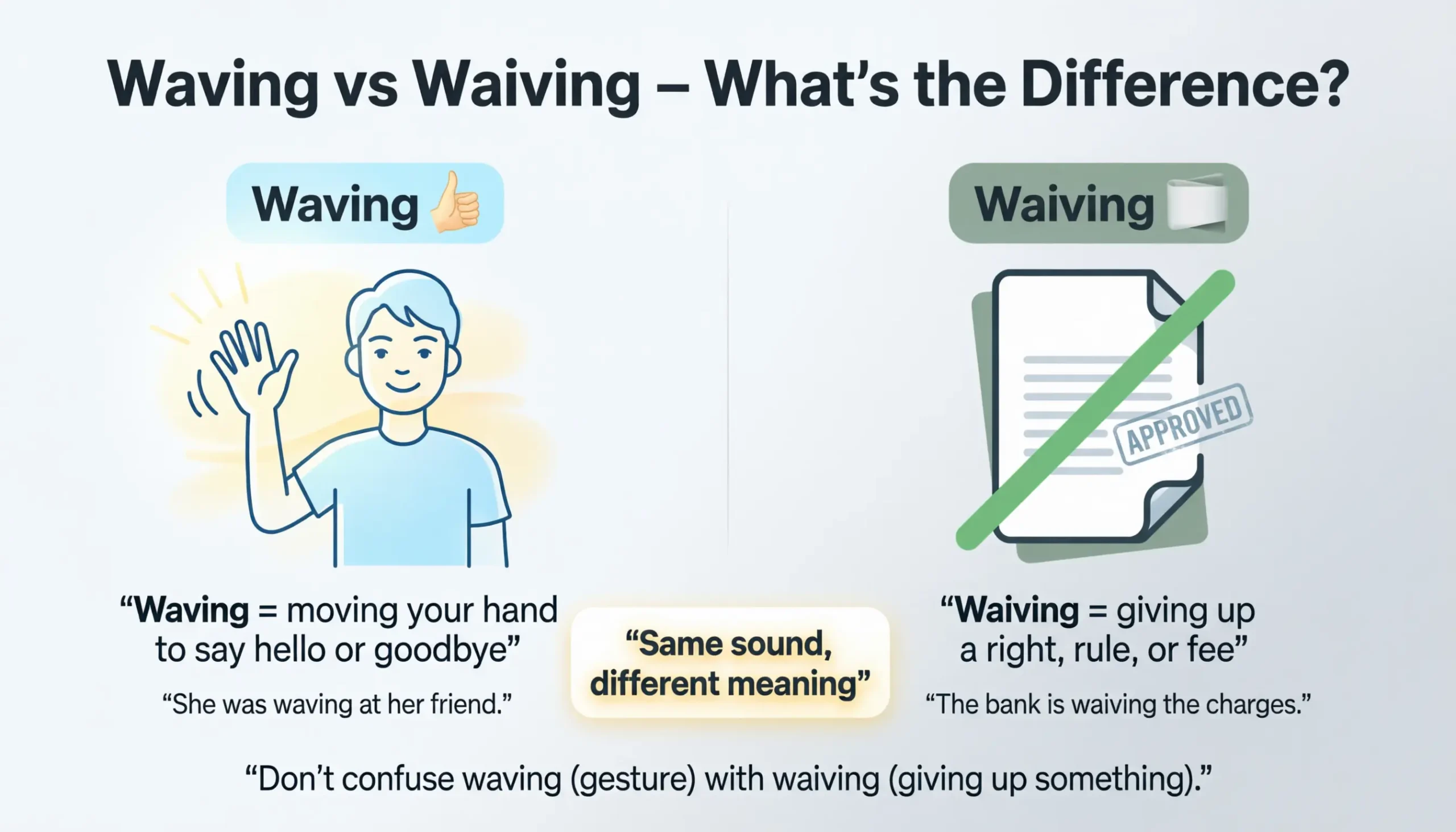
“Waving” is the present participle of wave, meaning to move your hand or something back and forth, while “waiving” is the present participle of waive, meaning to give up or voluntarily not enforce a right or rule.
Many English words sound the same but mean very different things. Waving and waiving are a perfect example. They sound alike, but they are not interchangeable. This is why many people search for “waving or waiving” when writing emails, legal papers, or social media posts.
A small spelling mistake can change the whole meaning of your sentence. Imagine writing “I am waving my rights” instead of “I am waiving my rights.” One means moving your hand. The other means giving up a right. That is a big difference.
This confusion happens because both words share the same pronunciation in most accents. But their meanings, origins, and uses are very different.
In this guide, you will learn the clear difference between waving and waiving, where these words came from, how British and American English treat them, and which one you should use in different situations. By the end, you will know exactly when to use each word with confidence.
Waving or Waiving – Quick Answer
The quick answer is simple:
- Waving means moving your hand, flag, or object back and forth.
- Waiving means giving up, canceling, or choosing not to enforce something.
Examples:
✅ She is waving at her friend from the bus.
✅ The bank is waiving the late fee.
❌ He is waiving hello. (Wrong)
❌ The company is waving the charges. (Wrong)
A simple trick:
- Waving = movement
- Waiving = giving up
The Origin of Waving or Waiving
Understanding the roots makes the difference easier.
Origin of Waving
Waving comes from the verb wave. The word comes from Old English wafian, meaning to move back and forth or shake.
Over time, it became common for:
- Hand gestures
- Flags
- Hair moving in the wind
- Water movement
Example:
The crowd was waving flags.
Origin of Waiving
Waiving comes from waive, from Anglo-French weyver, meaning to give up or abandon.
It became common in law and business.
Example:
She is waiving her right to appeal.
This is why the word is often seen in legal forms.
British English vs American English Spelling
Unlike many English words, waving and waiving are spelled the same way in both British and American English.
There is no US vs UK spelling difference here.
The difference is in meaning, not spelling.
| Word | British English | American English | Meaning |
| Waving | Waving | Waving | Moving hand/object |
| Waiving | Waiving | Waiving | Giving up rights/fees |
Examples in British English
- He was waving at the train.
- The club is waiving the joining fee.
Examples in American English
- She kept waving at the camera.
- The company is waiving extra charges.
So, spelling stays the same everywhere.
Which Spelling Should You Use?
Choose based on meaning.
Use waving when talking about movement
Use it for:
- Hand gestures
- Flags
- Trees moving
- Hair movement
Examples:
- She is waving goodbye.
- The flag is waving in the wind.
Use waiving when talking about giving something up
Use it for:
- Rights
- Rules
- Fees
- Conditions
Examples:
- The school is waiving admission fees.
- He is waiving his legal claim.
Audience-Based Advice
| Audience | Best Choice |
| US readers | Based on meaning |
| UK readers | Based on meaning |
| Global readers | Based on meaning |
| Legal writing | Usually waiving |
| Casual writing | Often waving |
The audience does not change spelling.
Meaning decides.
Common Mistakes with Waving or Waiving
People mix these words because they sound alike.
Here are common mistakes:
Mistake 1: Using waving for fees
❌ The hotel is waving the fee.
✅ The hotel is waiving the fee.
Why? Because the fee is being removed.
Mistake 2: Using waiving for greetings
❌ He was waiving at me.
✅ He was waving at me.
Why? Because it is hand movement.
Mistake 3: Using the wrong word in legal writing
❌ By signing, you are waving your rights.
✅ By signing, you are waiving your rights.
Legal meaning matters.
Quick Correction Tip
Ask yourself:
Is something moving?
Use waving.
Is something being given up?
Use waiving.
Waving or Waiving in Everyday Examples
Here is how both words appear in daily life.
Emails
Waving
“Just waving hello before the meeting.”
Waiving
“We are waiving the setup fee for new customers.”
News
Waving
“Fans were waving banners during the game.”
Waiving
“The government is waiving visa fees this month.”
Social Media
Waving
“Waving at everyone from the beach!”
Waiving
“The app is waiving charges for premium users.”
Formal Writing
Waving
“The witness was waving to the jury.”
Waiving
“The client is waiving the right to review.”
Waving or Waiving – Google Trends & Usage Data
Search data shows both words are used often, but in different contexts.
Waving
Popular in:
- Social posts
- Stories
- News
- Conversations
Common countries:
- USA
- UK
- Canada
- Australia
Common searches:
- waving hello
- waving hand
- flag waving
Waiving
Popular in:
- Legal writing
- Banking
- Business
- Education
Common countries:
- USA
- UK
- India
- Canada
Common searches:
- waiving fees
- waiving rights
- waiving charges
Usage Comparison Table
| Keyword | Main Use | Common Field |
| Waving | Physical movement | Daily life |
| Waiving | Giving up something | Legal/business |
In general, waving has wider everyday use, while waiving is more formal.
Comparison Table: Waving vs Waiving
| Feature | Waving | Waiving |
| Meaning | Moving back and forth | Giving up something |
| Part of speech | Verb | Verb |
| Common context | Greetings, flags | Fees, rights |
| Formality | Casual/common | Formal/legal |
| Example | Waving hello | Waiving charges |
FAQs About Waving or Waiving
1. Is it waving fees or waiving fees?
The correct phrase is waiving fees.
2. Is waving hello correct?
Yes. Waving hello is correct.
3. Can waiving mean moving your hand?
No. Waiving means giving up something.
4. Why do waving and waiving sound the same?
They are homophones. Same sound, different meaning.
5. Is waiving used in legal writing?
Yes. It is very common in law.
6. Is waving formal or informal?
It is usually everyday and informal.
7. Do British and American English spell them differently?
No. The spelling is the same.
8. How can I remember the difference?
Think:
Wave = hand movement
Waive = give away
Conclusion
The difference between waving and waiving is easy once you know the meaning. Even though they sound the same, they serve very different purposes in writing.
Use waving when talking about movement. This can mean moving your hand, a flag, hair, or anything that swings back and forth. It is common in everyday speech, stories, and social media.
Use waiving when talking about giving up something. This often includes rights, fees, or rules. It is common in legal papers, business writing, and official communication.
The good news is there is no British or American spelling difference. The spelling stays the same everywhere. The only thing that changes is the meaning. A simple memory trick can help:
Waving is for movement. Waiving is for removal.
If you remember this rule, you can avoid mistakes and write with more confidence every time.

I hold a degree in English Literature and Linguistics and have worked extensively on educational blogs, comparison websites, and digital learning platforms. My writing focuses on simplifying complex language rules, highlighting British vs American English differences, and providing practical examples for everyday usage.