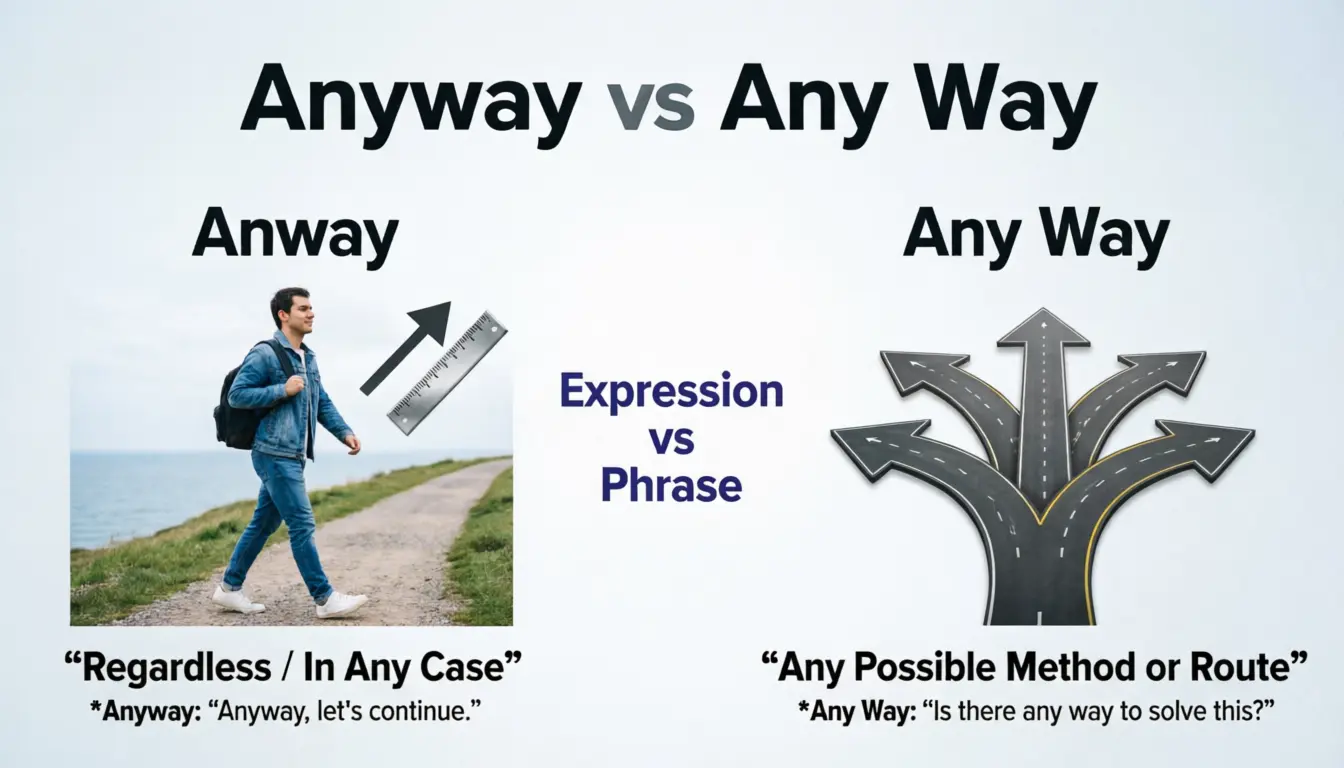
“Anyway” is an adverb meaning regardless, in any case, or moving on to another point, while “any way” refers to any method, manner, or possible way of doing something.
Have you ever stopped while writing and wondered whether to use “anyway” or “any way”? You are not alone. These two expressions look very similar, sound almost the same, and often appear in everyday writing. Because of this, many people mix them up.
The confusion usually comes from the fact that both forms are correct, but they have different meanings and uses. Choosing the wrong one can make your sentence sound awkward or change its meaning completely. Students, professionals, bloggers, and even native English speakers often search for “anyway vs any way” to make sure they are using the right form.
The good news is that the difference is simple once you understand it. In most cases, “anyway” is an adverb that means “regardless” or “in any case.” On the other hand, “any way” refers to a method, manner, or possible option for doing something.
In this guide, you will learn the meaning, history, spelling differences, common mistakes, real-life examples, and usage trends of anyway vs any way. By the end, you will know exactly which one to use in every situation.
Anyway vs Any Way – Quick Answer
The difference is simple:
| Term | Meaning | Example |
| Anyway | Regardless, in any case, moving on | I was tired, but I went anyway. |
| Any way | Any method, manner, or possible option | Is there any way to fix this problem? |
Examples
Anyway
- It was raining, but we went anyway.
- Thanks for your help anyway.
- Anyway, let’s continue the discussion.
Any Way
- Is there any way to contact her?
- Do you know any way to save time?
- We will try any way possible.
Quick Rule: If you can replace the phrase with “regardless” or “in any case,” use anyway. If you mean a method or option, use any way.
The Origin of Anyway vs Any Way
The phrase “any way” came first. In older English, it simply meant any method, route, or manner. Writers used it when discussing possible ways to do something.
Over time, English speakers began using the phrase more loosely to mean “regardless” or “in spite of that.” As this meaning became common, the words gradually merged into the single word “anyway.”
Today, both forms exist because they serve different grammatical purposes:
- Any way remains a noun phrase referring to a method or possibility.
- Anyway evolved into an adverb used to continue a conversation or express “regardless.”
This development is similar to how other English compounds formed over time.
British English vs American English Spelling
Both British English and American English use “anyway” and “any way.” The difference is not about regional spelling but about meaning and grammar.
However, British English sometimes uses “anyways” less frequently than some informal North American speakers. In formal writing, “anyway” is preferred.
Comparison Table
| Usage | American English | British English |
| Anyway (regardless) | Common | Common |
| Any way (method) | Common | Common |
| Anyways | Informal, sometimes used | Less common |
| Formal writing | Anyway | Anyway |
Examples
| Sentence | Correct Form |
| I went despite the weather. | Anyway |
| Is there a method to solve it? | Any way |
| We should continue regardless. | Anyway |
| Do you know a possible solution? | Any way |
The spelling rules are the same on both sides of the Atlantic.
Which Spelling Should You Use?
The correct choice depends on your meaning.
Use “Anyway” When:
- You mean regardless.
- You mean in any case.
- You are changing topics.
- You are concluding a discussion.
Examples
- I didn’t receive an invitation, but I attended anyway.
- Anyway, let’s get back to work.
- Thanks anyway.
Use “Any Way” When:
- You mean a method.
- You mean an option.
- You mean a possible solution.
Examples
- Is there any way to improve the results?
- Do you know any way around the traffic?
- We need any way possible to reduce costs.
Audience-Based Advice
| Audience | Recommended Usage |
| US readers | Follow standard meaning rules |
| UK readers | Follow standard meaning rules |
| Canada, Australia, New Zealand | Follow standard meaning rules |
| Global audience | Use the form that matches the meaning |
Because both forms are accepted worldwide, clarity is more important than location.
Common Mistakes with Anyway vs Any Way
Many writers accidentally use one form when they mean the other.
Mistake #1
❌ Is there anyway to fix this?
✅ Is there any way to fix this?
Reason: You are asking for a method or solution.
Mistake #2
❌ I was tired, but I went any way.
✅ I was tired, but I went anyway.
Reason: The meaning is “regardless.”
Mistake #3
❌ Thanks any way.
✅ Thanks anyway.
Reason: The phrase means “regardless.”
Mistake #4
❌ We will try anyway possible.
✅ We will try any way possible.
Reason: You are referring to every possible method.
Easy Memory Trick
- Anyway = Regardless
- Any way = Any method
If “method” fits, use two words.
Anyway vs Any Way in Everyday Examples
Here is how these forms appear in real-life communication.
Emails
Anyway
- Thanks for considering my application anyway.
Any Way
- Is there any way to reschedule the meeting?
News Articles
Anyway
- The event continued anyway despite the rain.
Any Way
- Officials searched for any way to reduce costs.
Social Media
Anyway
- I didn’t win, but I had fun anyway!
Any Way
- Does anyone know any way to speed up my laptop?
Formal Writing
Anyway
- The project proceeded anyway after review.
Any Way
- Researchers examined any way that could improve efficiency.
Anyway vs Any Way – Google Trends & Usage Data
Search behavior shows that people frequently look up “anyway vs any way” because they are unsure whether the expression should be one word or two.
Usage Patterns
- Anyway appears much more often in books, articles, blogs, and conversations.
- Any way appears less frequently because it is used only when discussing methods or options.
- English learners often search for the difference because spell-checkers may not always explain the distinction.
Popular Countries
Interest in this topic is common in:
- United States
- United Kingdom
- Canada
- Australia
- India
These searches usually come from students, writers, and professionals who want accurate grammar.
General Trend
| Form | Relative Usage |
| Anyway | Very High |
| Any way | Moderate |
| Anyways | Low in formal writing |
The single-word form is far more common in everyday English.
Comparison Table: Anyway vs Any Way
| Feature | Anyway | Any Way |
| Part of Speech | Adverb | Determiner + Noun |
| Meaning | Regardless, in any case | Any method or option |
| Formal Writing | Accepted | Accepted |
| Everyday Usage | Very common | Less common |
| Refers to Method? | No | Yes |
| Refers to Regardless? | Yes | No |
| Example | I went anyway. | Is there any way? |
FAQs
Is “anyway” one word or two words?
Usually, anyway is one word when it means “regardless” or “in any case.”
Is “any way” grammatically correct?
Yes. Any way is correct when referring to a method, option, or possibility.
Which form is more common?
Anyway is much more common in everyday English.
Can I use “anyway” in formal writing?
Yes. It is widely accepted in formal and professional writing.
Is “anyways” correct?
“Anyways” is considered informal. Most style guides prefer anyway.
How do I remember the difference?
If you mean a method, use any way. If you mean regardless, use anyway.
Is there any difference between British and American English?
No significant difference exists. Both forms follow the same grammar rules.
Why do people confuse these words?
They sound alike and have similar spellings, making them easy to mix up.
Which form should I use in business writing?
Use anyway for “regardless” and any way for “method” or “solution.”
Conclusion
Understanding anyway vs any way is easier than it first appears. While the two forms sound almost identical, they serve different purposes in English grammar. Anyway is an adverb that means “regardless,” “in any case,” or helps move a conversation forward. Any way, on the other hand, refers to a method, possibility, or option for doing something.
A simple test can help you choose the correct form. If you can replace the phrase with “regardless,” use anyway. If you are talking about a method or solution, use any way. This rule works in most situations and can prevent common writing mistakes.
Both British and American English follow the same usage rules, so the decision depends on meaning rather than location. Because anyway appears much more frequently in everyday communication, many people mistakenly use it where any way is needed. Paying attention to context will help you avoid that error.
By remembering the difference and practicing with real examples, you can confidently use anyway and any way in emails, academic work, business writing, and daily conversations.
People Also Search For:
Anyway vs Any Way Meaning
Many people confuse anyway vs any way because they sound exactly the same. Anyway is an adverb that means “regardless” or “in any case,” while any way refers to any possible method, manner, or option of doing something. Understanding this difference helps you choose the correct form in everyday writing.
Anyway Meaning
The word anyway is commonly used to continue a conversation, change a topic, or show that something happens despite other circumstances. For example, “It was raining, but we went out anyway.” It often means “regardless” or “nevertheless.”
Anyway vs Any Way Worksheet
An anyway vs any way worksheet can help learners practice identifying the correct form in different sentences. By completing fill-in-the-blank exercises and sentence corrections, students can better understand when to use the single-word and two-word versions.
Anyway or By the Way
Although anyway and by the way are both used in conversations, they serve different purposes. Anyway is often used to return to a topic or conclude a discussion, while by the way introduces new or additional information that may be related to the conversation.
Anyway or Anyways Examples
When comparing anyway or anyways examples, it is important to know that anyway is the standard form in formal English. Anyways is considered informal and is more common in casual speech. For example, “I wasn’t invited, but I went anyway” is preferred in professional writing.
Anyways in a Sentence
The word anyways is often used in informal conversations to transition between ideas. For example, “Anyways, let’s get back to our main topic.” While commonly heard in speech, many style guides recommend using anyway in formal writing.
Anyway vs Any Way Quiz
Taking an anyway vs any way quiz is a great way to test your understanding of these commonly confused terms. Quizzes usually present real-life examples and ask you to choose the correct option based on context.
Anyway vs Any Way Exercises
Regular anyway vs any way exercises can improve your grammar skills and writing accuracy. Practicing with example sentences helps reinforce the difference between using anyway as an adverb and any way as a phrase meaning “any possible method.”

I am an Emily Carter Brooks U.S.A based linguistics writer known for my clear, reader-friendly explanations of English grammar and vocabulary differences. I have contributed to multiple online language resources and specializes in spelling variations, pronunciation confusion, and British vs American English comparisons. I’m passionate about helping learners improve their English through practical, everyday communication. engaging, and stress-free.