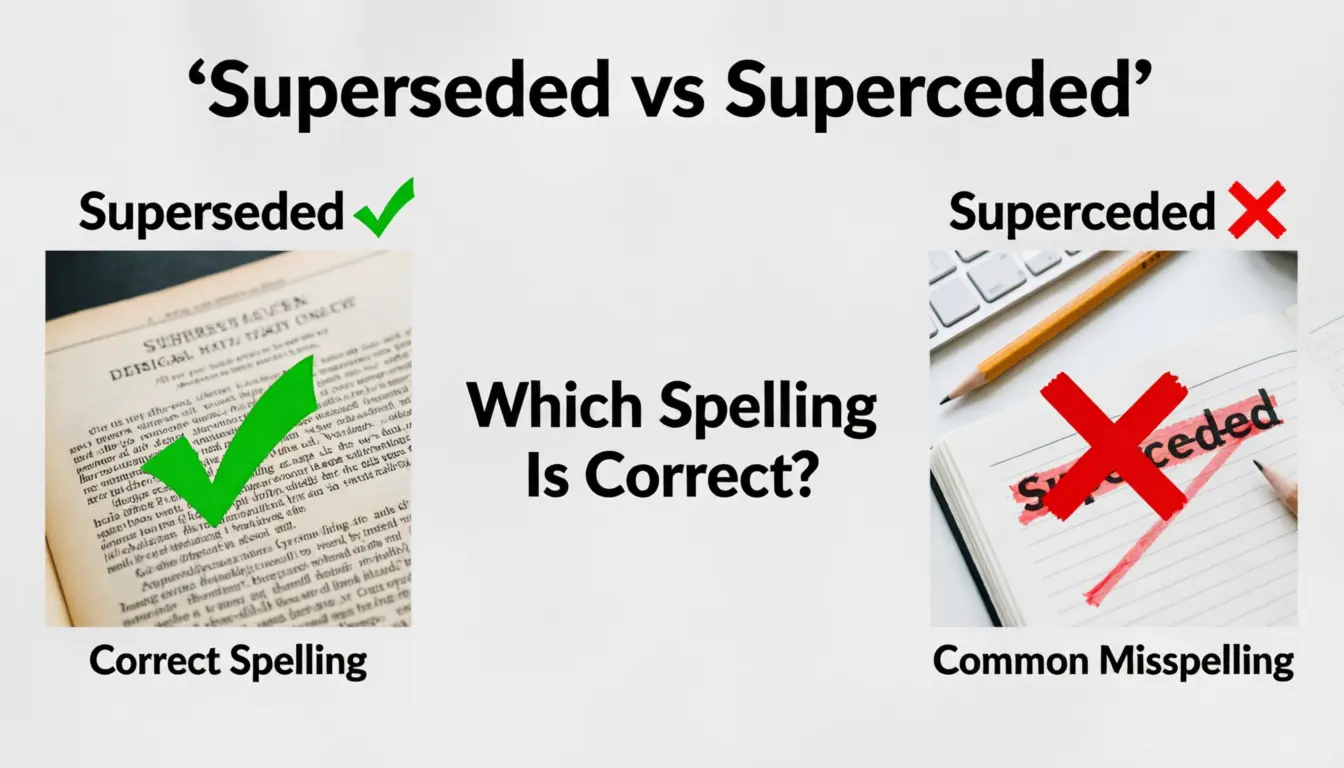
“Superseded” is the past tense of supersede, meaning to replace, take the place of, or make something outdated, whereas “superceded” has no accepted meaning in English.
Have you ever typed “superceded” and watched your spell checker flag it as wrong? You are not alone. Many English speakers get confused by superseded vs superceded because the spelling does not follow the pattern of similar words like preceded, receded, or conceded.
This confusion appears in emails, business documents, legal writing, academic papers, and online posts. People often search for superseded vs superceded to find out which version is correct and if the two spellings have different meanings.
The short answer is simple: superseded is the correct spelling. Superceded is a common misspelling. However, the reason behind this unusual spelling is interesting and rooted in the word’s history.
In this guide, you will learn the difference between superseded and superceded, where the word comes from, how British and American English treat it, which spelling you should use, common mistakes to avoid, and real-world examples. By the end, you will know exactly which version belongs in professional writing.
Superseded vs Superceded – Quick Answer
Superseded is the correct spelling.
Superceded is considered incorrect in modern English.
Correct Examples
✅ The old policy was superseded by a new regulation.
✅ This software version has been superseded by an update.
Incorrect Examples
❌ The policy was superceded by a new regulation.
❌ The software was superceded last year.
Whenever you need to describe something being replaced, updated, or made obsolete, use superseded.
The Origin of Superseded vs Superceded
The confusion comes from the word’s unusual history.
The word supersede comes from the Latin word supersedere, which means to sit above, to refrain from, or to replace.
It is made up of:
| Part | Meaning |
| Super | Above |
| Sedere | To sit |
Over time, the word entered English as supersede.
Many people assume it should be spelled supercede because several English words ending in -cede come from the Latin root cedere (“to go” or “yield”), such as:
- precede
- recede
- concede
- intercede
However, supersede does not share that root. It comes from sedere, not cedere.
That is why the spelling remains supersede and not supercede.
British English vs American English Spelling
Unlike many words that differ between British and American English, superseded has the same spelling in both versions of English.
Whether you are writing in the United States, the United Kingdom, Canada, Australia, New Zealand, or South Africa, the accepted spelling is:
✅ Superseded
❌ Superceded
Comparison Table
| Feature | Superseded | Superceded |
| Correct English spelling | Yes | No |
| British English | Yes | No |
| American English | Yes | No |
| Academic writing | Yes | No |
| Business writing | Yes | No |
| Dictionary approved | Yes | No |
| Recommended usage | Always | Never |
Examples
British English
- The previous guidance was superseded by updated instructions.
- The rule has been superseded.
American English
- The manual was superseded by a newer edition.
- The policy was superseded last month.
Which Spelling Should You Use?
The answer depends on your goal, but the recommendation is the same.
US Audiences
Use superseded.
American dictionaries and style guides recognize only this spelling.
UK Audiences
Use superseded.
British dictionaries also list superseded as the standard form.
Commonwealth Countries
Use superseded.
Countries such as Canada, Australia, and New Zealand follow the same rule.
For Global Writing
Use superseded.
It is universally accepted and understood.
Professional Advice
If you write:
- business reports
- legal documents
- academic papers
- technical manuals
- website content
always choose superseded.
Using superceded may make your writing appear less professional.
Common Mistakes with Superseded vs Superceded
Many writers make similar errors when using this word.
Mistake 1: Following the “-cede” Pattern
❌ supercede
✅ supersede
People assume the word follows precede, concede, and recede.
Mistake 2: Using Both Spellings Interchangeably
❌ The old rule was superseded. The new one superceded it.
✅ The old rule was superseded. The new one replaced it.
Only superseded is correct.
Mistake 3: Ignoring Spell Check Warnings
Modern grammar tools usually flag superceded as an error.
Always double-check before publishing.
Mistake 4: Using It Incorrectly
Remember that superseded means replaced or made obsolete.
Correct:
✅ The older version was superseded by a newer one.
Incorrect:
❌ The employee superseded to work early.
Superseded vs Superceded in Everyday Examples
Emails
✅ Your request has been superseded by the updated application.
✅ The previous instructions have been superseded.
News Articles
✅ The old law was superseded by new legislation.
✅ The regulation was superseded after public review.
Social Media
✅ This feature has been superseded by a better tool.
✅ That update has already been superseded.
Formal Writing
✅ The original agreement was superseded by a revised contract.
✅ Earlier recommendations were superseded by recent findings.
Technical Documents
✅ Version 3.0 has been superseded by Version 4.0.
✅ The older protocol was superseded due to security concerns.
Superseded vs Superceded – Google Trends & Usage Data
Search interest in superseded vs superceded remains steady because many people are unsure about the spelling.
Why People Search It
Common reasons include:
- Spell-check warnings
- Academic writing questions
- Business communication needs
- Legal document drafting
- Curiosity about English spelling rules
Usage by Country
United States
Writers frequently search the term when preparing professional documents.
United Kingdom
Many users check whether the spelling differs from American English.
Canada and Australia
Searches often come from students and professionals looking for the accepted form.
Real Usage Trends
In books, newspapers, legal texts, and government documents, superseded overwhelmingly dominates usage.
The spelling superceded appears mainly as a typo or spelling error.
Comparison Table: Superseded vs Superceded
| Aspect | Superseded | Superceded |
| Meaning | Replaced or made obsolete | Intended same meaning |
| Correct spelling | Yes | No |
| Dictionary approved | Yes | No |
| Professional writing | Yes | No |
| Academic writing | Yes | No |
| Legal writing | Yes | No |
| Business communication | Yes | No |
| Recommended use | Always | Never |
FAQs
Is superseded or superceded correct?
Superseded is correct. Superceded is a misspelling.
Why do people write superceded?
Many people assume the word follows the spelling pattern of words like precede and concede.
Is superceded in the dictionary?
Most modern dictionaries list it only as a misspelling or variant error.
Does British English use superceded?
No. British English uses superseded.
Does American English use superceded?
No. American English also uses superseded.
What does superseded mean?
It means replaced, overridden, or made obsolete by something newer.
Can I use superceded in formal writing?
No. Use superseded in all professional contexts.
Is supersede an irregular spelling?
Yes. Its spelling differs from many similar-looking English words because of its Latin origin.
How can I remember the correct spelling?
Think of super + sede, not super + cede. The correct word is always supersede, leading to superseded.
Conclusion
The debate over superseded vs superceded has a clear winner. Superseded is the only correct spelling recognized in modern English, while superceded is a common but incorrect variation. The confusion exists because many English words ending in -cede follow a different spelling pattern, leading people to assume that supersede should do the same.
The key point to remember is that supersede comes from the Latin word supersedere, not from the root that produced words like precede or concede. This historical difference explains the unusual spelling. Both British English and American English use superseded, making it the standard choice worldwide.
If you are writing emails, legal documents, academic papers, business reports, or website content, always use superseded. Doing so ensures clarity, professionalism, and grammatical accuracy. If you ever hesitate between the two spellings, remember this simple rule: superseded is correct, superceded is not. Following that guideline will help you avoid one of the most common spelling mistakes in English writing.

I hold a degree in English Literature and Linguistics and have worked extensively on educational blogs, comparison websites, and digital learning platforms. My writing focuses on simplifying complex language rules, highlighting British vs American English differences, and providing practical examples for everyday usage.