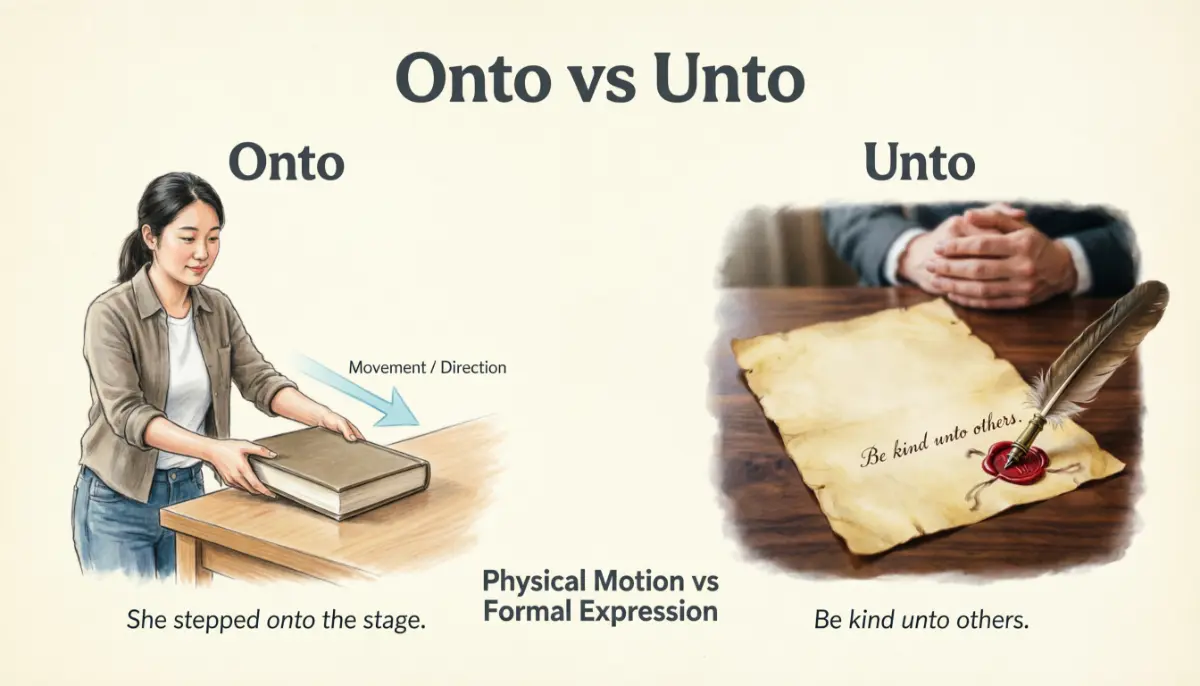
“Onto” and “unto” are both correct words, but they are used in very different ways. “Onto” refers to movement toward a surface (e.g., He jumped onto the table), while “unto” is an older or more formal word meaning to or toward someone, often used in literary or religious contexts (e.g., peace unto you).
Many English learners and writers get confused by onto vs unto because the two words look similar and sometimes appear in related contexts. However, they have different meanings and uses. Understanding the difference can help you write more clearly and avoid common grammar mistakes.
The confusion often happens because both words are prepositions, and both are found in formal writing. Yet, onto is common in modern everyday English, while unto is mostly used in religious, literary, or old-fashioned language. Choosing the wrong one can make your writing sound strange or incorrect.
In this guide, you’ll learn the meaning of onto and unto, where each word came from, how they are used in British and American English, and which one is best for your audience. You’ll also find comparison tables, real-life examples, quizzes, exercises, and answers to frequently asked questions.
By the end, you’ll know exactly when to use onto and when unto is the better choice.
Onto vs Unto – Quick Answer
Onto means moving to a position on something.
Unto means to, toward, or until, and is mainly used in religious or old-fashioned writing.
Examples
- She climbed onto the roof.
- The cat jumped onto the table.
- Peace be unto you.
- Give unto others what you wish for yourself.
Quick Comparison
| Word | Meaning | Modern Usage |
| Onto | Moving on top of something | Very common |
| Unto | To, toward, until | Rare and formal |
Simple rule: If there is physical movement, use onto. If the sentence sounds biblical or very formal, use unto.
The Origin of Onto vs Unto
Origin of Onto
The word onto developed from combining on and to. It became common in English to describe movement toward a surface.
Examples
- Step onto the stage.
- Put the book onto the shelf.
Over time, onto became a standard preposition in modern English.
Origin of Unto
The word unto comes from Old English and has existed for many centuries. It originally meant to, toward, or until.
It appears frequently in older texts, especially religious writings such as the King James Bible.
Examples
- Unto thee I give this gift.
- Glory be unto God.
Today, unto is rarely used in everyday conversation.
British English vs American English Spelling
Unlike many English word pairs, onto and unto are not British and American spelling variations of the same word. Both forms exist in both varieties of English.
The difference is based on meaning, not location.
Examples
| British English | American English |
| Jump onto the platform. | Jump onto the platform. |
| Peace be unto you. | Peace be unto you. |
Comparison Table
| Feature | Onto | Unto |
| British English | Common | Rare |
| American English | Common | Rare |
| Everyday writing | Yes | No |
| Religious writing | Sometimes | Very common |
| Indicates movement | Yes | No |
Therefore, there is no UK-versus-US spelling rule here. Writers choose the word based on meaning.
Which Spelling Should You Use?
Use Onto When:
- Describing movement.
- Writing emails.
- Writing news articles.
- Creating website content.
- Using everyday English.
Examples
- Walk onto the field.
- Place the bag onto the chair.
Use Unto When:
- Quoting religious texts.
- Writing historical fiction.
- Creating formal literary content.
- Reproducing traditional phrases.
Examples
- Peace be unto you.
- Give unto others.
Audience-Based Advice
| Audience | Recommended Word |
| United States | Onto |
| United Kingdom | Onto |
| Australia | Onto |
| Canada | Onto |
| Religious readers | Unto where appropriate |
| Global audience | Onto |
For most modern writing, onto is the safer choice.
Common Mistakes with Onto vs Unto
Many writers confuse these words because they look alike.
Mistake #1
❌ He climbed unto the ladder.
✅ He climbed onto the ladder.
Mistake #2
❌ The dog jumped unto the couch.
✅ The dog jumped onto the couch.
Mistake #3
❌ Peace be onto you.
✅ Peace be unto you.
Mistake #4
❌ Give onto others.
✅ Give unto others.
Mistake #5
❌ She walked unto the stage.
✅ She walked onto the stage.
The easiest way to avoid mistakes is to remember:
- Onto = movement
- Unto = formal or biblical language
Onto vs Unto in Everyday Examples
In Emails
- Please upload the file onto the server.
- Move the document onto the shared drive.
In News Articles
- Protesters climbed onto government vehicles.
- The player stepped onto the field after halftime.
On Social Media
- I finally got onto the train!
- My cat jumped onto my keyboard again.
In Formal Writing
- The package was loaded onto the truck.
- The speaker walked onto the stage.
In Religious Writing
- Blessings be unto you.
- Give thanks unto the Lord.
Onto vs Unto – Google Trends & Usage Data
Usage patterns show a clear difference between these two words.
Onto
- Frequently searched worldwide.
- Common in education and grammar discussions.
- Appears regularly in modern books, articles, and websites.
Unto
- Much less common.
- Popular in religious studies.
- Frequently found in Bible quotations and historical texts.
General Usage Comparison
| Context | Onto | Unto |
| Everyday speech | Very high | Very low |
| Social media | Very high | Rare |
| News writing | High | Rare |
| Academic writing | Moderate | Low |
| Religious writing | Low | High |
Countries with strong English-speaking populations generally use onto far more often than unto.
Comparison Table: Onto vs Unto
| Feature | Onto | Unto |
| Part of speech | Preposition | Preposition |
| Meaning | Movement to a surface | To, toward, until |
| Modern usage | Common | Rare |
| Formality | Neutral | Formal |
| Religious use | Rare | Common |
| Everyday writing | Yes | No |
| Example | Jump onto the bed | Peace be unto you |
Quiz: Onto vs Unto
Choose the correct word.
Questions
- The child climbed ___ the chair.
- Peace be ___ you.
- Put the box ___ the shelf.
- Give ___ others as you would receive.
- The bird landed ___ the fence.
Answers
- Onto
- Unto
- Onto
- Unto
- Onto
Fill in the Blanks Exercise
Complete each sentence.
- The cat jumped _____ the sofa.
- Blessings be _____ you.
- She stepped _____ the stage.
- Give _____ Caesar what belongs to Caesar.
- The athlete ran _____ the track.
Answers
- onto
- unto
- onto
- unto
- onto
FAQs
Is onto the same as unto?
No. Onto shows movement, while unto means to or toward and is usually formal.
Which word is more common?
Onto is much more common in modern English.
Is unto old-fashioned?
Yes. It is considered old-fashioned outside religious or literary contexts.
Can I use unto in everyday conversation?
You can, but it may sound unusual or overly formal.
Is onto one word or two words?
Onto is usually written as one word when showing movement.
Why does the Bible use unto?
Many older Bible translations use traditional English vocabulary, including unto.
Is onto correct in formal writing?
Yes. It is acceptable in both formal and informal writing.
Do British and American English use onto differently?
No. Both varieties use onto in the same way.
Should I avoid unto?
Only use it when the context is religious, historical, or intentionally formal.
Conclusion
Understanding onto vs unto is easier once you know their basic functions. Although the words look similar, they serve different purposes in English. Onto is the modern choice and is used to describe movement toward or on top of a surface. It appears in everyday conversations, emails, news articles, academic writing, and online content. Most English speakers encounter and use onto regularly.
Unto, on the other hand, belongs mainly to religious, literary, and historical language. It often means “to” or “toward” and is commonly found in Bible verses and traditional expressions. While it remains grammatically correct, it is rarely used in normal conversation or modern business writing.
For most readers and writers, the safest choice is onto. Use unto only when the context calls for a formal, biblical, or old-fashioned style. Remember the simple rule: onto indicates movement, while unto indicates direction or formality. Keeping this distinction in mind will help you write naturally, clearly, and confidently in any situation.

I am an Emily Carter Brooks U.S.A based linguistics writer known for my clear, reader-friendly explanations of English grammar and vocabulary differences. I have contributed to multiple online language resources and specializes in spelling variations, pronunciation confusion, and British vs American English comparisons. I’m passionate about helping learners improve their English through practical, everyday communication. engaging, and stress-free.