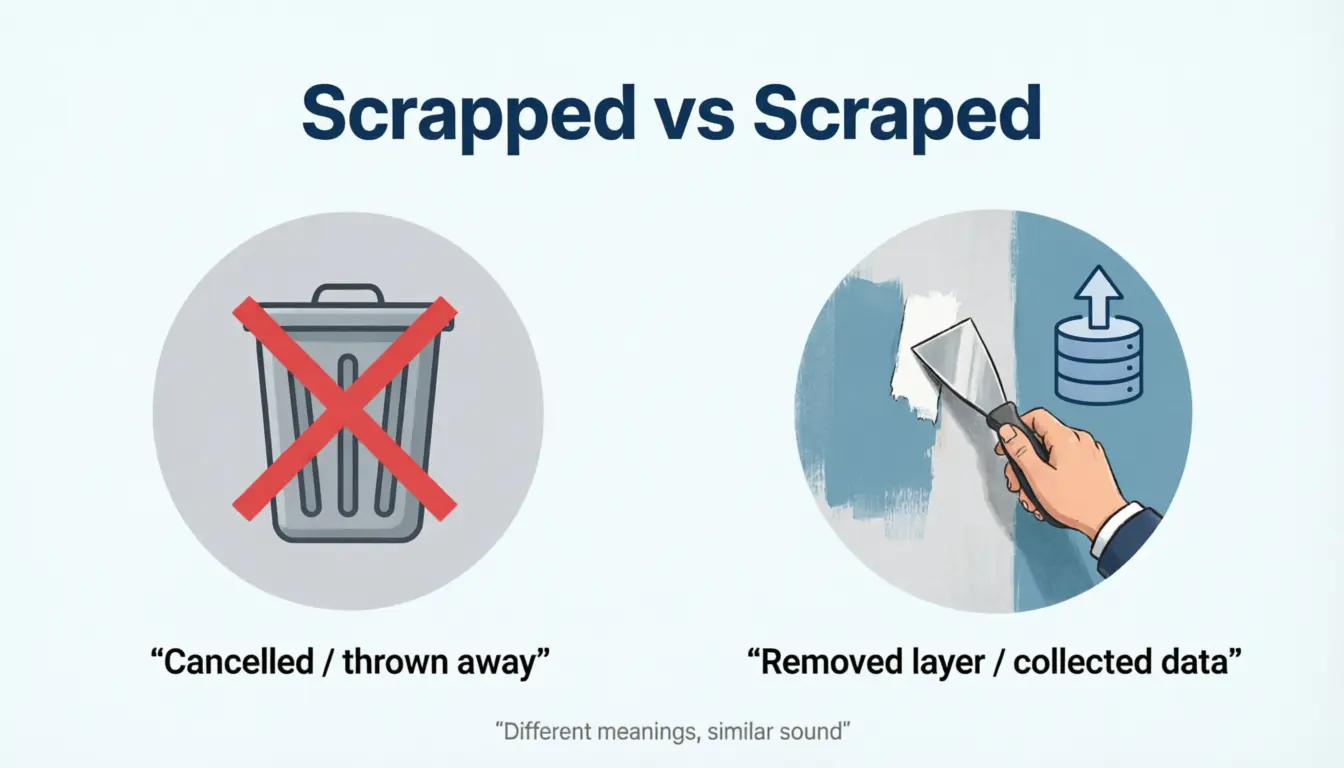
“Scraped” means to rub or scratch a surface or to remove something in thin layers, while “scrapped” means to discard, cancel, or get rid of something completely.
Many people confuse “scrapped” and “scraped” because the words look alike and sound similar. Yet they mean very different things. One small letter can completely change the meaning of your sentence. That is why writers, students, bloggers, and even business professionals often search for “scrapped or scraped” online.
The confusion usually happens in emails, news articles, social media posts, and technical writing. For example, someone may write, “The project was scraped,” when they really mean “The project was scrapped.” These mistakes can make writing unclear or even funny.
The good news is that the difference is simple once you learn it. “Scrapped” relates to throwing away, canceling, or abandoning something. “Scraped” relates to rubbing, scratching, or removing something from a surface.
This guide explains the meanings, origins, spelling differences, common mistakes, real-life examples, and usage trends of both words. By the end, you will know exactly when to use “scrapped” and when to use “scraped” with confidence.
Scrapped or Scraped – Quick Answer
Here is the simple answer:
| Word | Meaning | Example |
| Scrapped | Canceled, thrown away, or discarded | “The company scrapped the old plan.” |
| Scraped | Rubbed against a surface or removed by scratching | “She scraped mud off her shoes.” |
Quick Examples
- The government scrapped the law.
- I scraped my knee while running.
- They scrapped the old car.
- He scraped ice from the windshield.
A simple trick is this:
- Scrapped = Stopped or thrown away
- Scraped = Scratched or cleaned
The Origin of Scrapped or Scraped
The two words come from different roots, even though they look similar.
Origin of “Scrapped”
“Scrapped” comes from the word scrap, which originally meant small leftover pieces of material. Over time, the word also became linked to throwing things away or abandoning them.
Example:
- The factory scrapped broken machines.
- The team scrapped the failed idea.
By the late 1800s, “scrap” was widely used to mean canceling or discarding something.
Origin of “Scraped”
“Scraped” comes from the Old Norse word skrapa, meaning “to scratch.” It entered English centuries ago and kept the same core meaning.
Example:
- He scraped paint off the wall.
- The cat scraped the floor.
Because both words share similar spelling and pronunciation, many writers mix them up.
British English vs American English Spelling
There is no major spelling difference between British English and American English for these words. Both regions use:
- Scrapped
- Scraped
However, usage style may vary slightly depending on context.
Comparison Table
| British English | American English | Meaning |
| Scrapped | Scrapped | Canceled or discarded |
| Scraped | Scraped | Rubbed or scratched |
| The rail project was scrapped | The rail project was scrapped | Same meaning |
| He scraped mud off his boots | He scraped mud off his boots | Same meaning |
Unlike words such as “colour” and “color,” these spellings stay the same in both English styles.
Which Spelling Should You Use?
The correct spelling depends on your meaning, not your country.
Use “Scrapped” When:
You mean:
- canceled
- abandoned
- removed permanently
- thrown away
Examples:
- The company scrapped the proposal.
- Our travel plans were scrapped.
Use “Scraped” When:
You mean:
- rubbed
- scratched
- cleaned off
- barely achieved something
Examples:
- She scraped food from the plate.
- He scraped his elbow.
- The team scraped a narrow victory.
Audience-Based Advice
| Audience | Best Choice |
| US readers | Use the meaning carefully |
| UK readers | Use the meaning carefully |
| Global audience | Choose based on context |
Since the spelling is universal, clarity matters more than location.
Common Mistakes with Scrapped or Scraped
People often replace one word with the other because they type quickly or rely on spellcheck.
Common Error #1
❌ The project was scraped due to costs.
✅ The project was scrapped due to costs.
Reason:
Projects are canceled, not scratched.
Common Error #2
❌ She scrapped ice off the window.
✅ She scraped ice off the window.
Reason:
Ice is physically removed by scraping.
Common Error #3
❌ The company scraped its old policy.
✅ The company scrapped its old policy.
Reason:
Policies are abandoned or canceled.
Common Error #4
❌ He scrapped his knee on the road.
✅ He scraped his knee on the road.
Reason:
Skin gets scratched or rubbed.
Scrapped or Scraped in Everyday Examples
Understanding real-life examples makes the difference easier.
Emails
- “Management scrapped the meeting schedule.”
- “Please scrape the old paint before repainting.”
News Writing
- “The city scrapped the transportation plan.”
- “Workers scraped oil from the beach.”
Social Media
- “We scrapped our weekend trip because of rain.”
- “I scraped my car parking today.”
In Formal Writing
- “The proposal was scrapped after review.”
- “The surface was scraped clean.”
In Sports
- “The team scraped a 1–0 win.”
- “The tournament was scrapped.”
Scrapped or Scraped – Google Trends & Usage Data
Search interest for “scrapped or scraped” remains high because many English learners and native speakers confuse the terms.
Usage Trends
- Scrapped is common in:
- business news
- politics
- project management
- technology
- Scraped is common in:
- health
- cleaning
- cooking
- sports
Popular Countries Searching This Keyword
The keyword is frequently searched in:
- United States
- United Kingdom
- Canada
- Australia
- India
Why the Confusion Happens
The confusion exists because:
- The words sound similar.
- Both come from action verbs.
- Autocorrect sometimes replaces them.
- Fast typing causes spelling mistakes.
Comparison Table: Scrapped vs Scraped
| Feature | Scrapped | Scraped |
| Base Word | Scrap | Scrape |
| Main Meaning | Canceled or discarded | Rubbed or scratched |
| Used for Plans? | Yes | No |
| Used for Surfaces? | No | Yes |
| Related to Cleaning? | No | Yes |
| Related to Cancellation? | Yes | No |
| Example | “They scrapped the deal.” | “She scraped the pan.” |
FAQs About Scrapped or Scraped
Is “scrapped” the same as “scraped”?
No. “Scrapped” means canceled or thrown away. “Scraped” means scratched or rubbed.
Which is correct: “project scrapped” or “project scraped”?
“Project scrapped” is correct because projects are canceled, not scratched.
Can “scraped” mean barely achieved?
Yes. Example:
- “The team scraped a victory.”
It means they won with difficulty.
Is “scrapped” used in business English?
Yes. It is very common in business and news writing.
Example:
- “The company scrapped the merger.”
Why do people confuse scrapped and scraped?
The words look and sound alike, especially in fast reading or typing.
Is “scraped knee” correct?
Yes. A knee can be scraped because the skin rubs against a surface.
Can a plan be scraped?
Usually no. A plan is normally “scrapped.”
Do British and American English spell these words differently?
No. Both English styles use the same spelling.
Conclusion
The difference between “scrapped” and “scraped” is small in spelling but big in meaning. “Scrapped” relates to canceling, abandoning, or throwing something away. “Scraped” relates to scratching, rubbing, or cleaning a surface. Knowing this difference helps you write more clearly and avoid embarrassing mistakes.
A good way to remember the rule is to connect the words with their actions. We use “scrapped” for something that is stopped or discarded, and we use “scraped” for something that is scratched, rubbed, or removed from a surface.
These words appear often in business news, social media, emails, and everyday conversations. Because they sound similar, many writers accidentally use the wrong one. Learning the correct usage improves both professional and casual writing.
No matter if you write in British English or American English, the spellings stay the same. The key is choosing the word that matches your meaning. With the examples and tips in this guide, you can now use “scrapped” and “scraped” correctly with confidence every time.

I hold a degree in English Literature and Linguistics and have worked extensively on educational blogs, comparison websites, and digital learning platforms. My writing focuses on simplifying complex language rules, highlighting British vs American English differences, and providing practical examples for everyday usage.