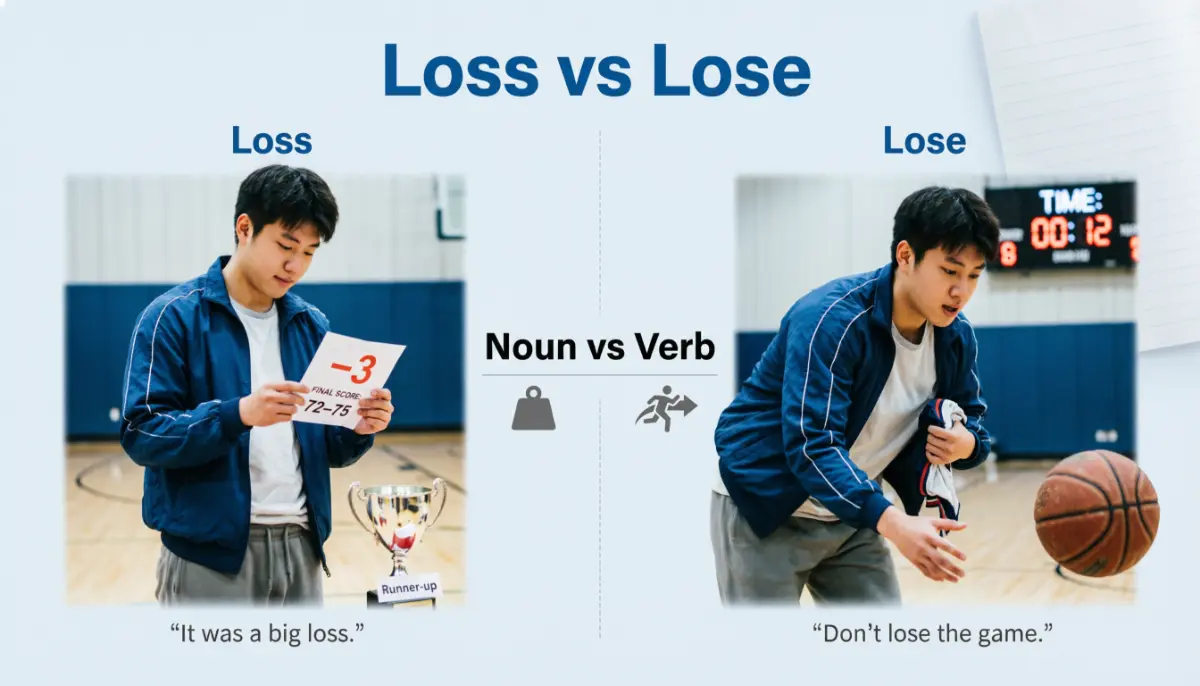
“Loss” and “lose” are both correct words, but they serve different grammatical functions. “Loss” is a noun meaning the act of losing something or the state of no longer having it, while “lose” is a verb meaning to fail to keep, find, win, or retain something.
Have you ever written “I don’t want to loss my keys” and wondered if it was correct? You’re not alone. Many English learners and native speakers confuse loss and lose because the words look similar and relate to the same idea. However, they have different meanings and grammar roles.
Understanding the difference between loss vs lose is important for writing clear emails, school assignments, business documents, and social media posts. A small spelling mistake can make your writing look less professional and may confuse readers.
The confusion often happens because lose is a verb (an action word), while loss is a noun (a thing or result). Since they are closely connected in meaning, people sometimes use one when they should use the other.
In this guide, you’ll learn the difference between loss and lose, their origins, common mistakes, real-world examples, and when to use each word correctly. By the end, you’ll never mix them up again.
Loss vs Lose – Quick Answer
The difference is simple:
- Lose = a verb meaning to misplace something or fail to win.
- Loss = a noun meaning the result of losing something.
Examples
✅ I don’t want to lose my wallet.
✅ The team may lose the game.
Quick Comparison
| Word | Part of Speech | Meaning | Example |
| Lose | Verb | To misplace or fail to win | I might lose my phone. |
| Loss | Noun | The result of losing | The loss of data was serious. |
The Origin of Loss vs Lose
Although these words are related, they developed differently over time.
Lose
The word lose comes from Old English losian, meaning “to perish,” “be destroyed,” or “fail to keep.”
Over centuries, its meaning expanded to include:
- Misplacing something
- Failing to win
- Being deprived of something
Loss
The word loss comes from Old English los, which meant destruction, ruin, or deprivation.
It later became a noun describing the result or consequence of losing something.
Why the Spelling Difference Exists
English often creates nouns and verbs from the same root word but changes the spelling.
Examples
| Verb | Noun |
| Lose | Loss |
| Choose | Choice |
| Believe | Belief |
This is why lose and loss look different even though they share a common meaning.
British English vs American English Spelling
Unlike many English words, loss and lose are spelled the same in both British and American English.
Examples
| British English | American English |
| We may lose the match. | We may lose the game. |
| The company suffered a loss. | The company suffered a loss. |
| The loss was significant. | The loss was significant. |
Comparison Table
| Feature | British English | American English |
| Lose spelling | Lose | Lose |
| Loss spelling | Loss | Loss |
| Meaning | Same | Same |
| Usage | Same | Same |
There is no spelling difference between the two varieties of English.
Which Spelling Should You Use?
The correct choice depends on the sentence structure.
Use Lose When:
You need a verb.
Examples:
- Don’t lose your passport.
- We could lose the contract.
- She doesn’t want to lose weight too quickly.
Use Loss When:
You need a noun.
Examples:
- The loss of revenue was unexpected.
- His loss affected the whole team.
- Weight loss takes time.
Audience-Based Advice
| Audience | Recommended Usage |
| United States | Lose (verb), Loss (noun) |
| United Kingdom | Lose (verb), Loss (noun) |
| Canada | Lose (verb), Loss (noun) |
| Australia | Lose (verb), Loss (noun) |
| Global Audience | Follow standard grammar rules |
The rule is universal across English-speaking countries.
Common Mistakes with Loss vs Lose
Many writers accidentally swap these words.
Mistake #1
❌ I don’t want to loss my job.
✅ I don’t want to lose my job.
Reason: The sentence needs a verb.
Mistake #2
❌ The company reported a lose.
✅ The company reported a loss.
Reason: The sentence needs a noun.
Mistake #3
❌ She suffered a lose after the accident.
✅ She suffered a loss after the accident.
Mistake #4
❌ If we don’t practice, we’ll loss.
✅ If we don’t practice, we’ll lose.
Easy Memory Trick
- Lose = Action → Verb
- Loss = Result → Noun
If someone can “do” it, use lose.
If it is the outcome, use loss.
Loss vs Lose in Everyday Examples
Emails
✅ We may lose access to the account if we miss the deadline.
✅ The data loss occurred during the system update.
News Reports
✅ The team could lose its star player next season.
✅ The company announced a quarterly loss.
Social Media
✅ I always lose my headphones!
✅ Major loss for our team tonight.
Formal Writing
✅ Organizations must avoid financial loss whenever possible.
✅ Businesses can lose customers due to poor service.
Workplace Communication
✅ We cannot afford to lose valuable clients.
✅ The loss of productivity is concerning.
Loss vs Lose – Google Trends & Usage Data
Google search data shows that many users frequently search for:
- loss vs lose
- lose or loss
- how to use lose
- difference between loss and lose
- loss meaning
Popular Countries Searching This Topic
The confusion is common in:
- United States
- United Kingdom
- Canada
- Australia
- India
Why People Search for It
Most searches occur because:
- The words sound similar.
- They are connected in meaning.
- One is a noun and the other is a verb.
- Spell-check tools may not always catch the mistake.
Usage Contexts
| Word | Common Contexts |
| Lose | Sports, games, personal items, opportunities |
| Loss | Finance, business, grief, health, statistics |
Loss vs Lose Comparison Table
| Feature | Lose | Loss |
| Part of Speech | Verb | Noun |
| Meaning | To fail to keep or win | The result of losing |
| Action Word | Yes | No |
| Used in Sentences | Performing an action | Naming an outcome |
| Example | I may lose my keys. | The loss was expensive. |
| British English | Same | Same |
| American English | Same | Same |
Quiz: Loss or Lose?
Choose the correct word.
Questions
- I don’t want to _____ my phone.
- The company reported a major _____.
- We may _____ the match.
- The _____ of data caused problems.
- Try not to _____ your ticket.
Answers
- Lose
- Loss
- Lose
- Loss
- Lose
Fill in the Blanks Exercise
Complete each sentence using loss or lose.
- The business suffered a financial ______.
- Be careful not to ______ your wallet.
- We could ______ the competition.
- The sudden ______ shocked everyone.
- They might ______ customers if prices rise.
- Weight ______ requires patience.
Answers
- Loss
- Lose
- Lose
- Loss
- Lose
- Loss
FAQs
1. Is it lose or loss weight?
The noun phrase is weight loss. The verb phrase is lose weight.
2. Why do people confuse loss and lose?
They look similar, have related meanings, and differ by only one letter.
3. Is lose a noun?
No. Lose is always a verb.
4. Is loss a verb?
No. Loss is a noun.
5. How do I remember the difference?
Think of lose as an action and loss as the result.
6. Is there a British spelling difference?
No. Both British and American English use lose and loss.
7. Can I say “a lose”?
No. The correct noun is loss.
8. Which is more common, loss or lose?
Both are common, but they appear in different grammatical situations.
9. Is “don’t loss it” correct?
No. The correct phrase is “don’t lose it.”
Conclusion
The difference between loss vs lose is straightforward once you understand their grammar roles. Lose is a verb that describes the action of misplacing something, failing to win, or no longer having something. Loss is a noun that refers to the result of that action. While the two words are closely related, they cannot be used interchangeably.
A simple way to remember the distinction is that lose shows action, while loss names an outcome. For example, you can lose your keys, but the missing keys represent a loss. This rule applies in everyday conversations, professional emails, academic writing, business reports, and social media posts.
Another helpful point is that there is no difference between British and American English spellings for these words. English speakers worldwide follow the same rule: lose for verbs and loss for nouns.
If you keep this simple grammar rule in mind and practice with real examples, you’ll use both words confidently and correctly every time.

I hold a degree in English Literature and Linguistics and have worked extensively on educational blogs, comparison websites, and digital learning platforms. My writing focuses on simplifying complex language rules, highlighting British vs American English differences, and providing practical examples for everyday usage.