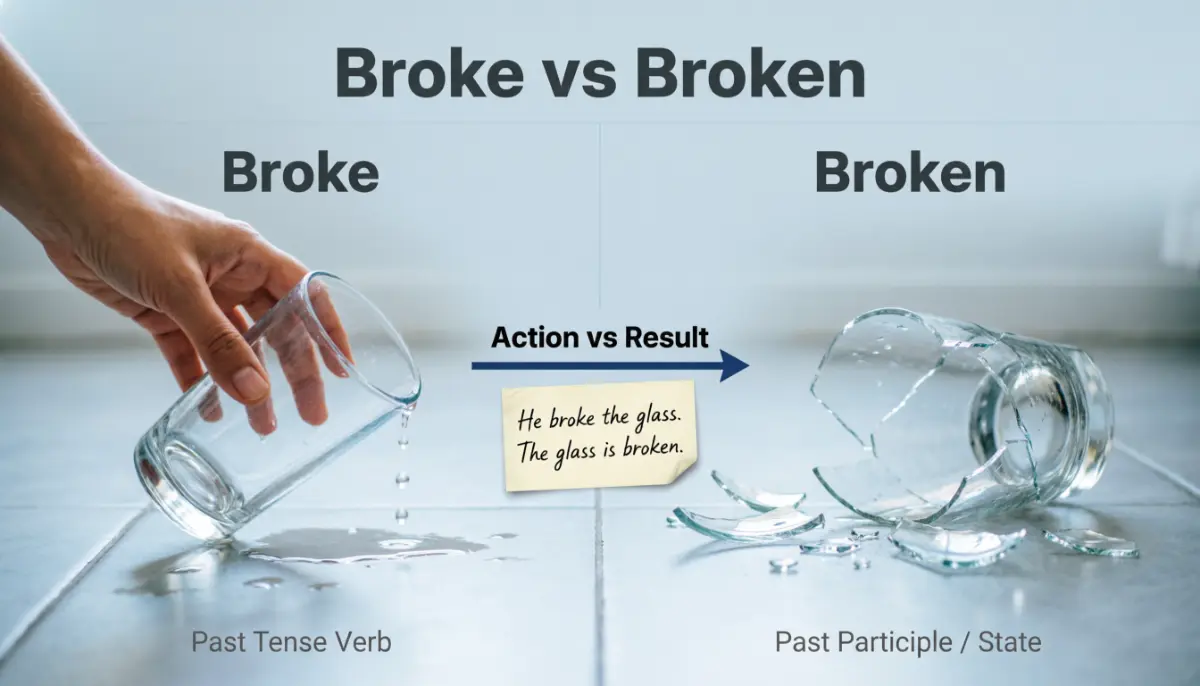
“Broke” and “broken” are both correct forms of the verb break, but they are used differently. “Broke” is the simple past tense (used on its own), while “broken” is the past participle (used with helping verbs like has, have, had) and also functions as an adjective.
Many English learners and native speakers get confused by broke vs broken. At first glance, both words seem to mean the same thing. They both come from the verb break, and both can describe something that is damaged. However, they are not always interchangeable.
This confusion happens because English verbs often change form depending on grammar rules. One form is used as the simple past tense, while another is used as the past participle. Knowing when to use broke and when to use broken can make your writing and speaking sound more natural and professional.
For example, should you say, “I broke my phone yesterday” or “I have broke my phone”? What about “The window is broke” versus “The window is broken”?
In this guide, you’ll learn the difference between broke and broken, their origins, common mistakes, usage examples, and practical tips. By the end, you’ll know exactly which form to use in every situation.
Broke vs Broken – Quick Answer
The difference is simple:
- Broke = Simple past tense of break
- Broken = Past participle of break
Examples
✅ I broke my glasses yesterday.
✅ The glass has broken.
❌ She has broke the record.
Quick Rule
Use broke when talking about a completed action in the past.
Use broken after helping verbs such as:
- has
- have
- had
- is
- was
- were
The Origin of Broke vs Broken
Both words come from the Old English verb brecan, meaning “to shatter, split, or destroy.”
Over time, English developed different verb forms:
| Form | Example |
| Base Verb | Break |
| Past Tense | Broke |
| Past Participle | Broken |
This pattern is common among irregular verbs.
Examples
| Base Verb | Past Tense | Past Participle |
| Speak | Spoke | Spoken |
| Wake | Woke | Woken |
| Break | Broke | Broken |
The spelling difference exists because English preserved older Germanic verb patterns rather than using the standard “-ed” ending.
British English vs American English Spelling
“Unlike many English words, both British and American English spell ‘broke’ and ‘broken’ in the same way.”
The difference is grammatical, not regional.
Examples
| British English | American English |
| I broke the vase. | I broke the vase. |
| The vase is broken. | The vase is broken. |
| She has broken her arm. | She has broken her arm. |
Comparison Table
| Usage | Broke | Broken |
| Simple past tense | ✔ | ✖ |
| Past participle | ✖ | ✔ |
| Used after has/have/had | ✖ | ✔ |
| Used as an adjective | Rare | ✔ |
| British English | ✔ | ✔ |
| American English | ✔ | ✔ |
There is no spelling variation between UK and US English.
Which Spelling Should You Use?
The correct choice depends on grammar.
Use Broke When:
You are describing a past action.
Examples:
- I broke my laptop.
- They broke the rules.
- He broke the window.
Use Broken When:
You need a past participle or adjective.
Examples:
- The laptop is broken.
- She has broken the rules.
- The broken chair was removed.
Audience-Based Advice
| Audience | Recommended Usage |
| United States | Follow standard grammar rules |
| United Kingdom | Follow standard grammar rules |
| Australia | Follow standard grammar rules |
| Canada | Follow standard grammar rules |
| Global Audience | Use broke for past tense and broken for participles |
The rule is universal across English-speaking countries.
Common Mistakes with Broke vs Broken
Many writers mix these forms because they both relate to the verb break.
Mistake #1
❌ I have broke my phone.
✅ I have broken my phone.
Mistake #2
❌ The machine is broke.
✅ The machine is broken.
Mistake #3
❌ She had broke the record.
✅ She had broken the record.
Mistake #4
❌ The cup broke on the table and now it is broke.
✅ The cup broke on the table and now it is broken.
Mistake #5
❌ We have never broke the law.
✅ We have never broken the law.
Broke vs Broken in Everyday Examples
In Emails
Broke
I accidentally broke the printer yesterday.
Broken
The printer has been broken since Monday.
In News Reports
Broke
The athlete broke the world record.
Broken
The previous record has been broken.
On Social Media
Broke
I broke my screen again!
Broken
My screen is completely broken.
In Formal Writing
Broke
The company broke several safety regulations.
Broken
Multiple regulations had been broken during the investigation.
In Daily Conversation
- I broke my watch.
- My watch is broken.
- Someone has broken the door.
- The door was broken last night.
Broke vs Broken – Google Trends & Usage Data
Search interest for broke vs broken remains steady because learners frequently struggle with irregular verbs.
Where Searches Are Common
- United States
- United Kingdom
- Canada
- Australia
- India
- Pakistan
Why People Search It
Most users want to know:
- Which form is grammatically correct.
- Whether broke can replace broken.
- How to use the words in sentences.
- Why English uses two forms.
Usage Contexts
| Context | More Common Form |
| Past actions | Broke |
| Present perfect tense | Broken |
| Passive voice | Broken |
| Adjective use | Broken |
| Storytelling | Broke |
In modern English, broken appears more frequently overall because it functions as both a participle and an adjective.
Broke vs Broken Comparison Table
| Feature | Broke | Broken |
| Word Type | Past tense verb | Past participle/adjective |
| Base Verb | Break | Break |
| Describes completed past action | ✔ | ✖ |
| Used with has/have/had | ✖ | ✔ |
| Used as adjective | Rare | ✔ |
| Example | I broke the glass. | The glass is broken. |
| Formal English | ✔ | ✔ |
Quick Quiz: Broke vs Broken
Choose the correct word.
1.
I _____ my phone yesterday.
A. broke
B. broken
Answer: A. broke
2.
The chair is _____.
A. broke
B. broken
Answer: B. broken
3.
She has _____ the record.
A. broke
B. broken
Answer: B. broken
4.
They _____ the window last week.
A. broke
B. broken
Answer: A. broke
5.
The vase had been _____ before we arrived.
A. broke
B. broken
Answer: B. broken
Fill in the Blanks Exercise
Complete each sentence with broke or broken.
- I ______ my glasses yesterday.
- The computer is ______.
- She has ______ the agreement.
- They ______ the door during the storm.
- The mirror was ______ into pieces.
- He ______ his promise.
- The toy is ______ beyond repair.
- We had ______ several records.
Answers
- broke
- broken
- broken
- broke
- broken
- broke
- broken
- broken
FAQs
1. What is the difference between broke and broken?
Broke is the past tense of break, while broken is the past participle and adjective form.
2. Is “I have broke” correct?
No. The correct phrase is I have broken.
3. Can broken be used as an adjective?
Yes. Example: The broken window needs repair.
4. Is “The car is broke” correct?
Standard English uses The car is broken.
5. Why does English have both broke and broken?
English irregular verbs often have separate past tense and past participle forms.
6. Is there a British spelling difference?
No. Both British and American English use broke and broken the same way.
7. Which word is more common?
Broken is generally more common because it functions as both an adjective and a participle.
8. Can I use broken after “has” or “have”?
Yes. Example: She has broken the record.
9. Can broken replace broke in every sentence?
No. Use broke for simple past tense and broken for participles and adjectives.
Conclusion
Understanding broke vs broken is easier once you know their grammatical roles. Both words come from the verb break, but they serve different purposes in English sentences.“We use ‘broke’ as the simple past tense for actions that happened in the past, for example: ‘I broke my phone yesterday.’“We use ‘broken’ as the past participle and adjective form with helping verbs, for example: ‘The phone is broken,’ or we say, ‘I have broken my phone.’”
The good news is that there is no British or American spelling difference to remember. The rule is the same worldwide. When writing, speaking, or editing, simply ask yourself if you are describing a past action or using a participle form. If it is a simple past event, choose broke. If it follows words like has, have, had, or describes a condition, choose broken.
Mastering this small difference will improve your grammar, make your writing clearer, and help you communicate with confidence in both formal and everyday English.

I hold a degree in English Literature and Linguistics and have worked extensively on educational blogs, comparison websites, and digital learning platforms. My writing focuses on simplifying complex language rules, highlighting British vs American English differences, and providing practical examples for everyday usage.