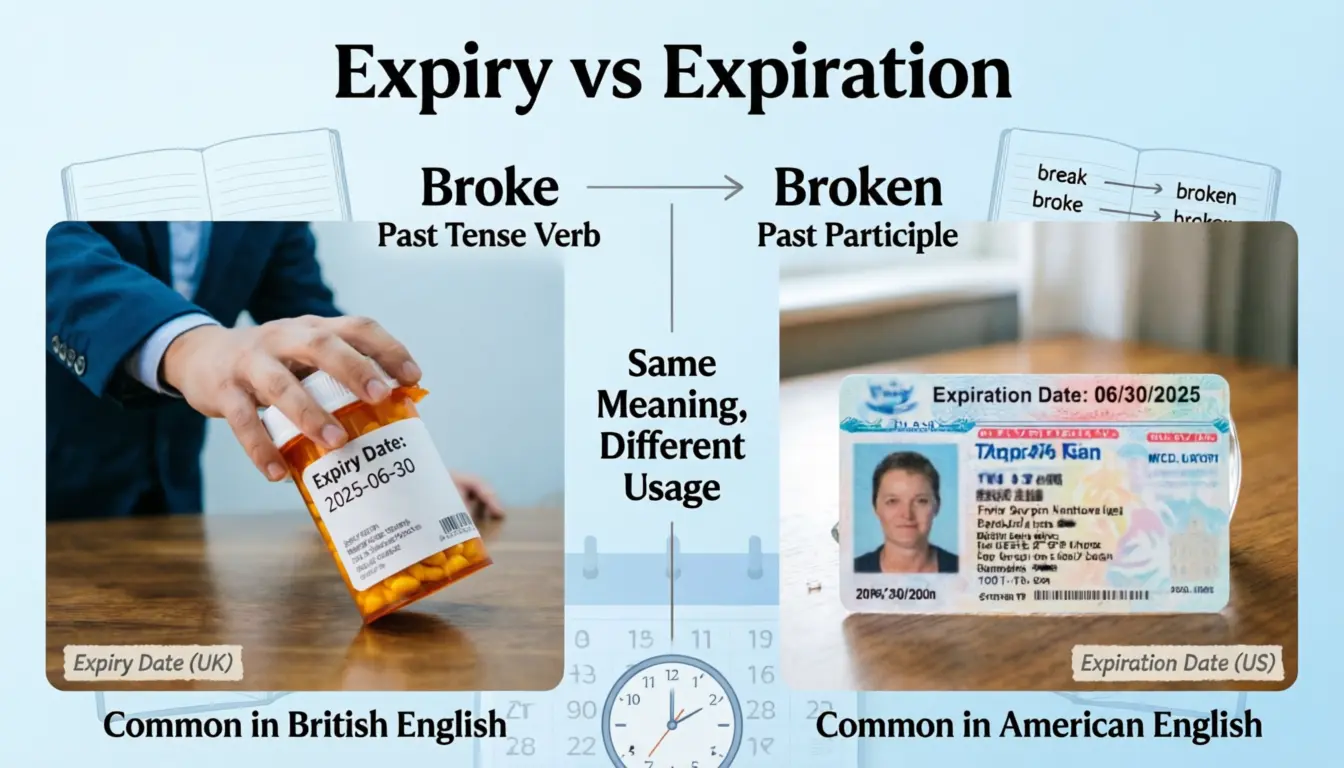
“Expiry” is more common in British English and often appears on documents, licenses, and product labels, while “expiration” is the preferred term in American English and refers to the end of a period of validity or usefulness.
Have you ever seen the words expiry and expiration on food packages, passports, insurance documents, or contracts and wondered if they mean the same thing? Many English learners, writers, and professionals search for “expiry vs expiration” because both words seem similar, yet they appear in different places and contexts.
The confusion often comes from regional language differences. In some countries, people commonly use expiry date, while in others, expiration date is the preferred term. Since both words relate to something reaching its end, many people are unsure which one is correct.
The good news is that both words are correct English. However, their usage depends largely on whether you are writing for a British English audience or an American English audience.
In this guide, you’ll learn the difference between expiry and expiration, their origins, regional preferences, common mistakes, and how to choose the right word for your audience. By the end, you’ll know exactly when to use each term with confidence.
Expiry vs Expiration – Quick Answer
Expiry and expiration both refer to the end of a period of validity, usefulness, or effectiveness.
- Expiry is more common in British English and Commonwealth countries.
- Expiration is more common in American English.
Examples
British English
- The passport is nearing its expiry date.
- Check the expiry date before buying the medicine.
American English
- The coupon reached its expiration date.
- The driver’s license is close to expiration.
In most situations, the meaning remains exactly the same.
The Origin of Expiry vs Expiration
Both words come from the Latin word expirare, meaning “to breathe out” or “to come to an end.”
The verb expire entered English centuries ago and originally referred to breathing one’s last breath. Over time, it gained a broader meaning of ending or becoming invalid.
Development of Expiration
The noun expiration appeared first and became widely used in formal English. It described both breathing out and the ending of a fixed period.
Development of Expiry
Later, British English developed the shorter noun expiry from the verb expire. It became especially common in business, legal, travel, and product-label contexts.
Why the Difference Exists
The difference is not about meaning. It is mainly about regional language preferences.
- British English often favors shorter forms.
- American English tends to keep the traditional noun form.
As a result, both words coexist today.
British English vs American English Spelling
The biggest difference between expiry and expiration is regional preference.
| Feature | Expiry | Expiration |
| Meaning | End of validity | End of validity |
| British English | Preferred | Less common |
| American English | Rare | Preferred |
| Canadian English | Common | Also used |
| Australian English | Common | Less common |
| Legal Documents | Common in UK | Common in US |
| Product Labels | Common in UK | Common in US |
Examples
| British English | American English |
| Expiry date | Expiration date |
| Passport expiry | Passport expiration |
| Insurance expiry | Insurance expiration |
| Visa expiry | Visa expiration |
Both versions are grammatically correct.
Which Spelling Should You Use?
Choosing between expiry and expiration depends on your audience.
Use “Expiry” When:
- Writing for the UK
- Writing for Australia
- Writing for New Zealand
- Writing for South Africa
- Writing for Commonwealth audiences
Examples
“The policy expiry date is June 30.”
Use “Expiration” When:
- Writing for the United States
- Writing for American businesses
- Creating US-focused content
Examples
“The policy expiration date is June 30.”
For Global Audiences
If your audience is international, either term works. However, many global companies use the wording that matches the region where the product is sold.
Common Mistakes with Expiry vs Expiration
Many writers make small errors when using these words.
Mistake 1: Thinking One Is Wrong
❌ Expiry is incorrect.
✅ Expiry and expiration are both correct.
Mistake 2: Mixing Regional Styles
❌ British article using expiration throughout.
✅ British article using expiry consistently.
Mistake 3: Assuming Different Meanings
❌ Expiry means something different from expiration.
✅ Both words refer to the same concept.
Mistake 4: Using Both in One Document
❌ The passport expiry date and expiration date are listed below.
✅ Use one version consistently.
Mistake 5: Ignoring Audience Expectations
A US reader expects expiration date.
A UK reader expects expiry date.
Consistency improves readability.
Expiry vs Expiration in Everyday Examples
Here is how these words appear in daily communication.
Emails
British English
“Please renew your membership before its expiry.”
American English
“Please renew your membership before its expiration.”
News Articles
British Example
“The government reminded citizens to check passport expiry dates.”
American Example
“Officials urged residents to monitor passport expiration dates.”
Social Media
British User
“My visa expiry date is next month.”
American User
“My visa expiration date is next month.”
Formal Writing
British Style
“The contract reaches expiry on December 31.”
American Style
“The contract reaches expiration on December 31.”
Product Packaging
UK Packaging
“Expiry Date: 12/08/2027”
US Packaging
“Expiration Date: 08/12/2027”
Expiry vs Expiration – Google Trends & Usage Data
Search data consistently shows regional preferences.
Countries Where “Expiry” Is More Popular
- United Kingdom
- Australia
- New Zealand
- South Africa
- India
In these countries, phrases like expiry date appear frequently on documents and product labels.
Countries Where “Expiration” Is More Popular
- United States
- American business publications
- US government documents
Context-Based Usage
| Context | Preferred Word |
| UK passports | Expiry |
| UK visas | Expiry |
| UK insurance | Expiry |
| US passports | Expiration |
| US contracts | Expiration |
| US legal documents | Expiration |
Overall, expiration generates more global searches because of the large American audience online. However, expiry remains dominant across many Commonwealth countries.
Expiry vs Expiration Comparison Table
| Feature | Expiry | Expiration |
| Part of Speech | Noun | Noun |
| Meaning | End of validity | End of validity |
| Origin | From expire | From Latin-derived noun |
| British English | Very common | Less common |
| American English | Rare | Very common |
| Formal Writing | Accepted | Accepted |
| Legal Usage | Common in UK | Common in US |
| Passport Documents | Common in UK | Common in US |
| Correct English? | Yes | Yes |
FAQs
Is expiry the same as expiration?
Yes. Both words mean the end of a period of validity or usefulness.
Which is correct, expiry date or expiration date?
Both are correct. The choice depends on whether you are using British or American English.
Do expiry and expiration have different meanings?
No. Their meanings are essentially identical.
Is expiry used in the United States?
It is understood in the United States but is much less common than expiration.
Why do British people say expiry?
British English often prefers the shorter noun form, making expiry more common.
Which term appears on medicine packaging?
It depends on the country. UK packaging usually uses expiry date, while US packaging often uses expiration date.
Is expiration more formal than expiry?
Not necessarily. Both are accepted in formal writing.
Should I use expiry or expiration in content?
Use the version that matches your target audience and location.
Can I use both terms in the same document?
It is better to choose one and remain consistent throughout the document.
Conclusion
The debate over expiry vs expiration is not about right versus wrong. Both words are correct and share the same meaning: the point when something ends, becomes invalid, or is no longer effective. The real difference lies in regional language preferences.
If you are writing for a British, Australian, or Commonwealth audience, expiry is usually the natural choice. Readers in these regions are accustomed to seeing terms such as expiry date, passport expiry, and policy expiry. On the other hand, if your audience is American, expiration is the standard form used in government documents, contracts, product labels, and everyday communication.
For international content, either version can work, but consistency is important. Avoid switching between the two terms within the same document. Instead, select the version that best matches your readers and use it throughout your writing.
Understanding this distinction helps improve clarity, professionalism, and audience trust. if you choose expiry or expiration, the key is matching your language to the people you are writing for.
Overview:
People also search for terms related to expiry and expiration in different contexts. For example, expiry vs expiration cosmetics refers to the labeling of beauty and skincare products, while expiry vs expiration food focuses on dates printed on packaged foods.
In Canada, both terms are used, though “expiration” is often seen on official product labels. Users also look up expiry pronunciation to learn the correct way to say the word, along with the expiry meaning, which refers to the end of a valid period. Related searches include expiry date meaning, which explains the date after which a product, document, or service is no longer considered valid.
Other common questions involve the expiry plural form (“expiries”) and finding an expiry date example, such as the date printed on medicine, food packaging, passports, or subscriptions.

I hold a degree in English Literature and Linguistics and have worked extensively on educational blogs, comparison websites, and digital learning platforms. My writing focuses on simplifying complex language rules, highlighting British vs American English differences, and providing practical examples for everyday usage.