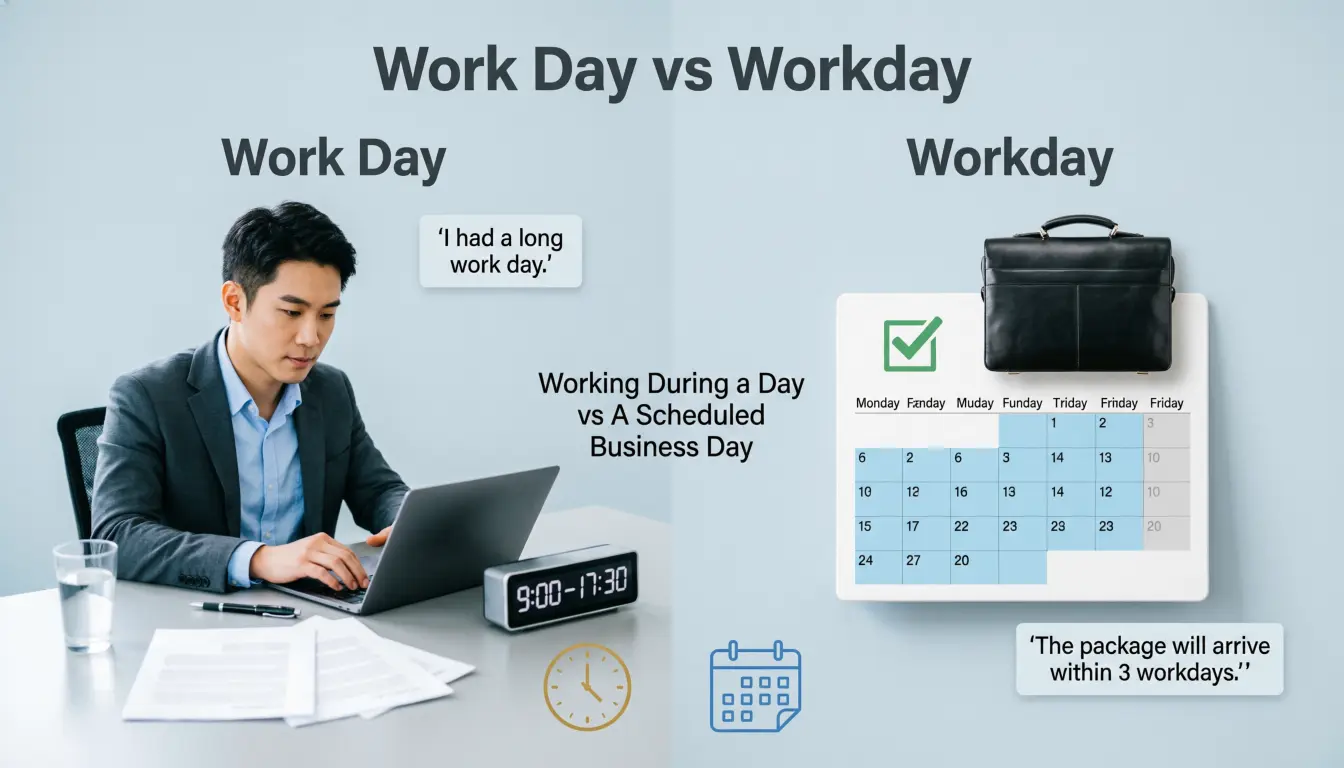
“Work day” and “workday” are both correct, but they have different meanings. “Work day” (two words) refers to the hours or period during which someone works (e.g., I had a long work day), while “workday” (one word) usually refers to a regular business day or weekday when work is done (e.g., Your order will arrive within three workdays).
Many English learners and native speakers get confused by work day vs workday. At first glance, these words look almost the same. The only difference is a space. However, that small space changes the meaning of the word.
People often search for this keyword because they see both forms in emails, business documents, job contracts, and workplace conversations. Some writers use work day, while others use workday, making it hard to know which one is correct.
The good news is that both forms are correct. They simply have different meanings and uses. Understanding the difference helps you write more clearly and professionally. If you are sending an email, writing a report, or creating content online, using the right form can improve your communication.
In this guide, you will learn the meaning of each term, where they came from, how British and American English use them, common mistakes to avoid, and practical examples. By the end, you will know exactly when to write work day and when to write workday.
Work Day vs Workday – Quick Answer
The difference is simple:
- Work day (two words) refers to the number of hours spent working in a day.
- Workday (one word) refers to a regular business day or a day when people work.
Examples
✅ My work day usually lasts eight hours.
✅ It was a long work day.
Quick Tip:
If you are talking about the length of time spent working, use work day. If you are talking about a business day, use workday.
The Origin of Work Day vs Workday
The phrase work day developed naturally from combining the words work and day. It originally described the amount of labor completed during a day.
Over time, English speakers began using workday as a compound noun. Compound words form when two separate words join together to create a new meaning. In this case, workday came to mean a scheduled day of work rather than the hours worked.
This change follows a common pattern in English. Many compounds start as two words and later become one word when their meaning becomes more specific.
Examples include:
- School day → Schoolday (less common)
- Week end → Weekend
- Work day → Workday
Today, both spellings exist because they serve different purposes.
British English vs American English Spelling
Unlike many English word pairs, work day and workday have the same meanings in both British and American English.
The difference is not regional. Instead, it depends on grammar and context.
Comparison Table
| Usage | Work Day | Workday |
| Refers to hours worked | ✅ Yes | ❌ No |
| Refers to a business day | ❌ No | ✅ Yes |
| Used as a noun phrase | ✅ Yes | ❌ Usually |
| Used as a compound noun | ❌ No | ✅ Yes |
| Common in schedules | ❌ Rare | ✅ Common |
British English Examples
- My work day starts at 9 a.m.
- The package will arrive within five workdays.
American English Examples
- Her work day ended late.
- Processing takes two workdays.
Both countries follow the same rule.
Which Spelling Should You Use?
The correct choice depends on what you mean.
Use “Work Day” When:
- Talking about working hours.
- Describing the length of a shift.
- Discussing daily workload.
Examples
- My work day lasts nine hours.
- It was a difficult work day.
Use “Workday” When:
- Talking about business days.
- Discussing office schedules.
- Referring to weekdays when people work.
Examples
- The bank processes requests within three workdays.
- Monday is a normal workday.
Audience-Based Advice
| Audience | Recommended Form |
| US readers | Follow context rules |
| UK readers | Follow context rules |
| Australia, Canada, New Zealand | Follow context rules |
| Global audience | Use the meaning that fits the sentence |
Because both forms are accepted worldwide, focus on meaning rather than location.
Common Mistakes with Work Day vs Workday
Many writers accidentally switch these terms.
Mistake #1
❌ The report will be ready in three work days.
✅ The report will be ready in three workdays.
Reason: Business days require the compound form.
Mistake #2
❌ My workday lasted ten hours.
✅ My work day lasted ten hours.
Reason: The sentence describes working hours.
Mistake #3
❌ It was a long workday.
✅ It was a long work day.
Reason: The focus is on the length of work.
Mistake #4
❌ The office closes on non-work day holidays.
✅ The office closes on non-workday holidays.
Reason: It refers to business days.
Work Day vs Workday in Everyday Examples
In Emails
- Please allow two workdays for processing.
- My work day ends at 5 p.m.
In News Articles
- Employees reported longer work days during the busy season.
- Government offices remain closed for three workdays.
On Social Media
- What a long work day!
- Back to the workday routine tomorrow.
In Formal Writing
- The average work day has increased by one hour.
- Payments are processed within five workdays.
Work Day vs Workday – Google Trends & Usage Data
Search interest shows that many people look up workday because it appears in business communication, employment policies, and workplace software.
The one-word form is especially common in:
- United States
- United Kingdom
- Canada
- Australia
Meanwhile, work day appears more often in articles discussing employee schedules, productivity, and working hours.
General Usage Trends
| Form | Most Common Context |
| Work day | Hours worked |
| Workday | Business days |
| Work days | Multiple days of labor |
| Workdays | Multiple business days |
The compound form tends to appear more frequently in professional and administrative writing.
Comparison Table: Work Day vs Workday
| Feature | Work Day | Workday |
| Number of words | Two | One |
| Meaning | Hours spent working | Business day |
| Part of speech | Noun phrase | Compound noun |
| Common in HR documents | Sometimes | Very common |
| Common in contracts | Less common | Very common |
| Example | A ten-hour work day | Three workdays |
Quick Quiz: Work Day vs Workday
Choose the correct answer.
1. The application will be reviewed within three ______.
a) work days
b) workdays
Answer: b) workdays
2. My ______ usually starts at 8 a.m.
a) work day
b) workday
Answer: a) work day
3. Friday is a regular ______.
a) workday
b) work day
Answer: a) workday
4. It was a very long ______.
a) work day
b) workday
Answer: a) work day
5. Most requests are completed within five ______.
a) workdays
b) work days
Answer: a) workdays
Fill in the Blanks
Fill in the correct form: work day or workday.
- My ______ ends at 6 p.m.
- The office is closed on non-______ holidays.
- It was a stressful ______.
- Shipping takes two ______.
- Her average ______ lasts eight hours.
Answers
- work day
- workday
- work day
- workdays
- work day
FAQs
Is workday one word or two?
Both are correct. The choice depends on the meaning.
What does workday mean?
A workday is a normal business day when people work.
What does work day mean?
A work day refers to the hours spent working during a day.
Is workday used in business writing?
Yes. It is very common in contracts, policies, and office communication.
Can I use work day and workday interchangeably?
No. Each form has a different meaning.
Which form appears in legal documents?
Workday is more common because legal documents often refer to business days.
Is workday correct in British English?
Yes. British and American English use the same spelling.
What is the plural of workday?
The plural form is workdays.
What is the plural of work day?
The plural form is work days.
Conclusion
The difference between work day vs workday comes down to meaning, not spelling preference. A work day refers to the amount of time someone spends working during a day. A workday, on the other hand, refers to a business day or a day when work normally takes place. Although the words look very similar, using the correct form helps readers understand your message immediately.
Remember a simple rule: if you can replace the phrase with “hours worked,” use work day. If you can replace it with “business day,” use workday. This guideline works in emails, contracts, reports, articles, and everyday conversations.
British English and American English follow the same usage rules, so there is no regional difference to worry about. Instead, focus on the context of your sentence. Choosing the right form makes your writing more professional, accurate, and easy to read. Whenever you are unsure, ask yourself whether you mean working hours or a business day. The answer will tell you which spelling to use.

I am an Emily Carter Brooks U.S.A based linguistics writer known for my clear, reader-friendly explanations of English grammar and vocabulary differences. I have contributed to multiple online language resources and specializes in spelling variations, pronunciation confusion, and British vs American English comparisons. I’m passionate about helping learners improve their English through practical, everyday communication. engaging, and stress-free.