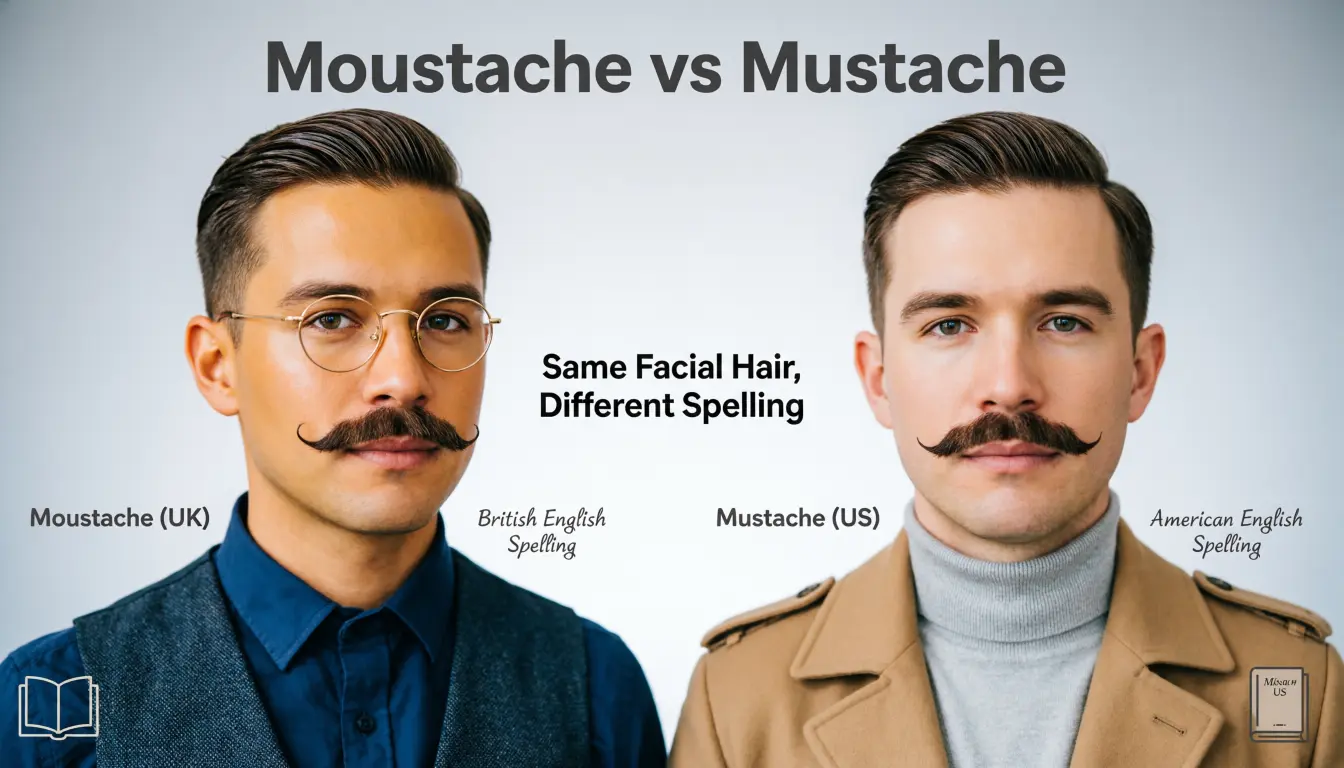
“Moustache” is the traditional British English spelling, while “mustache” is the American English spelling. Both refer to the facial hair that grows on the upper lip.
Have you ever typed moustache in a document only to have your spell checker suggest mustache? Or perhaps you saw both spellings online and wondered if one was wrong. This is a common language question, especially for writers, students, bloggers, and professionals who communicate with international audiences.
The confusion exists because both moustache and mustache refer to the same facial hair that grows on the upper lip. The difference is not in meaning but in spelling. One form is more common in British English, while the other is preferred in American English.
Understanding the distinction can help you write more naturally for your audience and avoid inconsistencies in professional documents, websites, academic papers, and social media posts. If you are writing for readers in the United States, the United Kingdom, Canada, Australia, or a global audience, knowing which spelling to choose is useful.
In this guide, you’ll learn the origins of both words, how they differ across English-speaking regions, common mistakes people make, and which spelling is best for your specific audience.
Moustache vs Mustache – Quick Answer
Both moustache and mustache are correct spellings.
- Moustache is the traditional British English spelling.
- Mustache is the simplified American English spelling.
Examples
British English:
- He grew a thick moustache during the winter.
- The actor’s curled moustache became famous.
American English:
- He shaved his mustache before the interview.
- The detective had a gray mustache.
The meaning remains exactly the same regardless of spelling.
The Origin of Moustache vs Mustache
The word comes from the French word moustache, which was borrowed into English several centuries ago.
Historical Development
| Period | Common Form |
| Early French | Moustache |
| Early English | Moustache |
| Modern British English | Moustache |
| Modern American English | Mustache |
When American English began simplifying many spellings during the 18th and 19th centuries, some words were shortened to make them easier to write and pronounce. As a result, mustache became the preferred American form.
The original French-influenced spelling, moustache, remained dominant in Britain and much of the Commonwealth.
British English vs American English Spelling
The difference between these spellings follows a broader pattern seen in many English words.
British English
British English often preserves spellings closer to their historical or French origins.
Examples
| British English | American English |
| Colour | Color |
| Favourite | Favorite |
| Centre | Center |
| Travelling | Traveling |
| Moustache | Mustache |
American English
American English tends to simplify spelling where possible.
Examples
- Color instead of colour
- Honor instead of honour
- Theater instead of theatre
- Mustache instead of moustache
Comparison Table
| Feature | Moustache | Mustache |
| Meaning | Facial hair above the upper lip | Facial hair above the upper lip |
| British English | Preferred | Less common |
| American English | Less common | Preferred |
| Formal Writing | Correct | Correct |
| Everyday Usage | UK, Australia, New Zealand | United States |
| Pronunciation | Same | Same |
Which Spelling Should You Use?
The best spelling depends on your audience.
Use “Mustache” If:
- You write for American readers.
- Your audience is mainly in the United States.
- You follow American English style guides.
Examples:
“The firefighter had a thick mustache.”
Use “Moustache” If:
- You write for readers in the UK.
- Your audience is in Australia, New Zealand, or other Commonwealth countries.
- You follow British English conventions.
Examples:
“The gentleman wore a neatly trimmed moustache.”
For Global Audiences
Either spelling works. The key is consistency. Once you choose one spelling, use it throughout your content.
Common Mistakes with Moustache vs Mustache
Many writers make avoidable errors when using these spellings.
Mistake 1: Mixing Both Spellings
❌ The man’s moustache was famous, and his mustache became a symbol of style.
✅ The man’s moustache was famous, and it became a symbol of style.
Mistake 2: Thinking One Is Incorrect
❌ Mustache is wrong.
✅ Both spellings are correct.
Mistake 3: Changing Spelling Mid-Article
If your article starts with moustache, keep using moustache throughout.
Mistake 4: Assuming Different Meanings
Some people think the words describe different facial hair styles.
❌ Incorrect
✅ They describe exactly the same thing.
Moustache vs Mustache in Everyday Examples
Here are examples from different situations.
British English:
“Please upload the photo showing the participant’s moustache.”
American English:
“Please upload the photo showing the participant’s mustache.”
News Writing
British Style:
“The politician’s distinctive moustache attracted attention.”
American Style:
“The politician’s distinctive mustache attracted attention.”
Social Media
- “Thinking about growing a moustache this year.”
- “Should I keep my mustache or shave it?”
Formal Writing
- “The portrait depicts a man with a carefully groomed moustache.”
- “Historical records describe him as having a thick mustache.”
Marketing Content
- “Premium moustache grooming products.”
- “Best mustache care tips for beginners.”
Moustache vs Mustache – Google Trends & Usage Data
Search behavior shows clear regional preferences.
Countries That Prefer “Moustache”
- United Kingdom
- Australia
- New Zealand
- South Africa
- Ireland
Countries That Prefer “Mustache”
- United States
Why the Difference Exists
The American spelling became common through dictionaries and style guides that favored simplified forms. British English continued using the original French-influenced spelling.
Online Usage
- International websites often use moustache.
- American publications typically use mustache.
- Search engines recognize both forms and understand them as the same word.
Because both spellings are widely known, readers rarely misunderstand either version.
Comparison Table: Moustache vs Mustache
| Aspect | Moustache | Mustache |
| Meaning | Facial hair above the upper lip | Facial hair above the upper lip |
| Correct Spelling | Yes | Yes |
| British English | Preferred | Less common |
| American English | Less common | Preferred |
| Origin | Original French-based form | Simplified American form |
| Pronunciation | Same | Same |
| Formal Usage | Accepted | Accepted |
| Informal Usage | Accepted | Accepted |
FAQs
Is moustache or mustache correct?
Both are correct. The choice depends on whether you use British or American English.
Why do Americans spell it mustache?
American English often simplifies spellings, leading to the shorter form mustache.
Why do British people use moustache?
British English retained the spelling closer to the original French word.
Do moustache and mustache mean different things?
No. They refer to the same facial hair above the upper lip.
Which spelling is more common worldwide?
Moustache is common across many Commonwealth countries, while mustache dominates in the United States.
Is moustache considered old-fashioned?
No. It remains the standard spelling in British English.
Can I use both spellings in one article?
It is better to choose one spelling and use it consistently.
Which spelling should businesses use?
Use the spelling that matches your target audience and brand style guide.
Does pronunciation change between moustache and mustache?
No. Both words are pronounced the same way.
Conclusion
The debate over moustache vs mustache is not about right versus wrong. Both spellings are accepted, widely understood, and refer to the same type of facial hair. The real difference lies in regional language preferences.
If you write for an American audience, mustache is usually the best choice because it matches standard American English spelling conventions. If your readers are in the United Kingdom, Australia, New Zealand, or other Commonwealth countries, moustache is generally preferred. For international audiences, either spelling can work as long as you remain consistent throughout your content.
The word itself has an interesting history that traces back to French origins, which explains why the British spelling retains the extra letters. American English later simplified the word, creating the shorter form that is common today.
When deciding between the two spellings, think about who will read your content. Matching your audience’s expectations helps your writing feel natural, professional, and trustworthy. Most importantly, remember that both spellings are correct, so consistency matters more than the choice itself.
People Also Search For:
Moustache or Mustache Pronunciation
If you spell it moustache or mustache, the pronunciation is almost the same: muh-STASH. The difference lies in spelling rather than sound, with “moustache” being more common in British English and “mustache” preferred in American English.
Moustache vs Mustache Fight
The so-called moustache vs mustache fight is really a spelling debate rather than a language battle. Both words refer to the same facial hair, but regional spelling conventions determine which version is considered standard.
Mustache Styles
There are many popular mustache styles, including the handlebar, chevron, pencil, horseshoe, and walrus. Regardless of whether you write moustache or mustache, these styles describe different ways of grooming upper-lip facial hair.
Toothbrush Mustache
The toothbrush mustache is a narrow, rectangular style that became famous in the early 20th century. Although once popular, it is now rarely worn due to its association with controversial historical figures.
Moustache Spelling UK
In the UK, the preferred spelling is moustache. British dictionaries, publications, and style guides generally use this French-influenced form.
Moustache Spelling US
In the United States, mustache is the standard spelling. American English simplified the original French spelling by dropping the extra “ou.”
Moustache in French
The word moustache comes directly from French, where it is still spelled moustache. This French origin explains why British English continues to favor the longer spelling.
Handlebar Mustache
A handlebar mustache features long ends that curve upward like bicycle handlebars. It is one of the most recognizable and stylish mustache designs, often associated with vintage fashion and grooming.

I hold a degree in English Literature and Linguistics and have worked extensively on educational blogs, comparison websites, and digital learning platforms. My writing focuses on simplifying complex language rules, highlighting British vs American English differences, and providing practical examples for everyday usage.