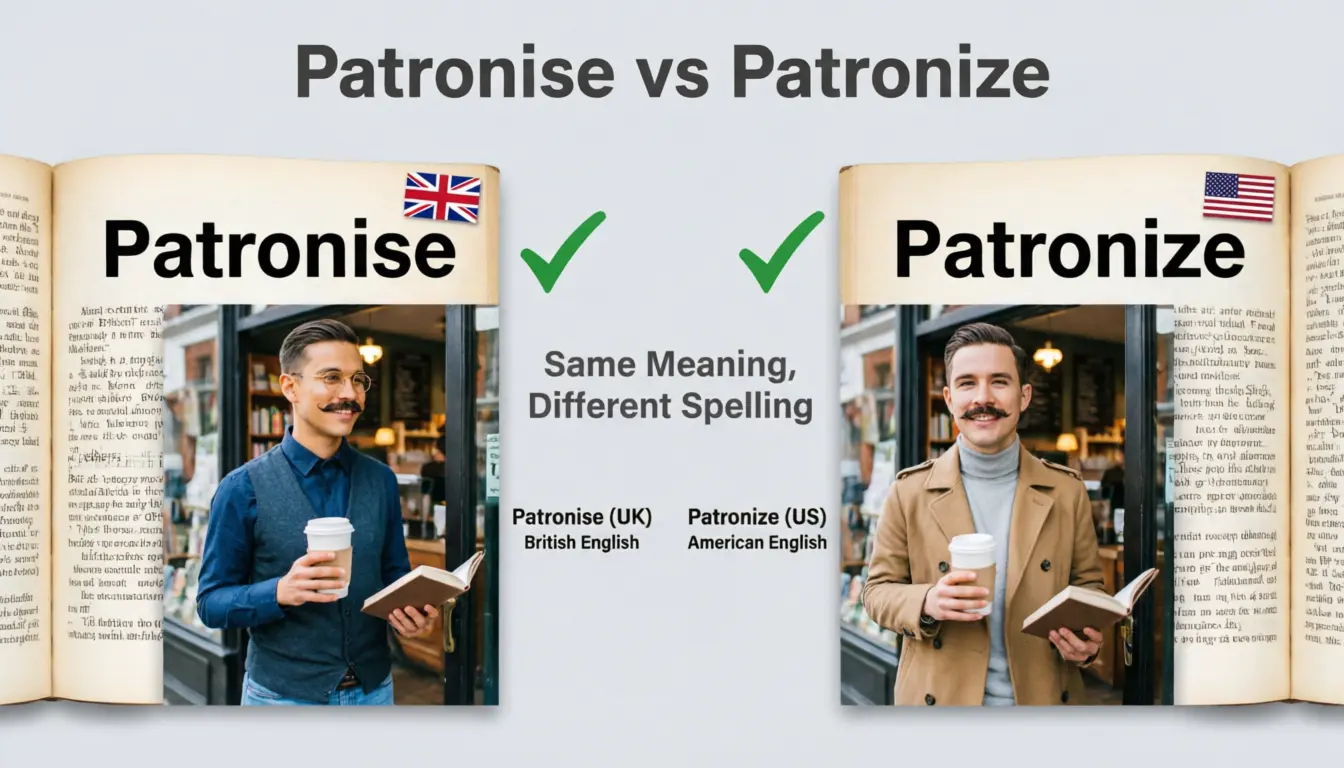
“Patronise” is the British English spelling, while “patronize” is the American English spelling. Both can mean to support a business by being a customer or to treat someone in a condescending manner.
Have you ever seen the words patronise and patronize and wondered if one is correct while the other is wrong? You are not alone. Many writers, students, business owners, and English learners search for patronise vs patronize because both spellings appear in books, articles, advertisements, and online content.
The confusion comes from the fact that both words have the same meaning but follow different spelling conventions. In some countries, you will often see patronise, while in others, patronize is the preferred form. This difference is similar to other spelling pairs such as “organise vs organize” or “realise vs realize.”
Understanding which spelling to use can help you write more professionally and communicate clearly with your audience. If you are writing an email, creating website content, publishing a blog post, or preparing academic work, choosing the correct spelling matters.
In this guide, you will learn the difference between patronise vs patronize, their history, usage rules, common mistakes, examples, and which version is best for your readers.
Patronise vs Patronize – Quick Answer
Patronise and patronize are both correct spellings of the same word.
They have two main meanings:
- To support a business by being a customer.
- To talk to someone in a way that seems superior or condescending.
Examples
- We always patronise local restaurants. (British English)
- We always patronize local restaurants. (American English)
- She spoke in a patronising tone. (British English)
- She spoke in a patronizing tone. (American English)
The only real difference is regional spelling preference.
The Origin of Patronise vs Patronize
The word comes from the Latin word patronus, meaning protector, supporter, or sponsor.
It entered English through French and was used to describe someone who supported artists, businesses, charities, or organizations. Over time, it gained a second meaning: treating someone as if they are less intelligent or less capable.
The spelling difference developed as English evolved in different regions.
Historically, many words ending in -ize came directly from Greek roots. Later, British English adopted both -ise and -ize forms, while American English strongly favored -ize.
As a result:
- Patronize became the standard American spelling.
- Patronise became common in modern British publishing and education.
Both forms have existed for centuries.
British English vs American English Spelling
The main distinction between patronise and patronize is geography.
| Feature | Patronise | Patronize |
| Meaning | Same | Same |
| British English | Common | Also accepted by some publishers |
| American English | Rare | Standard |
| Canadian English | Less common | More common |
| Australian English | Common | Less common |
| New Zealand English | Common | Less common |
| Pronunciation | Same | Same |
Examples
British English
- Many people patronise independent bookstores.
- Please do not patronise your colleagues.
American English
- Many people patronize independent bookstores.
- Please do not patronize your coworkers.
The meaning does not change. Only the spelling changes.
Which Spelling Should You Use?
The best spelling depends on your audience.
Use “Patronize” If:
- Your audience is in the United States.
- You are writing for American publications.
- You follow American English style guides.
Use “Patronise” If:
- Your audience is in the United Kingdom.
- You write for Australia, New Zealand, or other Commonwealth countries.
- Your organization follows British English conventions.
For Global Audiences
Choose one spelling and stay consistent throughout your content.
Many international businesses prefer British spelling in Commonwealth markets and American spelling in the United States.
Consistency is more important than the specific choice.
Common Mistakes with Patronise vs Patronize
Writers often make these mistakes.
| Incorrect Usage | Correct Usage |
| Mixing both spellings in one article | Use one spelling consistently |
| Thinking one spelling is wrong | Both are correct |
| Using patronize only for insulting someone | It also means supporting a business |
| Assuming pronunciation changes | Pronunciation stays the same |
| Switching spelling based on sentence meaning | Choose based on audience, not meaning |
Incorrect Example
- We patronise local shops because customers patronize them.
Better Example
British:
- We patronise local shops because residents patronise them regularly.
American:
- We patronize local shops because residents patronize them regularly.
Patronise vs Patronize in Everyday Examples
Here is how the word appears in real-life situations.
Emails
British English
- We encourage customers to patronise local businesses.
American English
- We encourage customers to patronize local businesses.
News Articles
British
- Residents continue to patronise family-owned stores.
American
- Residents continue to patronize family-owned stores.
Social Media
- Please patronise small businesses this weekend.
- Please patronize small businesses this weekend.
Formal Writing
- Consumers who patronise ethical brands often value sustainability.
- Consumers who patronize ethical brands often value sustainability.
Condescending Meaning
British:
- His comments sounded patronising.
American:
- His comments sounded patronizing.
Patronise vs Patronize – Google Trends & Usage Data
Search trends show that spelling preference depends largely on location.
Countries Where “Patronize” Is More Popular
- United States
- Canada
- American-based websites
- US media publications
Countries Where “Patronise” Is More Popular
- United Kingdom
- Australia
- New Zealand
- South Africa
- Many Commonwealth nations
Online Content Trends
- American websites typically use patronize.
- British publications often use patronise.
- International brands may use either version depending on target markets.
As global audiences grow, both spellings remain widely understood.
Patronise vs Patronize Comparison Table
| Aspect | Patronise | Patronize |
| Correct Spelling | Yes | Yes |
| Meaning | Same | Same |
| Pronunciation | Same | Same |
| British English | Preferred | Accepted by some publishers |
| American English | Uncommon | Preferred |
| Business Support Meaning | Yes | Yes |
| Condescending Meaning | Yes | Yes |
| Formal Writing | Yes | Yes |
FAQs
Is patronise the same as patronize?
Yes. Both spellings have the same meaning. The difference is regional spelling preference.
Which spelling is correct?
Both are correct. Use patronize for American English and patronise for British English.
Do patronise and patronize have different meanings?
No. They both mean supporting a business or speaking in a condescending way.
Why does British English use patronise?
British English commonly uses -ise endings for many words, including patronise.
Why does American English use patronize?
American English generally prefers -ize endings and treats patronize as the standard spelling.
Is patronize wrong in the UK?
No. Some British publishers and dictionaries accept patronize, although patronise is more common.
Which spelling should I use for content?
Use the spelling that matches your target audience’s location and search habits.
Is the pronunciation different?
No. Both spellings are pronounced exactly the same way.
Can I use both spellings in one article?
It is better to choose one version and remain consistent throughout the content.
Conclusion
The debate over patronise vs patronize is not about right versus wrong. Both spellings are correct and carry the same meanings. They can refer to supporting a business as a customer or speaking to someone in a way that seems superior or condescending.
The real difference comes from regional spelling conventions. Patronize is the standard choice in American English, while patronise is more common in British English and many Commonwealth countries. Readers from either region will usually understand both versions without confusion.
When choosing between the two spellings, think about your audience first. If you are writing for Americans, use patronize. If your readers are primarily in the UK, Australia, or New Zealand, patronise may feel more natural. For global audiences, consistency is the key. Pick one spelling style and use it throughout your document.
By understanding these regional differences, you can write more confidently, avoid spelling inconsistencies, and create content that feels professional and appropriate for your target readers.
People also want to know:
Patronise vs Patronize Meaning
The debate around patronise vs patronize comes down to spelling rather than meaning. Both words can mean to support a business by being a customer or to speak to someone in a condescending way. The only difference is that patronise is the preferred British English spelling, while patronize is commonly used in American English.
Patronise vs Patronize Synonyms
If you use patronise or patronize, common synonyms include support, favour, encourage, frequent, and condescend to, depending on the context. For example, customers may patronise a local café, while someone might patronise another person by speaking down to them.
Patronise Meaning
The word patronise has two primary meanings. First, it can mean to regularly support a shop, restaurant, or service as a customer. Second, it can describe treating someone as if they are less intelligent or less capable. The intended meaning usually becomes clear from the context of the sentence.
Patronise vs Patronize Examples
Here are simple examples of both spellings in use: “We always patronise local businesses in our town” (British English) and “Many tourists patronize this restaurant every summer” (American English). Both sentences convey the same idea, but the spelling changes according to the regional variety of English.
Patronise vs Patronize Reddit
Discussions about patronise vs patronize on Reddit often focus on regional spelling differences. Most users agree that neither spelling is incorrect; the choice depends on if you are writing in British English or American English. Style consistency throughout a document is generally considered more important than the spelling itself.
Patronize Synonym
Common patronize synonyms include support, sponsor, frequent, encourage, and condescend, depending on the meaning intended. When referring to customers, words like support or frequent work best, while condescend is suitable when describing a disrespectful attitude.
Don’t Patronize Me Meaning
The phrase “Don’t patronize me” means “Don’t speak to me as if I am inferior, inexperienced, or incapable of understanding.” It is often used when someone feels they are being treated with unnecessary superiority or condescension.
Patronize vs Patronage
Although related, patronize and patronage are not the same. Patronize is a verb meaning to support or speak down to someone, whereas patronage is a noun referring to the support, encouragement, or business provided by customers, sponsors, or patrons.

I am an Emily Carter Brooks U.S.A based linguistics writer known for my clear, reader-friendly explanations of English grammar and vocabulary differences. I have contributed to multiple online language resources and specializes in spelling variations, pronunciation confusion, and British vs American English comparisons. I’m passionate about helping learners improve their English through practical, everyday communication. engaging, and stress-free.