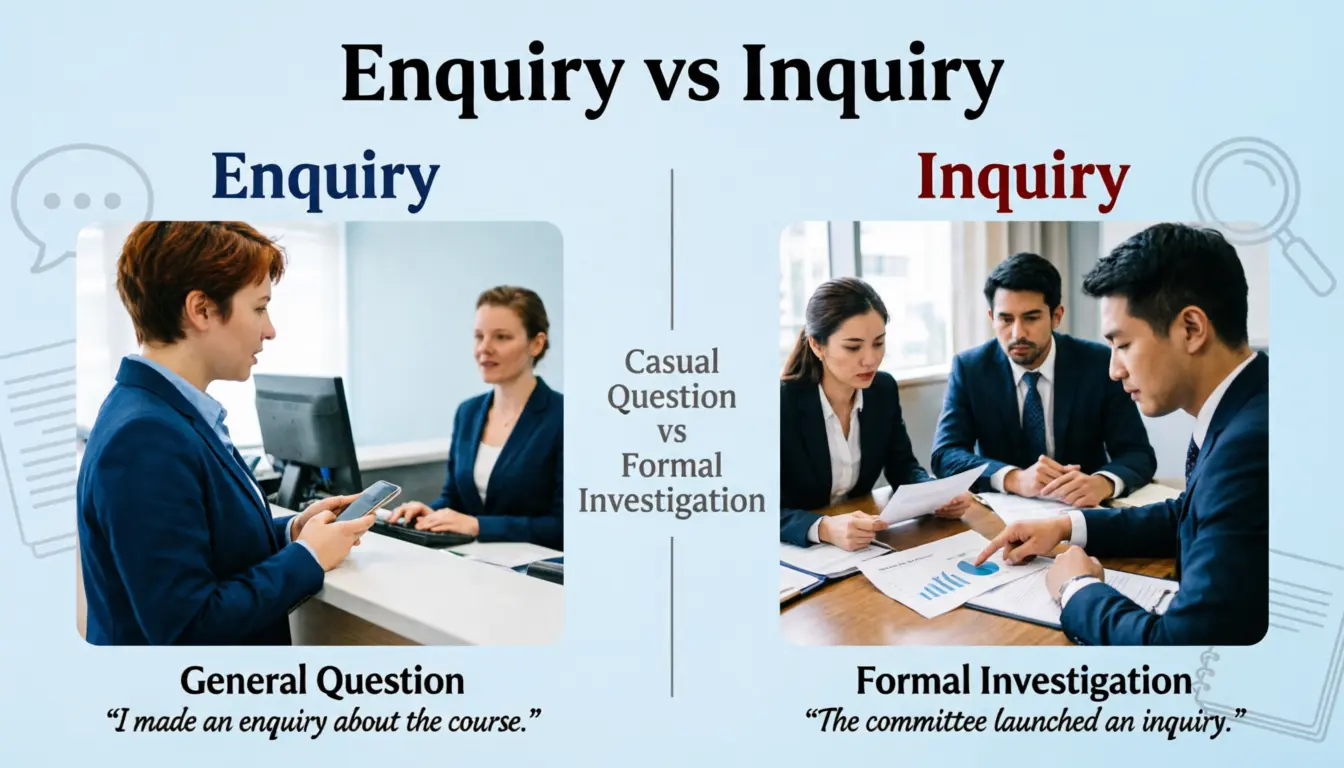
“Enquiry” is the traditional British English spelling for a general question or request for information, while “inquiry” is the standard American English spelling and is also commonly used in British English for formal investigations.
Have you ever wondered whether you should write enquiry or inquiry? Many English learners, writers, and professionals face this confusion. The two words look very similar and often seem interchangeable. However, their usage can vary depending on where you live and the type of English you use.
People commonly search for enquiry vs inquiry because they want to avoid spelling mistakes in emails, business communication, academic writing, and official documents. The confusion becomes even greater when British and American English rules enter the picture.
The good news is that both words are correct. The difference mainly comes down to regional spelling preferences and, in some cases, specific meanings used in British English.
In this guide, you’ll learn the difference between enquiry and inquiry, their origins, when to use each spelling, common mistakes to avoid, and real-life examples. By the end, you’ll know exactly which version fits your audience and writing style.
Enquiry vs Inquiry – Quick Answer
Enquiry and inquiry both refer to a question, request for information, or investigation.
- Enquiry is the preferred spelling in British English.
- Inquiry is the standard spelling in American English.
Examples
British English
- I sent an enquiry about the course fees.
- The hotel responded to my enquiry within a day.
American English
- I submitted an inquiry about the job opening.
- Customer inquiries increased this month.
In modern usage, both words usually mean the same thing.
The Origin of Enquiry vs Inquiry
Both words come from the Old French word enquerre, meaning “to seek” or “to investigate.” This word later entered Middle English and developed into the verbs enquire and inquire.
Over time, the nouns enquiry and inquiry appeared. For centuries, English writers used both spellings without strict rules.
As English evolved, regional preferences developed:
- British English favored enquiry for general questions.
- American English adopted inquiry as the standard form.
- Some British style guides later used inquiry for official investigations and enquiry for ordinary questions.
Today, the distinction is less strict than it once was.
British English vs American English Spelling
The main difference between enquiry and inquiry is regional preference.
| Usage | British English | American English |
| General question | Enquiry | Inquiry |
| Request for information | Enquiry | Inquiry |
| Customer support question | Enquiry | Inquiry |
| Formal investigation | Inquiry (often preferred) | Inquiry |
| Government investigation | Inquiry | Inquiry |
Examples
| British English | American English |
| Thank you for your enquiry. | Thank you for your inquiry. |
| We received several enquiries. | We received several inquiries. |
| The company answered my enquiry. | The company answered my inquiry. |
Quick Rule
- Writing for the UK, Australia, New Zealand, or other Commonwealth countries? Use enquiry.
- Writing for the United States? Use inquiry.
Which Spelling Should You Use?
Choosing the correct spelling depends on your audience.
Use Enquiry If:
- Your audience is in the UK.
- You follow British English spelling.
- You’re writing for Commonwealth countries.
Use Inquiry If:
- Your audience is in the United States.
- You’re using American English.
- You’re writing academic or business content for a global audience.
For International Content
Many global companies prefer inquiry because American English dominates international business communication. However, either spelling is acceptable if you remain consistent.
Common Mistakes with Enquiry vs Inquiry
Many writers make simple mistakes when using these words.
Mistake 1: Mixing Spellings
❌ We received your enquiry and will answer your inquiry soon.
✅ We received your enquiry and will answer it soon.
✅ We received your inquiry and will answer it soon.
Mistake 2: Assuming One Is Wrong
❌ Inquiry is incorrect.
✅ Both spellings are correct depending on the region.
Mistake 3: Ignoring Audience Preferences
A UK audience may expect enquiry, while an American audience expects inquiry.
Mistake 4: Switching Styles in One Document
Choose one spelling style and use it consistently throughout your content.
Enquiry vs Inquiry in Everyday Examples
Here are common situations where these words appear.
Emails
British English
- Thank you for your enquiry regarding our services.
American English
- Thank you for your inquiry regarding our services.
News Reports
- The government launched an inquiry into the incident.
- A public inquiry examined the safety concerns.
Social Media
- Send us an enquiry through direct message.
- Submit your inquiry through our website.
In Business Writing
- Customer enquiries increased by 20%.
- Customer inquiries increased by 20%.
In Academic Writing
- The study began as an inquiry into language learning.
- Further inquiry is needed before conclusions can be drawn.
Enquiry vs Inquiry – Google Trends & Usage Data
Search behavior shows clear regional preferences.
Countries That Prefer Enquiry
- United Kingdom
- Australia
- New Zealand
- South Africa
Countries That Prefer Inquiry
- United States
- Canada (often mixed)
- International business publications
Why Inquiry Appears More Online
The internet contains a large amount of American English content. As a result, inquiry often appears more frequently in global search results and business websites.
Context Matters
- Customer service pages in the UK often use enquiry.
- Government investigations worldwide commonly use inquiry.
- Academic publications usually favor inquiry.
Enquiry vs Inquiry Comparison Table
| Feature | Enquiry | Inquiry |
| Meaning | Question or investigation | Question or investigation |
| British English | Preferred | Sometimes used |
| American English | Rare | Standard |
| Business Communication | Common in UK | Common globally |
| Academic Writing | Less common | More common |
| Government Investigation | Sometimes used | Frequently used |
| Correct Spelling | Yes | Yes |
FAQs About Enquiry vs Inquiry
1. Are enquiry and inquiry the same?
Yes. Both words generally mean a request for information or an investigation.
2. Which spelling is correct?
Both are correct. The preferred version depends on whether you use British or American English.
3. Is enquiry British English?
Yes. Enquiry is the traditional British spelling.
4. Is inquiry American English?
Yes. Inquiry is the standard American spelling.
5. Which spelling should businesses use?
Businesses should use the spelling that matches their target audience.
6. Is inquiry more formal than enquiry?
In some British style guides, inquiry may refer to official investigations, making it seem more formal.
7. Which spelling is better for content?
Use the version your audience searches for most. Global audiences often encounter inquiry more frequently.
8. Can I use both spellings in one article?
It is better to choose one spelling style and remain consistent.
9. Why do official investigations often use inquiry?
Many governments and institutions traditionally use inquiry for formal investigations and public reviews.
Conclusion
The debate over enquiry vs inquiry is less about right and wrong and more about regional spelling preferences. Both words refer to asking questions, seeking information, or conducting investigations. The key difference lies in where the audience is located and which variety of English is being used.
If you write for a British audience, enquiry is generally the preferred choice for everyday questions and information requests. If you write for an American audience, inquiry is the accepted standard in nearly all situations. In international business, academic writing, and online content, inquiry is often seen more frequently because of the influence of American English.
The most important rule is consistency. Once you choose a spelling style, use it throughout your document. Doing so makes your writing look professional and polished. Understanding the difference between enquiry and inquiry helps you communicate clearly, avoid confusion, and match the expectations of your readers. If you choose enquiry or inquiry, you’ll be using a correct and widely accepted English word.
Overview:
Many people also search for related terms such as enquiry vs inquiry UK, enquiry meaning, enquiry vs inquiry vs query, and enquiry vs inquiry examples when trying to understand the difference between these commonly confused words. In British English, enquiry is often used for general questions, while inquiry can refer to formal investigations, though the distinction is becoming less strict.
The meaning of enquiry and inquiry is essentially the same both refer to asking for information. Their synonyms include question, request, investigation, and probe, depending on the context. If you’re unsure about pronunciation, both words are pronounced similarly, with the main difference being their spelling.
According to the Oxford Dictionary, both forms are accepted, but usage may vary based on region and context. Understanding these differences helps you choose the most appropriate word in professional, academic, and everyday writing.

I am an Emily Carter Brooks U.S.A based linguistics writer known for my clear, reader-friendly explanations of English grammar and vocabulary differences. I have contributed to multiple online language resources and specializes in spelling variations, pronunciation confusion, and British vs American English comparisons. I’m passionate about helping learners improve their English through practical, everyday communication. engaging, and stress-free.