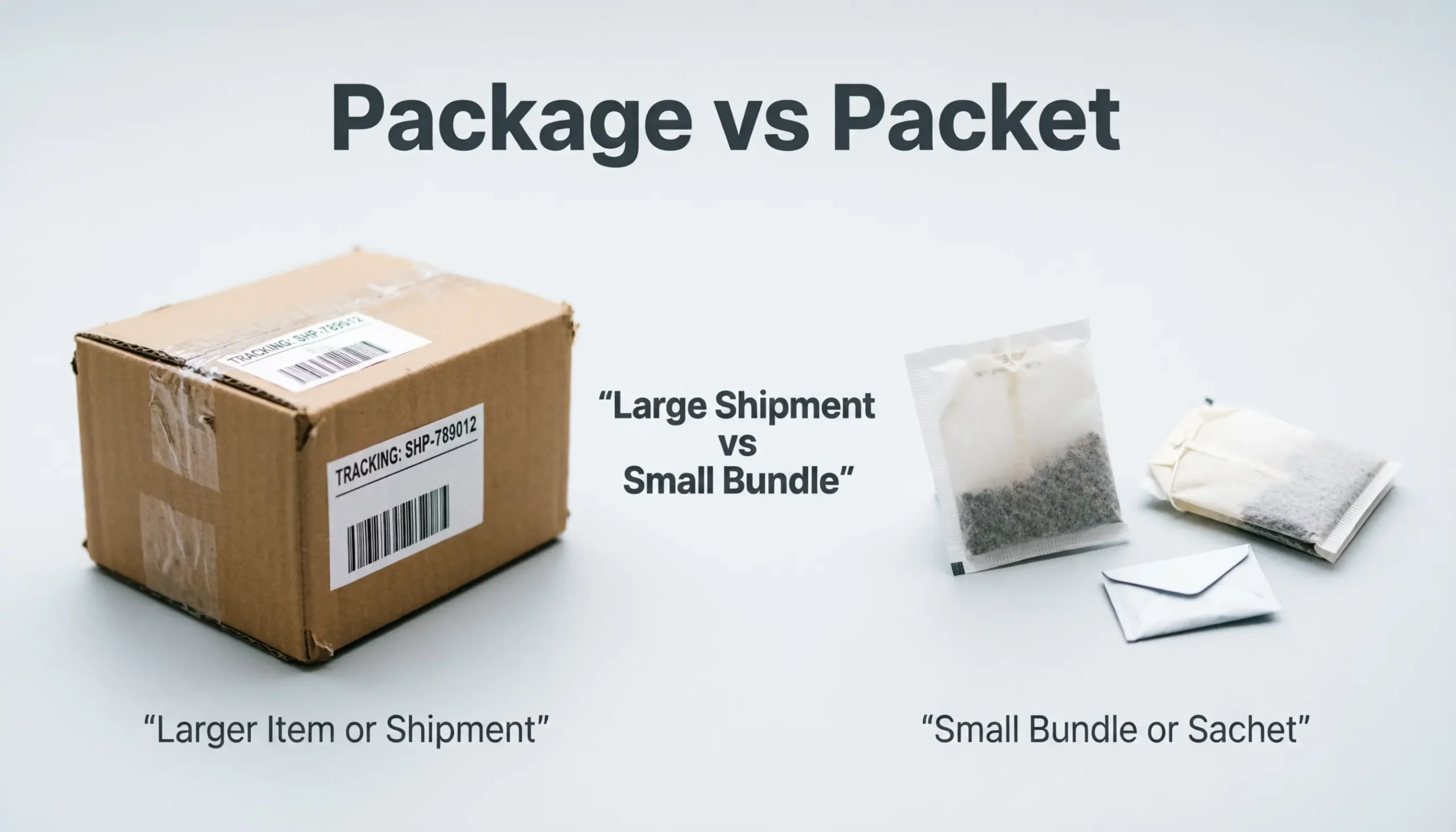
“Package” is a general term for a wrapped or boxed item, often larger in size, while “packet” usually refers to a small package, envelope, or container holding a limited amount of something.
Have you ever wondered if you should write package or packet? Many English learners and native speakers alike get confused because both words can refer to something that contains items. In some situations, they seem interchangeable, while in others, using the wrong word can sound strange or even incorrect.
People often search for package vs packet because they encounter these terms in shipping, technology, food packaging, business communication, and everyday conversations. Understanding the difference helps improve writing, avoid misunderstandings, and ensure you choose the right word for the right situation.
The confusion comes from the fact that both words describe containers or groups of items. However, their size, purpose, and context are often different. A package is usually larger and used for shipping or storing goods, while a packet is often smaller and may contain a limited quantity of something.
In this guide, you’ll learn the exact difference between package vs packet, their origins, common usage patterns, regional preferences, examples, mistakes to avoid, and practical advice on choosing the correct word.
Package vs Packet – Quick Answer
Package refers to a larger wrapped or boxed item, especially one sent through mail or delivery services.
Packet refers to a small package, envelope, bundle, or collection of items.
Examples
Package
- Your package arrived this morning.
- The company shipped the package yesterday.
- She opened the package carefully.
Packet
- Please add one packet of sugar.
- I received a packet of seeds.
- The sauce packet was inside the box.
Quick Difference
| Package | Packet |
| Usually larger | Usually smaller |
| Common in shipping and delivery | Common for small quantities |
| Often a box or wrapped item | Often an envelope, sachet, or bundle |
| Used in logistics | Used in food, medicine, technology, and stationery |
The Origin of Package vs Packet
The words share a common history.
Package
The word package comes from the Middle French word paquet, meaning a bundle or parcel. Over time, English speakers began using package to describe goods wrapped together for transport or delivery.
Packet
The word packet also comes from the French word paquet. The English suffix -et traditionally indicates a smaller version of something. As a result, packet developed the meaning of a small package or bundle.
Why the Difference Exists
Originally, both words described bundles of items. Over centuries, English usage separated them by size and purpose:
- Package became associated with shipping and larger containers.
- Packet became associated with smaller quantities and specialized uses.
This distinction remains common today.
British English vs American English Spelling
Unlike many English word pairs, package and packet are not spelling variations of the same word. They are different words with different meanings.
Both British and American English use the same spellings.
Comparison Table
| Feature | Package | Packet |
| British English | Package | Packet |
| American English | Package | Packet |
| Meaning | Larger parcel or bundle | Smaller bundle or container |
| Shipping Use | Very common | Less common |
| Food Packaging | Sometimes | Very common |
| Computer Networks | Rare | Very common |
Examples in British English
- Your package has been delivered.
- Add a packet of crisps to your lunch.
Examples in American English
- The package arrived today.
- Open the ketchup packet carefully.
Which Spelling Should You Use?
Because these are different words, the correct choice depends on context rather than location.
Use “Package” When:
- Talking about deliveries
- Referring to mailed items
- Describing larger wrapped goods
- Discussing product bundles
Examples
- The package is on the doorstep.
- We sent the package by express delivery.
Use “Packet” When:
- Talking about small quantities
- Referring to food sachets
- Describing medicine packets
- Discussing computer networking
Examples
- Take one packet of medicine daily.
- The data packet reached the server.
For Global Audiences
Choose the word based on meaning:
- Large shipment = package
- Small bundle = packet
This approach works worldwide.
Common Mistakes with Package vs Packet
Many writers use these words incorrectly because they both involve containers.
Mistake 1: Calling a Large Delivery a Packet
❌ The packet arrived from Amazon.
✅ The package arrived from Amazon.
Mistake 2: Calling a Sugar Sachet a Package
❌ Add one package of sugar.
✅ Add one packet of sugar.
Mistake 3: Using Them as Exact Synonyms
❌ Packet and package always mean the same thing.
✅ Packet is often smaller than a package.
Mistake 4: Ignoring Technical Usage
In networking, the correct term is:
✅ Data packet
Not:
❌ Data package
Package vs Packet in Everyday Examples
Understanding real-world usage makes the difference easier to remember.
Emails
Package
Your package has been shipped and will arrive tomorrow.
Packet
Please review the information packet attached.
News Reports
Package
Thousands of holiday packages were delivered this week.
Packet
The company recalled several medicine packets.
Social Media
Package
My package finally arrived!
Packet
Why do sauce packets always tear the wrong way?
In Formal Writing
Package
The software package includes five applications.
Packet
Each participant received an information packet.
In Technology
Packet
The router transmitted the data packet successfully.
Packet is the preferred technical term in networking.
Package vs Packet – Google Trends & Usage Data
Search interest shows that both words remain widely used, but their contexts differ.
Package
The word package is more common overall because it appears in:
- Shipping
- E-commerce
- Retail
- Logistics
- Product marketing
Countries with strong online shopping activity frequently use this term.
Packet
The word packet appears more often in:
- Food packaging
- Education
- Healthcare
- Computer networking
Geographic Trends
| Country | More Common Term |
| United States | Package |
| Canada | Package |
| Australia | Package |
| United Kingdom | Package (general), Packet (specific contexts) |
| India | Both common depending on context |
Context-Based Popularity
| Context | Preferred Word |
| Delivery Services | Package |
| E-commerce | Package |
| Sugar Sachets | Packet |
| Medicine Packs | Packet |
| Computer Networks | Packet |
| Information Handouts | Packet |
Package vs Packet Comparison Table
| Feature | Package | Packet |
| Meaning | Larger bundle or parcel | Smaller bundle or container |
| Size | Usually large | Usually small |
| Shipping | Common | Rare |
| Food Items | Less common | Common |
| Medicine | Sometimes | Common |
| Documents | Possible | Common |
| Technology | Rare | Standard term |
| Business Use | Common | Common for information sets |
| Everyday Use | Very common | Common |
Frequently Asked Questions (FAQs)
1. What is the difference between package and packet?
A package is usually a larger parcel or shipment, while a packet is generally a smaller bundle or container.
2. Is packet just a small package?
Yes. In many situations, a packet can be considered a smaller form of a package.
3. Which word is correct for mail delivery?
Package is usually the correct word for deliveries and shipped items.
4. Why is sugar sold in packets?
Because packets are designed for small quantities and single-use portions.
5. What is a data packet?
A data packet is a small unit of information transmitted across a computer network.
6. Can package and packet be used interchangeably?
Sometimes, but not always. Context usually determines the correct choice.
7. Is packet more common in British English?
Packet is often heard in British English for small packaged items, but package is also widely used.
8. What is an information packet?
An information packet is a collection of documents or materials provided together.
9. Which word should I use in business writing?
Use package for products, shipments, or service bundles. Use packet for collections of documents or small packaged items.
Conclusion
The difference between package vs packet is mainly about size, purpose, and context. A package usually refers to a larger parcel, shipment, or bundled product. It is the preferred word when discussing deliveries, logistics, retail purchases, and mailed items. A packet, on the other hand, generally refers to a smaller bundle, envelope, sachet, or collection of materials. It is commonly used for food items, medicines, information handouts, and computer networking.
Although both words share the same historical roots, modern English has developed clear distinctions between them. Using the correct term makes your writing more precise and professional. When talking about something arriving from a delivery company, choose package. When referring to a small quantity of sugar, seeds, medicine, or data, choose packet.
For most situations, remembering one simple rule is enough: packages are usually larger, while packets are usually smaller. Following this guideline will help you use both words confidently in everyday communication, academic writing, business documents, and online content.
People also search for:
Package vs Packet Meaning
The difference between package vs packet mainly comes down to size and usage. A package usually refers to a larger wrapped item or shipment, while a packet is often a smaller bundle, envelope, or collection of information. Although both terms describe something being packed together, their meanings can vary depending on the context.
Package vs Packet Reddit
In discussions about package vs packet on Reddit, users often point out that regional language differences influence which term is more common. Many people associate “packet” with smaller items such as snack packets or data packets, while “package” is generally used for parcels, deliveries, and bundled products.
Package vs Packet Shipping
When it comes to package vs packet shipping, a package is typically a larger shipment sent through postal or courier services, whereas a packet often refers to a lightweight envelope or small parcel. Shipping companies may use different classifications based on weight, dimensions, and delivery requirements.
Package vs Packet Tracking
The term package vs packet tracking refers to monitoring shipments during transit. Whether an item is classified as a package or a packet, modern postal and courier services usually provide tracking numbers that allow customers to check delivery status in real time.
Package or Packet of Documents
Choosing between a package or packet of documents depends on the quantity and presentation. A packet of documents commonly refers to a collection of papers grouped together, while a package of documents may suggest that the papers have been wrapped or shipped to another location.
Package vs Packet USPS
In Package vs Packet USPS terminology, USPS generally uses “package” for most shippable parcels. The word “packet” is less common in USPS services and is often associated with small packets used in international mail classifications rather than standard domestic shipments.
Package vs Parcel USPS
The comparison of package vs parcel USPS can be confusing because both terms are often used interchangeably. In everyday usage, a parcel is simply a package being sent through the mail, though specific postal regulations may categorize them based on size, weight, and service type.
Packet vs Package Network
In computer networking, packet vs package network highlights a different meaning altogether. A packet is a small unit of data transmitted across a network, while the term package is rarely used in networking to describe data transmission. Therefore, packet is the correct technical term in most network-related discussions.

I hold a degree in English Literature and Linguistics and have worked extensively on educational blogs, comparison websites, and digital learning platforms. My writing focuses on simplifying complex language rules, highlighting British vs American English differences, and providing practical examples for everyday usage.