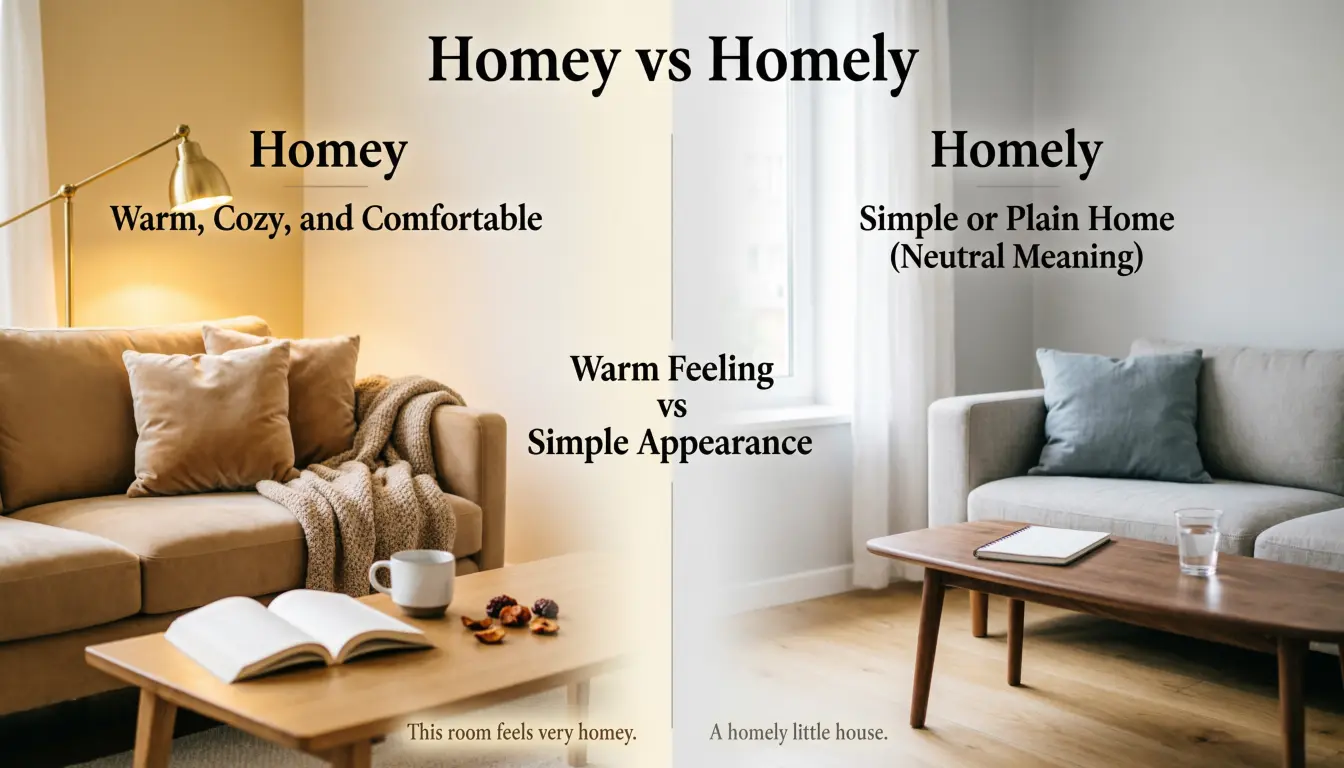
“Homey” and “homely” are both correct words, but they have very different meanings depending on region. “Homey” (mainly American English) means cozy, comfortable, and like home, while “homely” in British English can mean simple and unpretentious, but in American English it often means plain or unattractive in appearance.
Have you ever described a cozy house as homey or homely and wondered if you chose the right word? Many English learners and native speakers get confused by these two similar words. They look alike, sound similar, and both come from the word home, but their meanings are not always the same.
The confusion becomes even greater because British English and American English use these words differently. In one country, a word may be a compliment, while in another, it may sound negative. This difference often causes mistakes in writing, business communication, travel content, and everyday conversations.
If you have searched for homey vs homely, you are probably trying to understand which word fits a cozy house, a comfortable feeling, or even a person’s appearance. This guide explains the meanings, origins, usage rules, common mistakes, and real-world examples. By the end, you will know exactly when to use homey and when to use homely.
Homey vs Homely – Quick Answer
Homey and homely both relate to comfort and home, but they are not always interchangeable.
- Homey (mainly American English) means cozy, warm, comfortable, and welcoming.
- Homely (British English) often means cozy and comfortable.
- Homely (American English) can mean plain or unattractive in appearance.
Examples
✅ The cabin felt homey and inviting.
✅ Her kitchen has a homely atmosphere. (British English)
✅ In American English, calling someone homely may suggest they are not attractive.
The Origin of Homey vs Homely
Both words come from the Old English word ham, meaning home or dwelling place.
Homely
The word homely appeared first. It originally described something simple, familiar, and connected with everyday home life. Over time, British English kept the positive meaning of comfort and warmth.
Homey
The spelling homey developed later in North America. Americans began using it to express the positive meaning of comfort and coziness without the risk of confusion with the negative sense of homely.
Why the Difference Exists
Language changes differently across regions. While Britain preserved the original positive meaning of homely, American English gradually added the meaning of plain appearance. As a result, Americans often prefer homey when describing a welcoming place.
British English vs American English Spelling
The biggest difference is not spelling but meaning and preference.
| Feature | Homey | Homely (British English) | Homely (American English) |
| Meaning | Cozy and welcoming | Cozy and comfortable | Plain-looking or unattractive |
| Common Region | United States | United Kingdom | United States |
| Positive Meaning | Yes | Yes | Usually No |
| Used for Homes | Yes | Yes | Rarely |
| Used for People | Rarely | Sometimes | Often negative |
Examples
American English
- The apartment feels very homey.
- She decorated the room to make it more homey.
British English
- The cottage has a homely charm.
- We enjoyed the homely atmosphere.
Which Spelling Should You Use?
Your audience should guide your choice.
Use “Homey” If:
- Your audience is American.
- You are writing for a global audience.
- You want to avoid misunderstanding.
- You are describing a cozy place.
Use “Homely” If:
- Your audience is British.
- You are writing for UK publications.
- You mean comfortable and welcoming.
Quick Recommendation
| Audience | Best Choice |
| United States | Homey |
| United Kingdom | Homely |
| Australia | Homely |
| Canada | Homey or Homely |
| Global Audience | Homey |
Common Mistakes with Homey vs Homely
Mistake 1: Using Homely for a Person in America
❌ She is very homely.
Many Americans may interpret this as “unattractive.”
✅ She has a warm personality.
Mistake 2: Assuming Both Words Mean Exactly the Same
❌ The meanings are always identical.
✅ Meanings depend on region and context.
Mistake 3: Using Homey in Formal British Writing
While not wrong, British readers may expect homely.
✅ The cottage has a homely atmosphere.
Homey vs Homely in Everyday Examples
In Emails
American English
“The guest room should feel more homey for visitors.”
British English
“We want the hotel to have a homely atmosphere.”
In News Articles
“The renovation transformed the apartment into a homey retreat.”
“The inn is known for its homely charm.”
On Social Media
“Our new living room feels so homey!”
“This cottage has such a homely feel.”
In Formal Writing
“The designer created a homey environment for residents.”
“The building maintains a homely atmosphere despite modernization.”
Homey vs Homely – Google Trends & Usage Data
Search data generally shows that:
- Homey is more popular in the United States.
- Homely remains common in the United Kingdom.
- Travel, interior design, and real estate websites often use homey for international audiences.
- British lifestyle magazines frequently use homely when describing houses and cottages.
The popularity of each term depends largely on geography and audience expectations.
Homey vs Homely Comparison Table
| Aspect | Homey | Homely |
| Origin | North American variation | Older English word |
| Main Meaning | Cozy and welcoming | Cozy, simple, familiar |
| US Usage | Very common | May mean unattractive |
| UK Usage | Less common | Very common |
| Safe for Global Audience | Yes | Sometimes misunderstood |
| Formal Writing | Acceptable | Acceptable |
Homey vs Homely in Academic Writing
Academic writing usually values clarity.
Recommended Usage
- Use homey when writing for an international audience.
- Use homely when discussing British culture, literature, or architecture.
Examples
“The researchers noted that residents preferred a homey environment that encouraged social interaction.”
The goal is to avoid regional confusion.
Homey vs Homely in Business English
Business communication should be clear and easy to understand.
Marketing Example
✅ Our hotel offers a homey atmosphere for travelers.
Real Estate Example
✅ The apartment has a homey feel with modern features.
For global marketing, homey is usually the safer choice.
Common Style Guide Recommendations
| Style Context | Recommendation |
| American Publications | Homey |
| British Publications | Homely |
| International Marketing | Homey |
| Academic Writing | Choose based on audience |
| Business Writing | Homey |
Most modern international brands prefer homey because it avoids the negative American interpretation of homely.
Real Examples from Published Sources
Homey
- Travel blogs often describe hotels as “homey and welcoming.”
- Real estate listings frequently mention a “homey atmosphere.”
Homely
- British newspapers often refer to cottages as having “homely charm.”
- UK lifestyle magazines regularly use “homely” to describe comfortable interiors.
These examples show how regional preferences shape usage.
Homey vs Homely Quiz
Choose the correct answer.
1. Which word is most common in American English for a cozy room?
A. Homely
B. Homey
Answer: B. Homey
2. Which word often describes a comfortable cottage in Britain?
A. Homey
B. Homely
Answer: B. Homely
3. Which word may sound negative when describing a person’s appearance in the US?
A. Homely
B. Homey
Answer: A. Homely
4. Which word is safer for global marketing?
A. Homey
B. Homely
Answer: A. Homey
Fill in the Blanks Exercise
- The cabin felt warm and ________.
Answer: homey - The British inn had a ________ atmosphere.
Answer: homely - The designer created a more ________ living space.
Answer: homey - The cottage was small but very ________.
Answer: homely - Travelers loved the ________ feel of the guesthouse.
Answer: homey
FAQs
1. Is homey a real word?
Yes. Homey is a standard English word that means cozy, comfortable, and welcoming.
2. Is homely positive or negative?
It depends on the region. In Britain it is usually positive. In America it can be negative when describing appearance.
3. Which word should I use for a cozy house?
For international audiences, use homey. For British audiences, homely is also correct.
4. Are homey and homely interchangeable?
Sometimes. However, regional differences can change the meaning.
5. Why do Americans prefer homey?
It avoids confusion with the negative sense of homely.
6. Is homely old-fashioned?
Not necessarily. It remains common in British English.
7. Which word is better for marketing?
Homey is usually safer because global audiences understand it positively.
8. Can I use homey in formal writing?
Yes. It is acceptable when describing a comfortable environment.
9. Can homely describe a person?
Yes, but in American English it may mean unattractive, so use caution.
Conclusion
The debate over homey vs homely comes down to regional usage and audience expectations. Both words originate from the idea of home, comfort, and familiarity, but their meanings have evolved differently over time. In British English, homely often carries a positive sense of warmth, comfort, and simplicity. In American English, however, homely can suggest that a person is plain-looking or unattractive, which may lead to misunderstanding.
Because of this difference, many writers, marketers, and businesses choose homey when describing a cozy house, welcoming room, comfortable hotel, or inviting atmosphere. The word is widely understood and rarely causes confusion. Meanwhile, homely remains perfectly natural in British English and continues to appear in newspapers, books, and lifestyle publications.
When choosing between the two, think about your readers. If your audience is primarily British, homely may feel more familiar. If your audience is American or international, homey is often the safer choice. Understanding this distinction will help you communicate clearly and confidently in any situation.

I hold a degree in English Literature and Linguistics and have worked extensively on educational blogs, comparison websites, and digital learning platforms. My writing focuses on simplifying complex language rules, highlighting British vs American English differences, and providing practical examples for everyday usage.