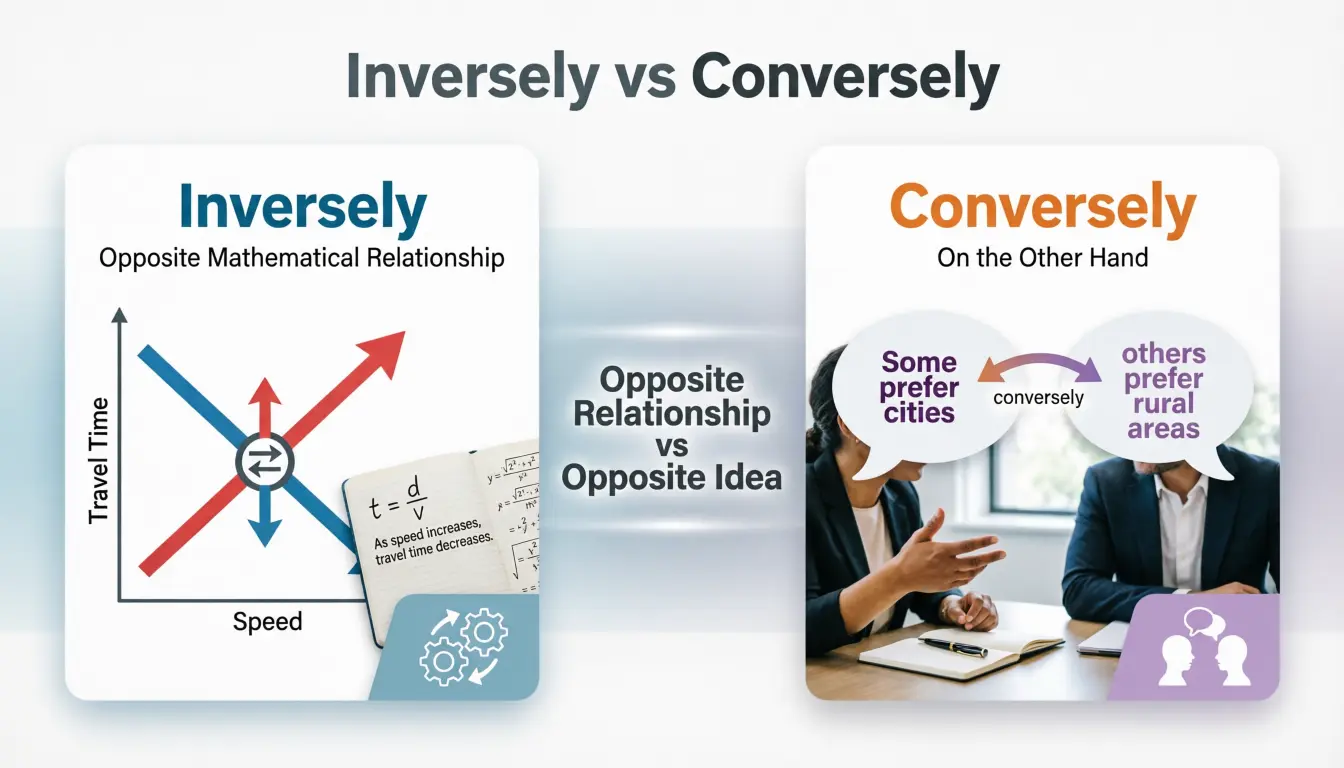
“Inversely” and “conversely” are both correct words, but they have different meanings. “Inversely” means in an opposite or reverse relationship (often in mathematics, science, or statistics), while “conversely” means on the other hand or from the opposite point of view when presenting a contrasting statement.
Have you ever read a sentence and wondered if you should use inversely or conversely? Many English learners, students, and even professional writers confuse these two words because both are used to show a relationship between ideas. However, they do not mean the same thing.
The confusion often appears in academic papers, business reports, news articles, and everyday conversations. Using the wrong word can make your writing unclear or even change the meaning of your sentence.
The good news is that understanding the difference is simple. Inversely describes an opposite relationship between two things, often involving numbers or changes. Conversely introduces an opposite statement, idea, or viewpoint.
In this guide, you’ll learn the meaning, origin, examples, usage rules, common mistakes, and professional writing tips for inversely vs conversely. By the end, you’ll know exactly when to use each word and avoid one of the most common English vocabulary mistakes.
Inversely vs Conversely – Quick Answer
Inversely means that two things change in opposite directions.
Example:
- As temperature increases, heating costs decrease.
- Temperature and heating costs are inversely related.
Conversely means “on the other hand” or “in contrast.”
Example:
- Large companies often have more resources.
- Conversely, small companies may be more flexible.
Quick Comparison
| Word | Meaning | Use |
| Inversely | Opposite relationship between variables | Math, science, statistics |
| Conversely | Opposite idea or statement | Writing, speaking, discussions |
The Origin of Inversely vs Conversely
Both words come from Latin roots.
Inversely
The word inverse comes from the Latin word inversus, meaning “turned upside down” or “reversed.”
Over time, English speakers used inversely to describe situations where one thing moves in the opposite direction of another.
Conversely
The word converse comes from the Latin word conversari, meaning “to turn around” or “change direction.”
The adverb conversely developed to introduce an opposite point of view or contrasting statement.
Why the Difference Exists
Although both words involve opposition, they developed in different contexts:
- Inversely = opposite relationship
- Conversely = opposite idea
This difference explains why they cannot always replace each other.
British English vs American English Spelling
Unlike words such as “analysed” and “analyzed,” inversely and conversely have the same spelling in both British and American English.
Example:
| British English | American English |
| Inversely proportional | Inversely proportional |
| Conversely, the result was different | Conversely, the result was different |
| Usage is identical | Usage is identical |
Comparison Table
| Feature | British English | American English |
| Inversely | Correct | Correct |
| Conversely | Correct | Correct |
| Spelling Difference | None | None |
| Meaning Difference | None | None |
There is no regional spelling variation for these words.
Which Spelling Should You Use?
The answer is simple:
Use inversely when describing opposite changes or relationships.
Use conversely when presenting an opposite idea.
American Audiences
- Use both words according to meaning.
- No spelling changes are required.
British Audiences
- Use the same spellings.
- Follow the same usage rules.
For Global Writing
Whether your readers are in the US, UK, Canada, Australia, or elsewhere, the spellings remain identical.
Common Mistakes with Inversely vs Conversely
Many writers confuse the two words because both suggest opposition.
Mistake 1: Using Conversely for Mathematical Relationships
❌ Sales are conversely proportional to costs.
✅ Sales are inversely proportional to costs.
Mistake 2: Using Inversely for Contrasting Ideas
❌ The first group supported the plan. Inversely, the second group opposed it.
✅ The first group supported the plan. Conversely, the second group opposed it.
Mistake 3: Assuming They Are Synonyms
❌ They can always replace each other.
✅ They have different meanings and uses.
Mistake 4: Overusing Conversely
Using “conversely” in every contrast can make writing repetitive.
Better alternatives:
- However
- On the other hand
- In contrast
Inversely vs Conversely in Everyday Examples
In Emails
Inversely
- Customer demand is inversely related to product price.
Conversely
- The premium plan includes extra support. Conversely, the basic plan offers limited assistance.
In News Writing
Inversely
- Interest rates and borrowing often move inversely.
Conversely
- Urban populations continue to grow. Conversely, some rural areas are shrinking.
In Social Media
Inversely
- Screen brightness is inversely linked to battery life.
Conversely
- Some people prefer remote work. Conversely, others enjoy office environments.
In Formal Writing
Inversely
- The variables were found to be inversely correlated.
Conversely
- Conversely, the alternative hypothesis received stronger support.
Inversely vs Conversely – Google Trends & Usage Data
Search data shows that many users look for inversely vs conversely because the words appear similar in meaning.
Where Inversely Is Most Common
- Mathematics
- Statistics
- Science
- Engineering
- Economics
Where Conversely Is Most Common
- Academic writing
- Journalism
- Business communication
- Essays
- Reports
Popular Countries
The terms are commonly searched in:
- United States
- United Kingdom
- Canada
- Australia
- India
Most searches come from students, researchers, and professional writers trying to improve accuracy.
Inversely vs Conversely Comparison Table
| Feature | Inversely | Conversely |
| Meaning | Opposite relationship | Opposite idea |
| Part of Speech | Adverb | Adverb |
| Common Context | Math, science | Writing, discussion |
| Shows Contrast | Sometimes | Yes |
| Shows Variable Relationship | Yes | No |
| Can Replace the Other? | No | No |
Inversely vs Conversely in Academic Writing
Academic writing often requires precise language.
Use Inversely When:
- Discussing correlations
- Describing proportional relationships
- Reporting scientific findings
Example:
“The variables were inversely related.”
Use Conversely When:
- Presenting opposing arguments
- Comparing theories
- Discussing alternative viewpoints
Example:
“Conversely, the second study reported different results.”
Using the correct word improves clarity and professionalism.
Inversely vs Conversely in Business English
Business communication also uses both terms.
Inversely
Used for data and performance relationships.
Example:
“Customer satisfaction was inversely related to waiting time.”
Conversely
Used when comparing strategies or outcomes.
Example:
“Large firms benefit from scale. Conversely, small firms adapt more quickly.”
Common Style Guide Recommendations
Major writing guides generally recommend:
| Situation | Recommended Word |
| Opposite numerical relationship | Inversely |
| Opposite viewpoint | Conversely |
| Scientific reports | Inversely |
| Academic contrast | Conversely |
| Business analysis | Depends on context |
The key recommendation is to choose the word based on meaning, not preference.
Real Examples from Published Sources
Inversely
- “Risk is inversely related to diversification.”
- “Pressure varies inversely with volume.”
Conversely
- “Some markets expanded rapidly. Conversely, others experienced decline.”
- “The first proposal succeeded. Conversely, the second proposal failed.”
These examples reflect how professional writers use the words correctly.
Inversely vs Conversely Quiz
Choose the correct answer.
1. As supply increases, prices often decrease. They are _____ related.
A. Conversely
B. Inversely
✅ Answer: B
2. Some employees prefer remote work. _____, others prefer working in an office.
A. Conversely
B. Inversely
✅ Answer: A
3. Height and travel distance are _____ concepts.
A. Inversely
B. Conversely
✅ Answer: B
4. Speed and travel time are often _____ proportional.
A. Inversely
B. Conversely
✅ Answer: A
Fill in the Blanks Exercise
Complete the sentences.
- The two variables were __________ correlated.
- The first team won the match. __________, the second team lost.
- Demand is often __________ related to price.
- The experiment supported the theory. __________, another study challenged it.
- Speed and time are __________ proportional.
Answers
- inversely
- conversely
- inversely
- conversely
- inversely
FAQs About Inversely vs Conversely
1. What is the difference between inversely and conversely?
Inversely describes opposite relationships, while conversely introduces opposite ideas.
2. Can inversely and conversely be used interchangeably?
No. Their meanings are different.
3. Is inversely used in mathematics?
Yes. It commonly describes inverse relationships and proportions.
4. Is conversely used in essays?
Yes. It is often used to introduce a contrasting viewpoint.
5. Which word is more common in academic writing?
Both are common, but they serve different purposes.
6. Are there British and American spelling differences?
No. The spelling is identical worldwide.
7. Is conversely formal?
Yes. It is considered a formal transition word.
8. Is inversely always related to numbers?
Usually, but it can also describe opposite relationships in broader contexts.
9. How can I remember the difference?
Think of inverse = opposite relationship and converse = opposite idea.
Conclusion
Understanding inversely vs conversely is important for clear and professional communication. Although both words involve some form of opposition, they serve different purposes and should not be used interchangeably. Inversely is used when two things move in opposite directions or have an opposite relationship.
It is especially common in mathematics, science, economics, and data analysis. Conversely, on the other hand, introduces a contrasting statement, viewpoint, or outcome and is widely used in essays, reports, journalism, and everyday writing.
A simple way to remember the distinction is this: if you are discussing numbers, measurements, variables, or relationships, inversely is usually the correct choice. If you are presenting an alternative idea or contrasting opinion, conversely is the better option. Since both words have the same spelling in British and American English, writers only need to focus on meaning rather than regional spelling rules.
By choosing the correct word, you can make your writing more accurate, natural, and easier for readers to understand.

I hold a degree in English Literature and Linguistics and have worked extensively on educational blogs, comparison websites, and digital learning platforms. My writing focuses on simplifying complex language rules, highlighting British vs American English differences, and providing practical examples for everyday usage.