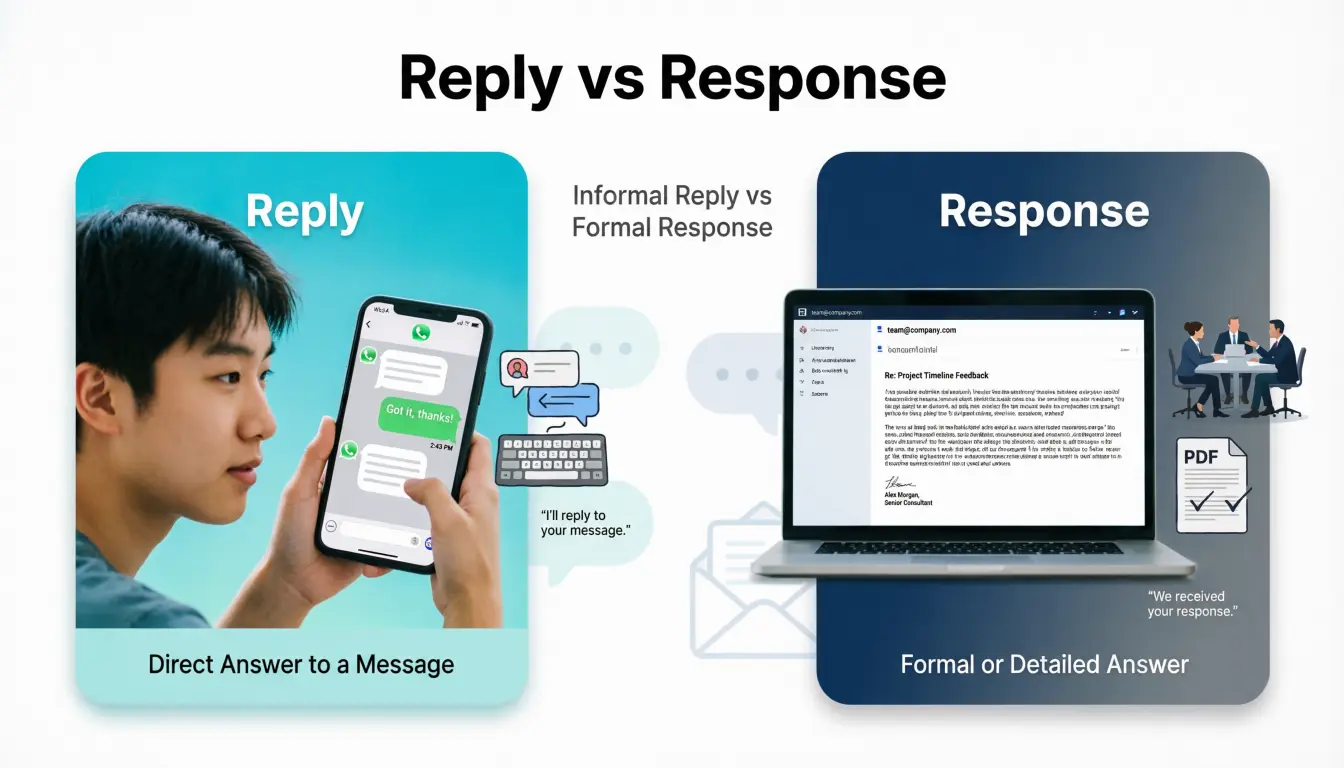
“Reply” and “response” are both correct words, but they are used slightly differently. “Reply” usually refers to a direct answer to a message, question, or communication, while “response” is a broader term meaning any reaction or answer to something, including actions as well as words.
Have you ever received an email and wondered if you should send a reply or a response? Many English learners, writers, and professionals use these words as if they mean the same thing. While they are closely related, they are not always interchangeable.
People search for reply vs response because both words involve answering someone or reacting to something. However, the tone, context, and usage can differ. Understanding the difference helps you communicate more clearly in emails, business writing, academic work, and everyday conversations.
A reply is usually a direct answer to a message, question, or comment. A response is broader and can refer to any reaction, answer, or action taken because of an event or situation.
In this guide, you’ll learn the meaning, origin, usage, examples, common mistakes, style recommendations, and practical tips for choosing the right word. By the end, you’ll know exactly when to use reply and when response is the better choice.
Reply vs Response – Quick Answer
Reply = A direct answer to a question, email, text, or statement.
Response = Any answer, reaction, or action resulting from something.
Examples
- She sent a reply to my email.
- The company issued a response to the complaint.
- His reply was short and polite.
- The government’s response was immediate.
Quick Comparison
| Reply | Response |
| Direct answer | Broader reaction |
| Often used in communication | Used in communication and actions |
| Usually personal | Can be personal or organizational |
| Email reply | Emergency response |
The Origin of Reply vs Response
The word reply comes from the Latin word replicare, meaning “to fold back” or “answer back.” It entered English through Old French and has been used for centuries to describe a direct answer.
The word response comes from the Latin respondere, meaning “to answer” or “promise in return.” It entered English later and developed a wider meaning.
Why the Difference Exists
Although both words relate to answering, English evolved so that:
- Reply became associated with direct communication.
- Response expanded to include reactions, feedback, behavior, and official statements.
This is why a person sends a reply, while a government may issue a response.
British English vs American English Spelling
Unlike words such as analysed and analyzed, reply and response have the same spelling in both British and American English.
Comparison Table
| Feature | British English | American English |
| Reply | Reply | Reply |
| Response | Response | Response |
| Meaning Difference | Same | Same |
| Pronunciation | Similar | Similar |
There is no spelling variation between the two forms.
Which Word Should You Use?
Choosing between reply and response depends on your audience and context.
Use Reply When:
- Answering emails
- Responding to text messages
- Replying to comments
- Answering questions
Examples
- Please send your reply by Friday.
- I received her reply yesterday.
Use Response When:
- Discussing reactions
- Talking about policies
- Describing behavior
- Writing formally
Examples
- The company released a response.
- The patient’s response to treatment was positive.
For Global Audiences
Both words are understood worldwide. Simply choose the one that best fits the situation.
Common Mistakes with Reply vs Response
Many writers confuse these words because they both involve answering.
Mistake #1: Using Reply for a General Reaction
❌ The government’s reply to the crisis was effective.
✅ The government’s response to the crisis was effective.
Mistake #2: Using Response for a Simple Email Answer
❌ Thank you for your response to my email.
✅ Thank you for your reply to my email.
(Although “response” is not wrong, “reply” sounds more natural.)
Mistake #3: Assuming They Always Mean the Same Thing
❌ Every reply is a response, and every response is a reply.
✅ Every reply is a type of response, but not every response is a reply.
Reply vs Response in Everyday Examples
Email Communication
- Thank you for your reply.
- I am waiting for your reply.
News Reporting
- The minister issued a response.
- The company released an official response.
Social Media
- She posted a funny reply.
- Users’ responses were mostly positive.
Formal Writing
- The committee’s response addressed the concerns.
- His reply answered all questions.
Reply vs Response – Google Trends & Usage Data
Google search behavior shows that both terms are widely used, but in different contexts.
Reply
Most commonly searched alongside:
- Email reply
- Reply meaning
- Quick reply
- Auto reply
Popular in:
- Business communication
- Customer service
- Personal messaging
Response
Frequently searched with:
- Response meaning
- Emergency response
- Customer response
- Government response
Popular in:
- News articles
- Healthcare
- Business reports
- Academic writing
Usage Comparison
| Context | Reply | Response |
| Emails | Very Common | Common |
| Text Messages | Very Common | Rare |
| News | Rare | Very Common |
| Business Reports | Common | Very Common |
| Academic Writing | Common | Very Common |
Reply vs Response Comparison Table
| Feature | Reply | Response |
| Meaning | Direct answer | Answer or reaction |
| Scope | Narrow | Broad |
| Communication | Primary use | Common use |
| Action/Reactions | Rare | Common |
| Formality | Neutral | Often formal |
| Email Usage | Very common | Less common |
| Official Statements | Less common | Very common |
Reply vs Response in Academic Writing
Academic writing often favors response because it sounds broader and more analytical.
Examples
- The participants’ response indicated strong agreement.
- The study examined students’ responses to feedback.
Reply is usually used when discussing direct communication.
Examples
- The researcher received a reply from participants.
Academic Preference
| Situation | Preferred Word |
| Survey reaction | Response |
| Experimental reaction | Response |
| Email communication | Reply |
| Interview answer | Reply or Response |
Reply vs Response in Business English
Business professionals use both words regularly.
Reply Examples
- Please send your reply by Monday.
- We appreciate your quick reply.
Response Examples
- Customer response was positive.
- The company’s response addressed concerns.
Business Comparison
| Situation | Best Choice |
| Email answer | Reply |
| Customer feedback | Response |
| Official statement | Response |
| Direct question | Reply |
Common Style Guide Recommendations
Most major style guides do not prohibit either word. Instead, they recommend choosing the term that best fits the context.
General Guidance
- Use reply for direct answers.
- Use response for broader reactions.
- Avoid switching between them unnecessarily.
- Maintain consistency throughout a document.
Real Examples from Published Sources
Reply
- “Please reply by return mail.”
- “Thank you for your reply.”
Response
- “The company issued a response to allegations.”
- “Public response was overwhelmingly positive.”
These examples show how reply usually involves direct communication, while response often refers to broader reactions.
Quiz: Reply vs Response
Choose the correct word.
1.
I received her email ______.
A. reply
B. response
Answer: A. reply
2.
The government’s ______ was immediate.
A. reply
B. response
Answer: B. response
3.
Thank you for your quick ______.
A. reply
B. response
Answer: A. reply
4.
Customer ______ was positive.
A. reply
B. response
Answer: B. response
5.
He wrote a detailed ______ to my question.
A. reply
B. response
Answer: A. reply
Fill in the Blanks Exercise
Choose reply or response.
- Thank you for your quick ______.
- The hospital’s ______ was efficient.
- I am waiting for her ______.
- Public ______ was largely favorable.
- Please send your ______ before Friday.
Answers
- reply
- response
- reply
- response
- reply
FAQs
1. Is reply the same as response?
Not exactly. A reply is a direct answer, while a response can be any reaction or answer.
2. Which word is more formal?
Response is generally considered more formal and broader in meaning.
3. Can I use response in an email?
Yes, but reply often sounds more natural for everyday email communication.
4. Is every reply a response?
Yes. Every reply is a response, but not every response is a reply.
5. Which word is better in business writing?
Both are correct. Use reply for direct communication and response for reactions or official statements.
6. Is response used in academic writing?
Yes. Academic writing frequently uses response when discussing reactions, results, or feedback.
7. Which word is more common in news reports?
Response is much more common because it covers reactions and official statements.
8. Can governments issue replies?
They can, but response is usually the preferred word in formal reporting.
9. Which word should I use in customer service?
Use reply for direct communication and response when discussing customer reactions or feedback.
Conclusion
Understanding reply vs response can improve your writing and communication. Although both words involve answering something, they are not always interchangeable. A reply is usually a direct answer to a message, question, or comment. A response is broader and includes reactions, feedback, actions, and official statements.
In everyday communication, especially emails and text messages, reply is often the most natural choice. In professional, academic, business, and news contexts, response is frequently preferred because it covers a wider range of reactions and actions.
The good news is that both words are accepted in British English, American English, and international English without any spelling differences. The key is choosing the word that best matches your situation. If you’re answering someone directly, use reply. If you’re describing a reaction, policy, behavior, or broader answer, use response.
By applying these simple guidelines, you’ll communicate more clearly, sound more professional, and avoid one of the most common vocabulary mistakes in modern English.

I am an Emily Carter Brooks U.S.A based linguistics writer known for my clear, reader-friendly explanations of English grammar and vocabulary differences. I have contributed to multiple online language resources and specializes in spelling variations, pronunciation confusion, and British vs American English comparisons. I’m passionate about helping learners improve their English through practical, everyday communication. engaging, and stress-free.