“Bicep” refers to one upper-arm muscle (singular), while “biceps” can refer to the muscle as a whole or both upper-arm muscles (plural/common form).
You are not alone if you have searched “bicep or biceps” and felt confused. Many people hear both words in gyms, fitness videos, and everyday talk. One trainer may say, “Work your biceps,” while another says, “Build your bicep.” So which one is right?
The confusion happens because both words are used, but they are not always used the same way. The difference is about singular and plural, not spelling. This matters in fitness writing, anatomy, workouts, and even casual speech.
If you are writing about exercise, muscle growth, or body parts, using the right form makes your writing clearer. It also helps you sound more natural to native English speakers.
In this guide, you will learn the quick answer, the history of the word, British and American English usage, common mistakes, and real-life examples. By the end, you will know exactly when to use bicep and when to use biceps.
Bicep or Biceps – Quick Answer
The quick answer is simple:
- Bicep = one muscle (singular)
- Biceps = two muscles or the general muscle group (plural or collective)
Example:
✅ My left bicep is sore after lifting.
✅ I trained my biceps today.
Think of it like this:
- One arm muscle = bicep
- Both arm muscles = biceps
But in anatomy, biceps is also the formal name of the muscle, even when talking about one arm.
Example:
✅ The biceps muscle helps bend the elbow.
So in casual speech, “bicep” is common for one. In formal anatomy, “biceps” is often used.
The Origin of Bicep or Biceps
The word biceps comes from Latin.
It is made of:
- bi = two
- ceps = heads
So biceps means “two-headed.”
This makes sense because the biceps muscle has two points of origin in the upper arm.
The full anatomical name is biceps brachii. This muscle sits on the front of the upper arm and helps move the arm.
Over time, English speakers shortened it.
Instead of saying:
“The biceps muscle”
People started saying:
“My bicep hurts.”
That is how bicep became common in everyday English.
So:
- Biceps = original Latin-based form
- Bicep = modern shortened singular form
That is why both exist today.
British English vs American English Spelling
Here is the important part:
This is not a British vs American spelling issue.
Unlike words like “colour” and “color,” both British and American English use the same forms:
- bicep
- biceps
The difference is grammar, not region.
| Usage | American English | British English |
| One muscle | bicep | bicep |
| Two muscles | biceps | biceps |
| Anatomical term | biceps | biceps |
Examples in American English:
✅ He injured his bicep.
✅ His biceps are strong.
Examples in British English:
✅ He pulled a bicep muscle.
✅ His biceps look bigger.
So there is no spelling battle here. It is only about singular and plural use.
Which Spelling Should You Use?
The right choice depends on your audience.
Use “bicep” if:
- You mean one muscle
- You write casually
- Your audience is gym-goers
- You want simple wording
Example:
“My right bicep feels tight.”
Use “biceps” if:
- You mean both muscles
- You write medical content
- You write fitness guides
- You want formal accuracy
Example:
“The biceps are used in pulling movements.”
Best advice by audience:
| Audience | Best Choice |
| US readers | bicep / biceps |
| UK readers | bicep / biceps |
| Medical readers | biceps |
| Fitness readers | both work |
| Global audience | use based on meaning |
Rule:
Use bicep for one.
Use biceps for both or formal anatomy.
Common Mistakes with Bicep or Biceps
People often mix them up.
Here are common mistakes:
Mistake 1: Using biceps as singular in casual writing
❌ My biceps is sore.
✅ My bicep is sore.
Better:
✅ My biceps are sore.
Mistake 2: Using bicep for both arms
❌ I trained my bicep today.
✅ I trained my biceps today.
Mistake 3: Wrong possessive form
❌ My biceps’s size increased.
✅ My biceps’ size increased.
Mistake 4: Wrong plural
❌ Bicepses
✅ Biceps
The plural stays the same.
Mistake 5: Mixing anatomy and casual speech
Formal:
✅ The biceps brachii contracts.
Casual:
✅ My bicep is bigger now.
Bicep or Biceps in Everyday Examples
Here is how people use these words in real life.
In emails
“Hi coach, my left bicep hurts after curls.”
In news
“The athlete suffered a torn biceps during training.”
On social media
“Arm day done. My biceps are on fire!”
In formal writing
“The biceps muscle supports elbow flexion.”
In casual conversation
“My bicep feels pumped.”
In fitness plans
“Focus on biceps with hammer curls.”
Bicep or Biceps / Google Trends & Usage Data
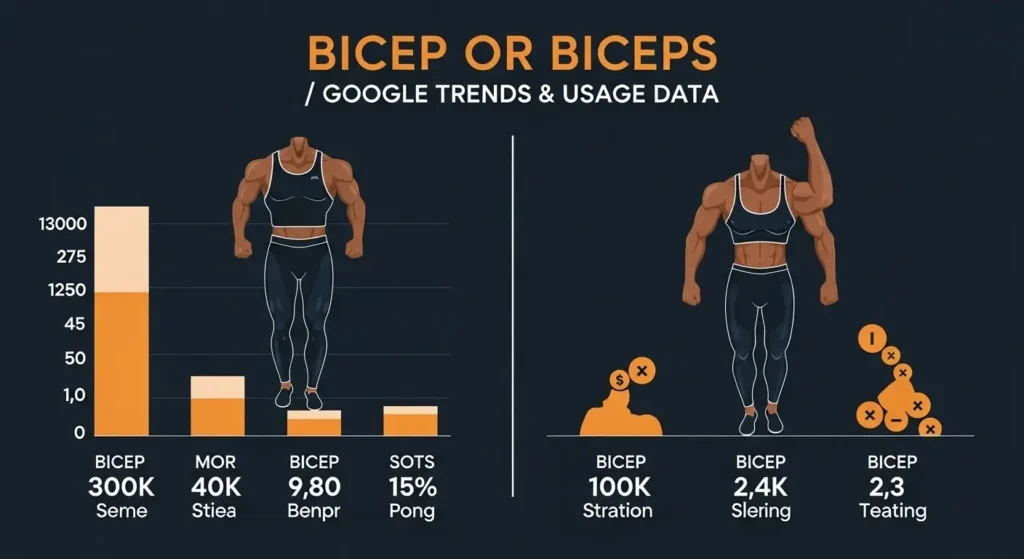
Search data shows that both words are popular, but they are used in different ways.
Biceps is searched more often because:
- fitness plans talk about both arms
- anatomy books use it
- workout routines target biceps
Bicep is also common because:
- people talk about one arm
- injury searches often use singular
- gym talk is casual
Popular countries searching these terms:
- United States
- United Kingdom
- Canada
- Australia
- India
Usage context:
| Word | Main Use |
| bicep | single muscle, casual |
| biceps | plural, anatomy, fitness |
In workout articles, biceps is more common.
In personal stories, bicep appears more.
Bicep vs Biceps Comparison Table
| Word | Type | Meaning | Example |
| bicep | singular noun | one arm muscle | My bicep hurts |
| biceps | plural noun | both arm muscles | My biceps are sore |
| biceps | anatomical noun | one muscle formally | The biceps contracts |
FAQs About Bicep or Biceps
Is bicep a real word?
Yes. It is a correct informal singular word.
Is biceps singular or plural?
It can be both. In anatomy, it can name one muscle. In common use, it often means plural.
Should I say bicep curl or biceps curl?
Both are used, but bicep curl is more common.
Why is it called biceps?
Because the muscle has two heads.
Can I say my biceps hurts?
No. Say:
“My bicep hurts”
or
“My biceps hurt”
Which is more formal?
Biceps is more formal.
Which word is better for fitness blogs?
Use both correctly based on meaning.
Do British people say bicep?
Yes, just like Americans.
Conclusion
The difference between bicep or biceps is easier than many people think. It is not about right or wrong spelling. It is about how many muscles you mean and how formal your writing is.
Use bicep when talking about one muscle in casual speech. For example, “My bicep is sore” sounds natural and clear. Use biceps when talking about both arms or when writing in fitness, anatomy, or medical contexts.
Remember that biceps is the original word from Latin, meaning “two-headed.” That is why it remains the formal term in anatomy. But everyday English has made bicep normal for singular use.
If your audience is general readers, gym users, or social media followers, “bicep” is easy and natural. If your audience is professional, academic, or medical, “biceps” is usually the safer choice.
The best rule is simple:
One muscle = bicep. Two muscles or formal term = biceps.
That rule will keep your writing correct and clear every time.

I hold a degree in English Literature and Linguistics and have worked extensively on educational blogs, comparison websites, and digital learning platforms. My writing focuses on simplifying complex language rules, highlighting British vs American English differences, and providing practical examples for everyday usage.