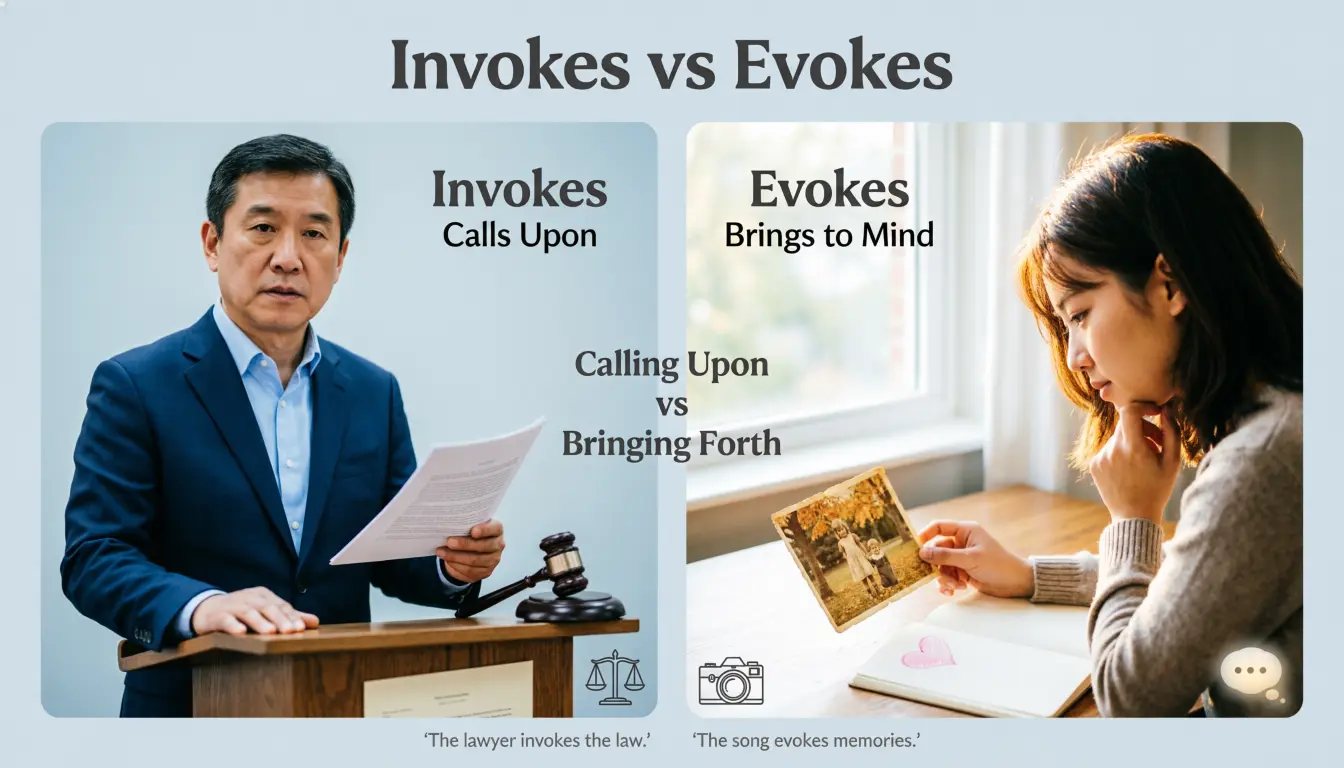
“Invokes” means to call upon, appeal to, or bring something into effect, while “evokes” means to bring a feeling, memory, image, or response to mind.
Many English learners and writers get confused by invokes vs evokes because the two words look similar and are often used in formal writing. At first glance, they seem interchangeable, but they have different meanings and uses.
People search for invokes vs evokes when writing essays, emails, business reports, academic papers, or creative content. Using the wrong word can change the meaning of a sentence and make your writing less clear.
The good news is that the difference is easy to understand. Invoke usually means to call upon, appeal to, or bring something into effect. Evoke means to bring a memory, feeling, image, or reaction to mind.
For example:
- The lawyer invoked a constitutional right.
- The old photograph evoked memories of childhood.
This guide explains the meanings, origins, usage differences, common mistakes, examples, and popularity trends of both words. By the end, you will know exactly when to use invoke and when to use evoke with confidence.
Invokes vs Evokes – Quick Answer
The difference is simple:
| Word | Meaning | Example |
| Invoke | To call upon, appeal to, or activate something | She invoked her right to remain silent. |
| Evoke | To bring feelings, memories, or images to mind | The song evoked memories of summer vacations. |
Quick Rule
- Use invoke when you are calling on something for help, authority, protection, or effect.
- Use evoke when something creates an emotion, memory, image, or feeling.
Examples
✅ The company invoked a clause in the contract.
✅ The painting evoked feelings of peace.
The Origin of Invokes vs Evokes
Although these words sound alike, they come from different Latin roots.
Origin of Invoke
Invoke comes from the Latin word invocare, which means “to call upon.”
It combines:
- in- = upon
- vocare = to call
Historically, people used invoke when calling upon gods, spiritual powers, laws, or authority figures.
Examples:
- Invoke divine protection.
- Invoke legal rights.
- Invoke a rule or policy.
Origin of Evoke
Evoke comes from the Latin word evocare, meaning “to call out” or “bring forth.”
It combines:
- e- = out
- vocare = to call
Over time, the word developed the meaning of bringing thoughts, memories, emotions, or images into the mind.
Examples:
- Evoke nostalgia.
- Evoke sympathy.
- Evoke excitement.
Why the Confusion Exists
Both words come from forms of the Latin verb vocare (“to call”), which is why they look and sound similar. However, their meanings developed in different directions.
- Invoke = call upon something.
- Evoke = call forth a reaction.
British English vs American English Spelling
Unlike many English word pairs, invoke and evoke do not have different spellings in British and American English.
Both forms are spelled exactly the same worldwide.
Comparison Table
| Meaning | British English | American English |
| Call upon authority | Invoke | Invoke |
| Activate a rule | Invoke | Invoke |
| Bring memories to mind | Evoke | Evoke |
| Create emotions | Evoke | Evoke |
Examples
British English:
- The government invoked emergency powers.
- The speech evoked national pride.
American English:
- The company invoked federal regulations.
- The movie evoked strong emotions.
The spelling remains unchanged in both varieties of English.
Which Spelling Should You Use?
Since there is no spelling difference, the real question is which word fits your meaning.
For US Audiences
Use:
- Invoke for rights, laws, powers, authority, or rules.
- Evoke for feelings, memories, and emotions.
For UK Audiences
The same rule applies.
Examples:
- Invoke a legal precedent.
- Evoke a sense of history.
For International Audiences
Choose based on meaning rather than location.
Ask yourself:
Am I calling upon something?
→ Use invoke.
Am I creating a feeling or memory?
→ Use evoke.
This simple test works almost every time.
Common Mistakes with Invokes vs Evokes
Many writers accidentally swap these words.
Mistake 1: Using Invoke for Emotions
❌ The song invoked happy memories.
✅ The song evoked happy memories.
Reason: Memories are brought to mind, not called upon.
Mistake 2: Using Evoke for Legal Rights
❌ The defendant evoked his constitutional rights.
✅ The defendant invoked his constitutional rights.
Reason: Rights are called upon or activated.
Mistake 3: Assuming the Words Are Synonyms
❌ They can always replace each other.
✅ They have different meanings and should be chosen carefully.
Mistake 4: Using Invoke in Creative Descriptions
❌ The painting invoked sadness.
✅ The painting evoked sadness.
Mistake 5: Using Evoke for Rules
❌ The company evoked a contract clause.
✅ The company invoked a contract clause.
Invokes vs Evokes in Everyday Examples
Understanding real-life examples makes the difference easier.
Emails
Invoke
- We may invoke the warranty if the issue continues.
Evoke
- Your message evoked memories of our first project together.
News Articles
Invoke
- The president invoked emergency powers.
Evoke
- The memorial ceremony evoked strong emotions.
Social Media
Invoke
- Fans invoked the team’s historic achievements.
Evoke
- This photo evokes pure nostalgia.
In Academic Writing
Invoke
- The researcher invoked established theories.
Evoke
- The findings evoke questions about future studies.
In Business Writing
Invoke
- The contract allows either party to invoke arbitration.
Evoke
- The advertisement evokes trust and confidence.
Invokes vs Evokes – Google Trends & Usage Data
Search interest for invokes vs evokes remains steady because both words frequently appear in professional and academic writing.
Where Invoke Is Common
- Legal writing
- Government documents
- Business contracts
- Policy discussions
- Academic research
Countries where usage is common include:
- United States
- United Kingdom
- Canada
- Australia
Where Evoke Is Common
- Literature
- Journalism
- Marketing
- Creative writing
- Social media content
Countries where usage is common include:
- United States
- United Kingdom
- Canada
- Australia
- New Zealand
Usage Trend
In modern English:
- Invoke appears more often in formal and legal contexts.
- Evoke appears more often in emotional and creative contexts.
Both words remain important and widely used.
Invokes vs Evokes Comparison Table
| Feature | Invoke | Evoke |
| Main Meaning | Call upon | Bring to mind |
| Context | Legal, formal, authority | Emotional, creative |
| Refers To | Rights, rules, powers | Feelings, memories |
| Tone | Formal | Descriptive |
| Common Use | Invoke a law | Evoke nostalgia |
| Business Writing | Very common | Common |
| Creative Writing | Less common | Very common |
| Academic Writing | Common | Common |
FAQs
1. What is the main difference between invoke and evoke?
Invoke means to call upon or activate something, while evoke means to bring memories, feelings, or images to mind.
2. Can invoke and evoke be used interchangeably?
No. They have different meanings and should not normally replace each other.
3. Is invoke a legal term?
Yes. It is often used in legal, governmental, and policy-related writing.
4. Is evoke mainly used for emotions?
Yes. Evoke is commonly used when discussing emotions, memories, and imagery.
5. Which word should I use for memories?
Use evoke.
Example:
- The photograph evoked memories of childhood.
6. Which word should I use for rights?
Use invoke.
Example:
- She invoked her constitutional rights.
7. Do British and American English spell these words differently?
No. The spelling is identical in both forms of English.
8. Can a speech evoke emotions and invoke authority?
Yes.
Example:
- The speech invoked historical principles and evoked national pride.
9. Which word is more formal?
Invoke is generally more formal because it often appears in legal and official contexts.
Conclusion
The distinction between invokes vs evokes is easier than it first appears. While both words share a similar history and come from related Latin roots, they serve different purposes in modern English.
Use invoke when you are calling upon something such as a law, rule, authority, right, power, or principle. It is common in legal documents, business contracts, government communications, and formal discussions. Think of it as activating or appealing to something that already exists.
Use evoke when you want to describe something that creates an emotion, memory, image, or feeling. It is especially common in storytelling, journalism, marketing, social media, and creative writing. Think of it as bringing thoughts or emotions to the surface.
A helpful memory trick is this: invoke calls upon, evoke calls forth. If you are activating authority, choose invoke. If you are creating a feeling or memory, choose evoke.
Understanding this difference will make your writing clearer, more professional, and easier for readers to understand.
People also search For:
Invokes vs Evokes Meaning
The difference between invokes and evokes lies in intention. Invoke means to deliberately call upon, request, or bring something into effect, while evoke means to bring a memory, feeling, or image to mind. For example, a speaker may invoke authority, but a story can evoke emotions.
Evoke or Invoke Feelings
When talking about emotions, evoke feelings is usually the correct phrase. A movie, song, or photograph can evoke happiness, sadness, or nostalgia. Although people sometimes say “invoke feelings,” evoke is more natural because it refers to creating an emotional response.
Invokes vs Evokes Examples
A simple way to remember the difference is through examples. The lawyer invoked a legal precedent means he intentionally cited it. The old photograph evoked childhood memories means it brought memories back to mind. One calls upon something; the other triggers a reaction.
Invokes vs Evokes Reddit Discussions
Many Reddit users discuss invokes vs evokes because the words sound similar but have different meanings. Most language enthusiasts agree that invoke is used for calling upon authority, rules, or spirits, while evoke is preferred when discussing emotions, memories, and imagery.
Evoke vs Invoke vs Provoke
While evoke, invoke, and provoke are related to causing reactions, they are not interchangeable. Invoke means to call upon something, evoke means to bring forth feelings or memories, and provoke means to intentionally trigger a reaction, often anger, debate, or conflict.
Invoke or Evoke a Response
Both phrases can be correct depending on context. You invoke a response when you formally call for or request one, while you evoke a response when something naturally causes people to react emotionally or mentally.
Invoke vs Evoke Spirits
In spiritual or supernatural contexts, invoke spirits is the standard expression because it means to call upon or summon them. Evoke spirits is less common and is generally used when referring to bringing the idea or presence of spirits to mind rather than actively summoning them.
Invoke or Evoke Fear
When discussing emotions, evoke fear is usually the preferred phrase because it means to create or inspire fear in someone. However, invoke fear may be used in formal writing when fear is intentionally used as a tool or strategy to influence behavior.

I hold a degree in English Literature and Linguistics and have worked extensively on educational blogs, comparison websites, and digital learning platforms. My writing focuses on simplifying complex language rules, highlighting British vs American English differences, and providing practical examples for everyday usage.