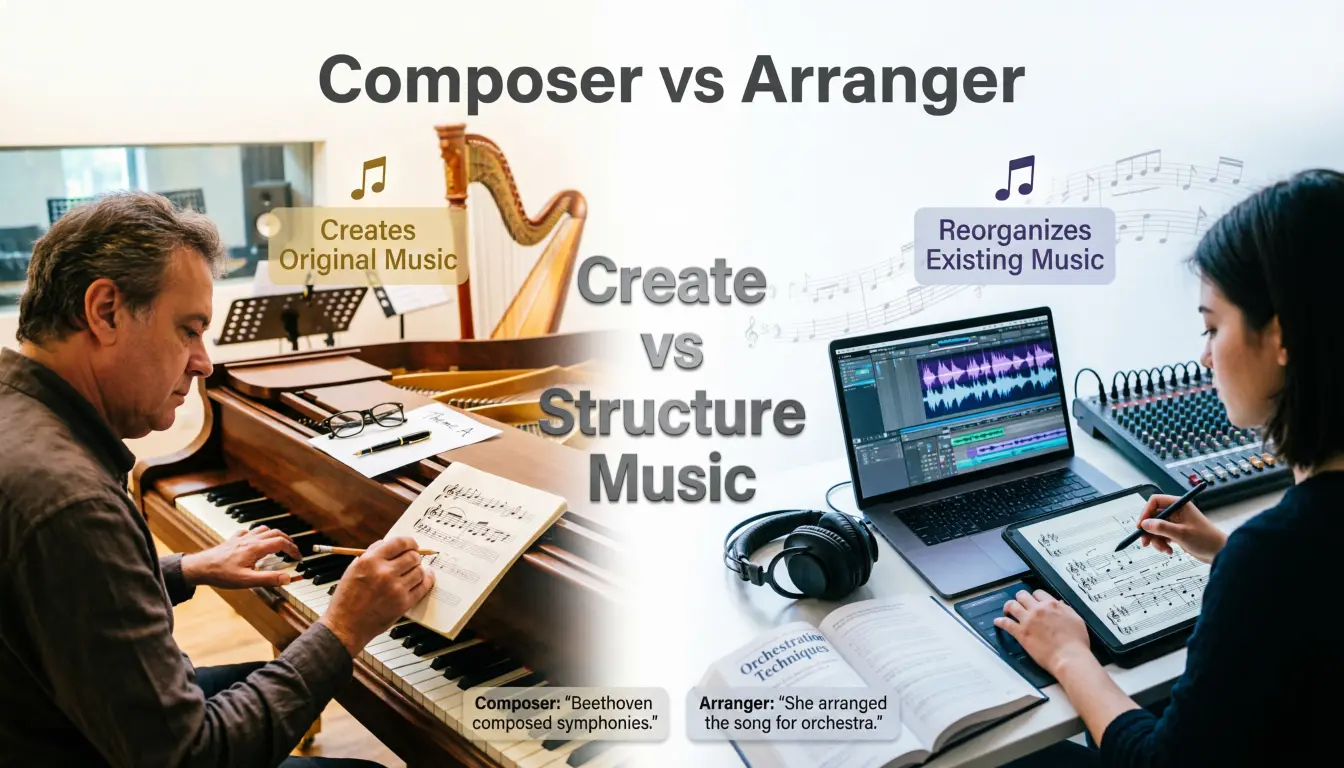
“Composer” and “arranger” are both correct musical terms, but they refer to different roles. “Composer” is a person who creates original music, while “arranger” is a person who takes existing music and adapts it for different instruments, styles, or performances.
Have you ever looked at the credits of a song, movie soundtrack, or musical performance and wondered about the difference between a composer and an arranger? Many people see both terms used together and assume they mean the same thing. However, they describe two very different roles in music.
The confusion often happens because composers and arrangers both work with musical pieces. A composer creates the original music, while an arranger adapts or reorganizes existing music for a different style, instrument, or performance setting.
Understanding the difference is important for musicians, students, music lovers, and anyone involved in creative projects. Knowing who wrote a piece and who transformed it can help you better appreciate the creative process behind music.
In this guide, we will explain composer vs arranger in simple terms, explore the history of both roles, examine common misconceptions, compare their responsibilities, and provide real-world examples. By the end, you will clearly understand when to use each term and why both are essential in music.
Composer vs Arranger – Quick Answer
A composer creates original music.
An arranger takes existing music and changes how it is presented without changing the core composition.
Examples
- A composer writes a new piano concerto from scratch.
- An arranger adapts that concerto for a jazz band.
- A composer creates a movie soundtrack.
- An arranger rewrites the soundtrack for a school orchestra.
| Composer | Arranger |
| Creates original music | Modifies existing music |
| Writes melodies and harmonies | Changes instrumentation and style |
| Starts the musical work | Adapts the musical work |
| Owns original composition rights | Usually receives arrangement credit |
The Origin of Composer vs Arranger
The word composer comes from the Latin word componere, meaning “to put together.” It has been used since the 16th century to describe someone who creates music.
The word arranger comes from the Old French word arangier, meaning “to organize” or “put in order.” In music, the term became common when musicians began adapting existing compositions for different instruments and ensembles.
Unlike spelling differences such as “analysed” and “analyzed,” composer and arranger are not alternative spellings. They are separate job titles with different responsibilities.
Historically, famous composers such as Johann Sebastian Bach, Wolfgang Amadeus Mozart, and Ludwig van Beethoven created original works. Later musicians often arranged these works for new audiences and instruments.
British English vs American English Spelling
Unlike many English word pairs, composer and arranger have the same spelling in both British and American English.
Comparison Table
| Term | British English | American English |
| Composer | Composer | Composer |
| Arranger | Arranger | Arranger |
| Meaning Change | No | No |
| Spelling Change | No | No |
Because there is no regional spelling variation, writers worldwide can use both words confidently.
Which Spelling Should You Use?
Since there are no spelling differences, the choice depends on the person’s role.
Use Composer When:
- Someone creates original music.
- Discussing songwriting and composition.
- Referring to music creators in films, games, or concerts.
Use Arranger When:
- Someone adapts existing music.
- Discussing orchestration changes.
- Referring to new versions of older songs.
For Global Audiences
Use the term that accurately describes the work performed:
- Original creator = Composer
- Musical adapter = Arranger
Common Mistakes with Composer vs Arranger
Many people mix these terms because both contribute to music production.
Incorrect
❌ The arranger wrote the entire original symphony.
Correct
✅ The composer wrote the symphony, and the arranger adapted it for a brass band.
Incorrect
❌ The composer rearranged the song for a jazz ensemble.
Better
✅ The arranger rearranged the song for a jazz ensemble.
Incorrect
❌ Composer and arranger always mean the same thing.
Correct
✅ A composer creates music, while an arranger modifies existing music.
Composer vs Arranger in Everyday Examples
“The composer delivered the final score yesterday.”
“The arranger completed the orchestral adaptation today.”
News Article
“The composer won an award for the original soundtrack.”
“The arranger received recognition for transforming the piece into a modern jazz version.”
Social Media
“Our composer just finished a brand-new song!”
“Shoutout to our arranger for creating this amazing acoustic version.”
Formal Writing
“The composer developed the thematic material, while the arranger prepared the work for chamber ensemble performance.”
Composer vs Arranger – Google Trends & Usage Data
Search interest in composer and arranger often depends on context.
Composer Searches
People commonly search for:
- Famous composers
- Film composers
- Music composition
- Classical music creators
Arranger Searches
People often search for:
- Music arrangement
- Orchestration
- Song adaptation
- Band and choir arrangements
Popular Countries
Interest in composers is especially strong in:
- United States
- United Kingdom
- Germany
- Austria
- Italy
Interest in arrangers is often higher among:
- Music students
- Band directors
- Choir leaders
- Professional musicians
Composer vs Arranger Comparison Table
| Feature | Composer | Arranger |
| Creates original music | Yes | No |
| Adapts existing music | Rarely | Yes |
| Writes melodies | Yes | Sometimes |
| Changes instrumentation | Sometimes | Frequently |
| Receives composition credit | Yes | No |
| Receives arrangement credit | No | Yes |
| Works from scratch | Yes | Usually not |
Composer vs Arranger in Academic Writing
Academic music writing requires precise terminology.
Examples:
“The composer established the harmonic structure of the work.”
“The arranger modified the orchestration for educational performance.”
Using the correct term improves clarity and demonstrates understanding of music theory and history.
Composer vs Arranger in Business English
The music industry uses these terms in contracts, licensing, and project documentation.
Composer
Often credited for:
- Original scores
- Soundtracks
- Commercial jingles
- Video game music
Arranger
Often credited for:
- Adaptations
- Orchestral reductions
- Cover versions
- Educational editions
Accurate terminology is important when discussing royalties and intellectual property.
Common Style Guide Recommendations
Most music publishers and academic organizations recommend:
- Use composer for original creators.
- Use arranger for adaptations.
- Credit both when both contributed.
- Avoid using the terms interchangeably.
Consistency improves professional communication.
Real Examples from Published Sources
Classical Music
Beethoven is credited as the composer of Symphony No. 5.
Many later musicians created arrangements of the symphony for piano, brass ensembles, and chamber groups.
Film Music
A film composer writes the original score.
An arranger may adapt that score for live concert performances.
Popular Music
A songwriter may compose a song.
An arranger may transform it into an acoustic, orchestral, or jazz version.
Composer vs Arranger Quiz
Choose the correct answer.
1. Who creates original music?
A. Arranger
B. Composer
✅ Answer: B
2. Who adapts existing music?
A. Arranger
B. Composer
✅ Answer: A
3. Which role often changes instrumentation?
A. Composer
B. Arranger
✅ Answer: B
4. Who writes a new symphony from scratch?
A. Composer
B. Arranger
✅ Answer: A
5. Which term describes a musical adapter?
A. Composer
B. Arranger
✅ Answer: B
Fill in the Blanks Exercise
- The ______ created the original soundtrack.
Answer: composer
- The ______ adapted the piece for a jazz band.
Answer: arranger
- Beethoven was a famous ______.
Answer: composer
- The ______ changed the instrumentation for choir performance.
Answer: arranger
- Original music is written by a ______.
Answer: composer
Frequently Asked Questions
1. What is the main difference between a composer and an arranger?
A composer creates original music, while an arranger adapts existing music.
2. Can one person be both a composer and an arranger?
Yes. Many musicians compose original works and arrange music for different performances.
3. Does an arranger own the original composition?
Usually no. The original composition belongs to the composer or rights holder.
4. Are composers more important than arrangers?
No. Both play valuable roles in music creation and performance.
5. Do arrangers write new melodies?
Sometimes they may add material, but the original composition remains the composer’s work.
6. Are composers and songwriters the same?
Not always. A songwriter often writes lyrics and music, while a composer may create instrumental works.
7. Why are arrangers needed?
They adapt music for different instruments, performers, audiences, and styles.
8. Can classical music be arranged?
Yes. Many classical works have been arranged for modern ensembles and educational groups.
9. Do music credits usually list both roles?
Yes, when both contributed significantly to the final performance version.
Conclusion
Understanding composer vs arranger is essential for anyone studying, performing, or enjoying music. Although both roles involve creativity and musical expertise, they serve different purposes. A composer creates the original musical work, including melodies, harmonies, and overall structure. An arranger takes that work and adapts it for different instruments, styles, or performance settings.
The distinction matters in academic writing, music publishing, performance credits, and professional communication. Using the correct term helps avoid confusion and gives proper recognition to the people involved in creating and shaping music.
Remember a simple rule: if someone writes the music from scratch, they are the composer. If someone changes how that music is presented, they are the arranger. Many musicians perform both roles, but the responsibilities remain distinct.
If you are reading concert programs, studying music theory, writing about music, or working in the industry, knowing the difference between a composer and an arranger will help you communicate accurately and professionally.

I hold a degree in English Literature and Linguistics and have worked extensively on educational blogs, comparison websites, and digital learning platforms. My writing focuses on simplifying complex language rules, highlighting British vs American English differences, and providing practical examples for everyday usage.