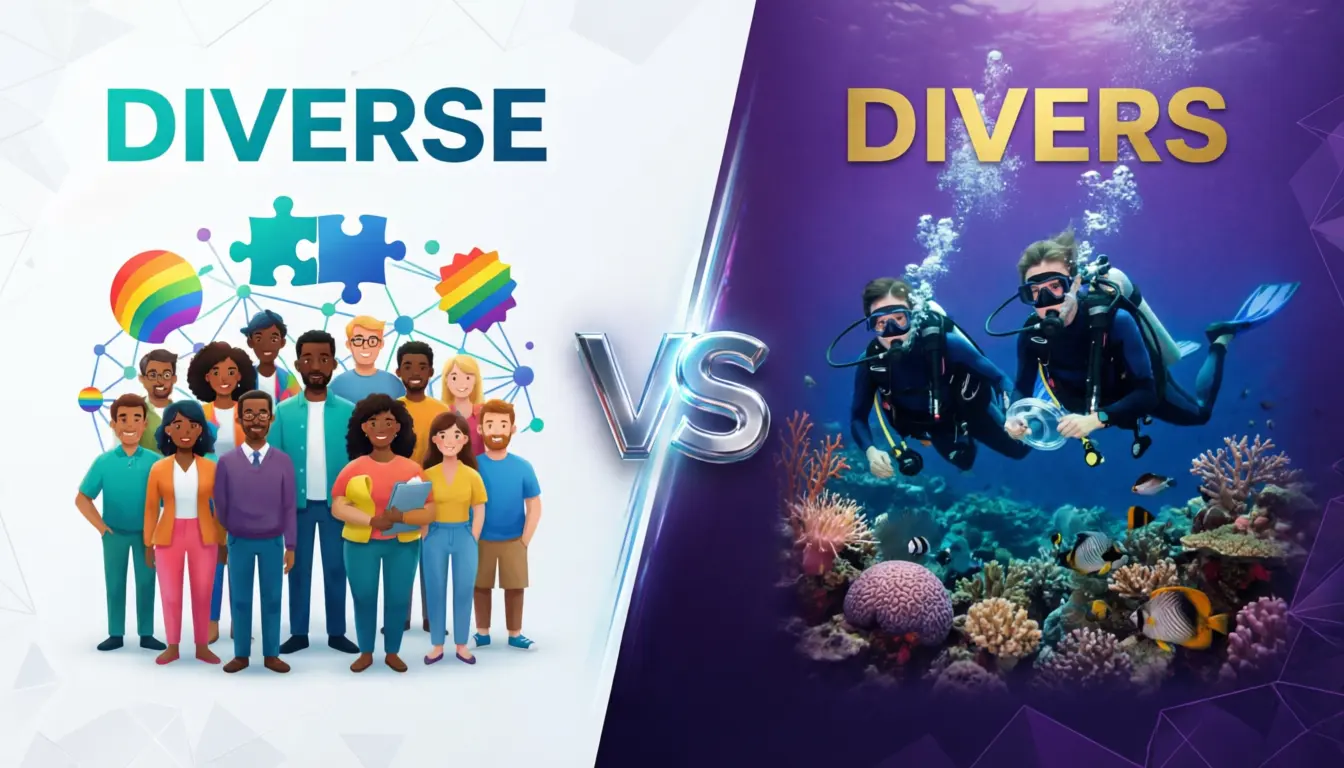
“Diverse” is an adjective meaning showing variety or differences, while “divers” is an older word meaning several or various, now mostly used in formal or literary English.
Many English learners and writers search for “diverse vs divers” because the two words look similar and share the same root. At first glance, they may seem like spelling variants of the same word. However, they have different meanings and uses in modern English.
The confusion often happens in formal writing, school essays, business emails, and online posts. Some people see the word divers in old books, legal writing, or historical texts and think it is a typo for diverse. Others wonder if one spelling is British English while the other is American English.
In reality, diverse is the common modern adjective used to describe variety or difference. The word divers is much older and is now rare in everyday English. It mainly appears in historical, literary, or formal legal contexts.
This guide explains the meaning, history, spelling rules, usage examples, common mistakes, and global trends for diverse vs divers. By the end, you will know exactly which word to use in modern writing and when the older term may still appear.
Diverse vs Divers – Quick Answer
Diverse means showing variety or many different types.
Divers is an old-fashioned word that means several or various.
Examples
- The city has a diverse population.
- Our team includes people from diverse backgrounds.
- The old document mentioned divers reasons for the decision.
Quick Rule
- Use diverse in modern English.
- Use divers only when quoting old texts or writing in an old-fashioned style.
| Word | Meaning | Modern Use |
| Diverse | Different, varied | Very common |
| Divers | Several, various | Rare and old-fashioned |
The Origin of Diverse vs Divers
The words diverse and divers come from the Latin word diversus, meaning “different” or “turned in different directions.”
Origin of Diverse
The word diverse entered Middle English through Old French. Over time, it became the standard adjective for describing variety and difference.
Today, it is widely used in:
- Education
- Business
- Politics
- Media
- Social discussions
Origin of Divers
The word divers was common in Middle English and Early Modern English. Writers used it to mean “many” or “several.”
For example:
- “Divers people attended the meeting.”
- “Divers opinions were shared.”
You may still see it in:
- Historical books
- Religious texts
- Legal language
- Classical literature
Over time, diverse replaced divers in normal conversation and writing.
British English vs American English Spelling
Unlike words such as colour/color or organise/organize, diverse and divers are not British and American spelling variations.
Both British English and American English use diverse as the standard modern word.
The word divers is considered old-fashioned in both regions.
Examples
| Region | Preferred Modern Word | Notes |
| United Kingdom | Diverse | Standard usage |
| United States | Diverse | Standard usage |
| Canada | Diverse | Standard usage |
| Australia | Diverse | Standard usage |
| Historical English | Divers | Old literary form |
Example Sentences
British English
- Britain has a diverse culture.
American English
- The United States has a diverse population.
Historical Style
- The king received petitions from divers citizens.
Which Spelling Should You Use?
Your choice depends on your audience and purpose.
Use “Diverse” For:
- Modern writing
- Academic essays
- Business communication
- Websites and blogs
- Social media
- News articles
Use “Divers” Only For:
- Historical writing
- Literary effect
- Quotations from old texts
- Legal or religious archives
Audience-Based Advice
| Audience | Best Choice |
| American readers | Diverse |
| British readers | Diverse |
| Commonwealth countries | Diverse |
| International audience | Diverse |
| Historical fiction readers | Divers may work |
Professional Advice
If you are unsure, always choose diverse. It is the safe and correct modern option.
Common Mistakes with Diverse vs Divers
Many writers misuse these words because they sound related.
Mistake 1: Using Divers in Modern Writing
❌ Our company has a divers workforce.
✅ Our company has a diverse workforce.
Mistake 2: Thinking Divers Is British English
❌ Divers is the UK spelling.
✅ Diverse is standard in both UK and US English.
Mistake 3: Confusing Divers with Divers (People Who Dive)
The noun divers can also mean people who dive underwater.
Example
- The scuba divers explored the reef.
This meaning is completely different from the old adjective divers.
Mistake 4: Using Diverse as a Noun
❌ We hired many diverse.
✅ We hired people from diverse backgrounds.
Diverse vs Divers in Everyday Examples
Emails
- We want a diverse team with different skills.
- Our workplace supports diverse viewpoints.
News Writing
- The city is known for its diverse community.
- The festival welcomed people from diverse cultures.
Social Media
- I love meeting people from diverse backgrounds.
- Diverse voices make conversations better.
In Formal Writing
- The research included a diverse sample group.
- Students explored diverse learning methods.
In Historical Writing
- The council received divers complaints from citizens.
Diverse vs Divers – Google Trends & Usage Data
Search interest for diverse is much higher than for divers worldwide.
Why “Diverse” Is Popular
The word appears often in discussions about:
- Diversity and inclusion
- Education
- Hiring practices
- Culture
- Society
Countries with strong search interest include:
- United States
- United Kingdom
- Canada
- Australia
- India
Why “Divers” Is Rare
Modern searches for divers usually relate to:
- Scuba divers
- Diving sports
- Historical language questions
Very few people use divers as an adjective today.
Usage Trend Summary
| Word | Popularity | Common Context |
| Diverse | Very high | Modern English |
| Divers | Low | Historical or diving-related |
Comparison Table: Diverse vs Divers
| Feature | Diverse | Divers |
| Part of Speech | Adjective | Adjective |
| Meaning | Varied, different | Several, various |
| Modern Usage | Common | Rare |
| British English | Standard | Old-fashioned |
| American English | Standard | Old-fashioned |
| Formal Writing | Common | Rare |
| Historical Texts | Sometimes | Common |
| Everyday Speech | Yes | No |
FAQs About Diverse vs Divers
Is divers a real word?
Yes. Divers is a real English word, but it is old-fashioned when used to mean “several” or “various.”
Is divers the British spelling of diverse?
No. Both British and American English use diverse.
Which word is more common today?
Diverse is far more common in modern English.
Can divers mean scuba divers?
Yes. Divers is also the plural noun for people who dive underwater.
Should I use divers in essays?
Usually no. Use diverse unless you are discussing historical language.
Why do old books use divers?
Older English writing often used divers to mean “many” or “various.”
Is diverse formal or informal?
It works in both formal and informal writing.
Can diverse describe people?
Yes. It can describe groups, cultures, communities, ideas, and experiences.
Is divers incorrect today?
Not completely, but it sounds outdated in normal writing.
Conclusion
The difference between diverse vs divers is mainly about modern versus historical usage. Today, diverse is the standard English word used to describe variety, difference, and inclusion. It appears in business, education, media, and everyday conversation across both British and American English.
The word divers, on the other hand, belongs mostly to older English. While it once meant “several” or “various,” modern readers rarely use it in daily communication. You may still find it in historical books, religious writing, legal documents, or literary works. It can also refer to people who dive underwater, which is a completely separate meaning.
For modern writing, the safest and clearest choice is almost always diverse. It sounds natural, professional, and easy to understand for global audiences. Unless you are quoting historical material or creating an old-fashioned tone, avoid using divers as an adjective.
Knowing the difference helps you write with confidence and avoid common language mistakes. Clear word choice always improves communication.

I hold a degree in English Literature and Linguistics and have worked extensively on educational blogs, comparison websites, and digital learning platforms. My writing focuses on simplifying complex language rules, highlighting British vs American English differences, and providing practical examples for everyday usage.