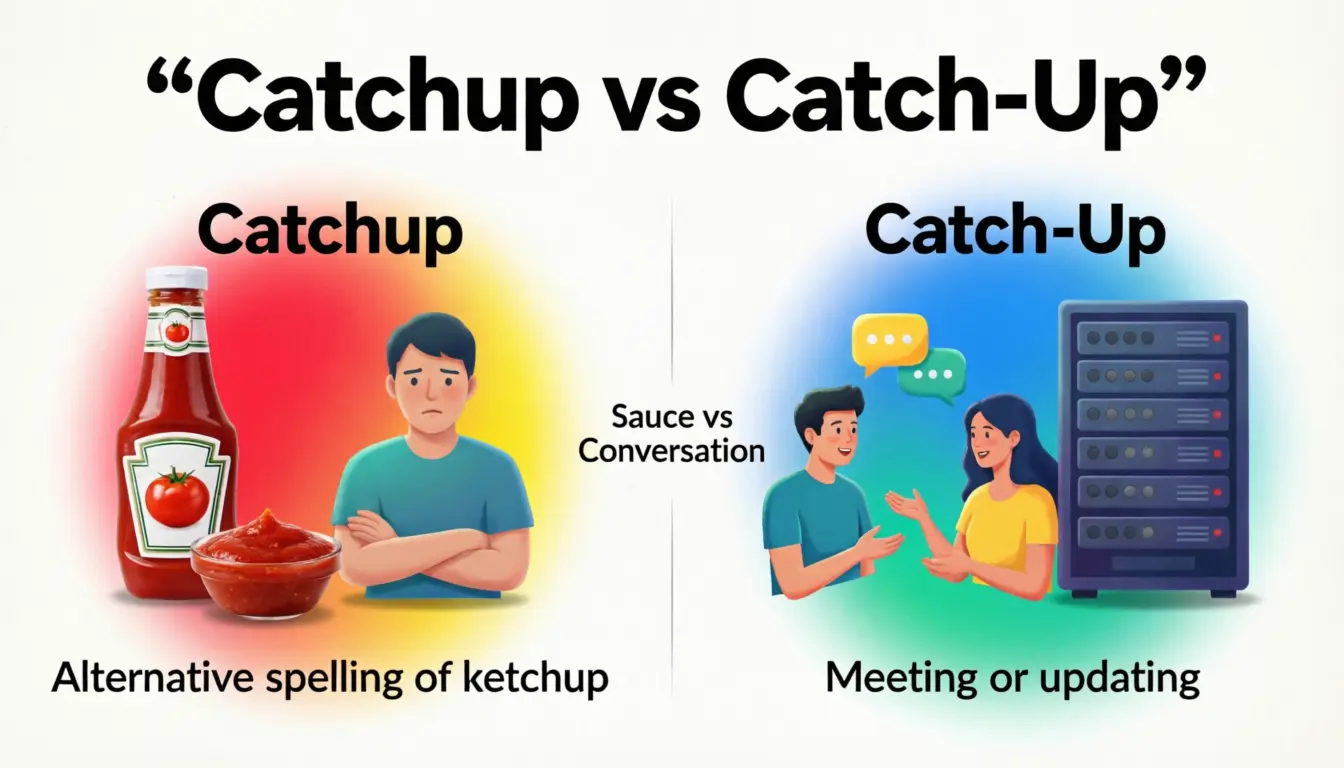
“Catch-up” is a noun or adjective meaning an update, meeting, or attempt to reach the same level as someone else, whereas “catchup” is sometimes used casually but is less accepted in formal writing.
Have you ever typed “let’s catchup tomorrow” and wondered if it should actually be “catch-up” or even “catch up”? You are not alone. Many English learners, writers, students, and professionals search for catchup vs catch-up because the words look similar but work differently in sentences.
The confusion happens because English often changes words depending on how they are used. Sometimes a phrase becomes one word, sometimes it needs a hyphen, and sometimes it stays as two separate words. That makes writing emails, social posts, blog articles, and business messages harder than expected.
This guide will help you fully understand the difference between catchup, catch-up, and catch up. You will learn which form is correct, when to use each version, and which spelling works best in American English, British English, and global writing.
By the end, you will know how to avoid common mistakes and write naturally in both casual and professional situations.
Catchup vs Catch-Up – Quick Answer
Here is the simple answer:
- Catch-up is the most common and correct noun or adjective form.
- Catch up is the correct verb phrase.
- Catchup is rare and usually considered informal or incorrect in modern writing.
Examples
| Form | Usage | Example |
| Catch up | Verb | “We need to catch up soon.” |
| Catch-up | Noun/Adjective | “Let’s have a catch-up meeting.” |
| Catchup | Rare variant | “We had a quick catchup.” |
Quick Rule
- Use catch up when talking about the action.
- Use catch-up when naming the event or thing.
- Avoid catchup in formal writing.
The Origin of Catchup vs Catch-Up
The phrase catch up first appeared in English as a verb phrase. It originally meant reaching the same level or position as someone else.
Early Meaning
People used “catch up” to describe:
- Moving fast enough to reach someone
- Completing unfinished work
- Sharing updates after time apart
Over time, English speakers began turning the phrase into a noun. That created the hyphenated form catch-up.
Why the Hyphen Appeared
English often uses hyphens when two words work together as one idea.
For example:
- check-in
- follow-up
- grown-up
- catch-up
The hyphen helps readers understand the words act together.
What About “Catchup”?
The single-word version catchup appeared later as an informal spelling. Some writers removed the hyphen because many English compound words eventually become one word over time.
Still, dictionaries and style guides mostly prefer catch-up today.
British English vs American English Spelling
Both British and American English generally prefer catch-up and catch up over catchup.
However, usage can slightly differ depending on style and publication.
American English
In the United States:
- “Catch up” is common as a verb
- “Catch-up” appears in business and media writing
- “Catchup” is less common
British English
In the United Kingdom:
- “Catch-up” is strongly preferred
- Newspapers and formal writing use the hyphen often
- “Catchup” looks informal or unusual
Comparison Table
| Version | American English | British English | Formal Writing | Casual Writing |
| Catch up | Very common | Very common | Yes | Yes |
| Catch-up | Common | Very common | Yes | Yes |
| Catchup | Rare | Rare | No | Sometimes |
Examples
American English
- “We should catch up next week.”
- “The team scheduled a catch-up session.”
British English
- “Parents attended a catch-up meeting at school.”
- “I need to catch up on my emails.”
Which Spelling Should You Use?
The best spelling depends on your audience and sentence structure.
Use “Catch Up” When Writing a Verb
Choose this form when describing an action.
Examples
- “I want to catch up with my friends.”
- “She stayed late to catch up on work.”
Use “Catch-Up” as a Noun or Adjective
Examples
Choose this form when naming an event, meeting, or session.
- “We had a catch-up call.”
- “The company held a catch-up meeting.”
Avoid “Catchup” in Professional Writing
Although some people use it online or in text messages, it is not the safest choice for:
- Business emails
- Academic papers
- Website content
- News writing
Best Advice by Audience
| Audience | Best Choice |
| US readers | catch up / catch-up |
| UK readers | catch up / catch-up |
| Global audience | catch up / catch-up |
| Informal texting | catchup possible |
| Professional writing | avoid catchup |
Common Mistakes with Catchup vs Catch-Up
Many writers mix these forms incorrectly. Here are the most common mistakes.
Mistake 1: Using “Catchup” in Formal Writing
❌ “We scheduled a catchup meeting.”
✅ “We scheduled a catch-up meeting.”
Mistake 2: Using a Hyphen with the Verb Form
❌ “Let’s catch-up tomorrow.”
✅ “Let’s catch up tomorrow.”
Mistake 3: Writing Two Words as a Noun
❌ “We had a catch up yesterday.”
✅ “We had a catch-up yesterday.”
Mistake 4: Mixing Styles in One Document
❌ “We should catchup later after the catch-up meeting.”
✅ “We should catch up later after the catch-up meeting.”
Consistency matters in professional writing.
Catchup vs Catch-Up in Everyday Examples
Understanding real-life usage makes the rule easier.
Emails
✅ “I would love to catch up next week.”
✅ “Let’s schedule a catch-up meeting.”
News Writing
✅ “The government announced a catch-up education program.”
Social Media Posts
✅ “Great catching up with old friends today!”
✅ “Weekend catch-up coffee with Sarah.”
In Workplace Communication
✅ “We need a quick catch-up before the presentation.”
✅ “I am trying to catch up on missed tasks.”
In Academic Writing
Formal writing usually prefers:
- catch up
- catch-up
Avoid:
- catchup
Catchup vs Catch-Up – Google Trends & Usage Data
Search trends show that people often look for:
- “catch up”
- “catch-up”
- “catchup”
This happens because users are unsure which form is correct.
Popularity by Usage
| Form | Popularity | Common Context |
| Catch up | Highest | Verbs and daily conversation |
| Catch-up | High | Meetings, business, education |
| Catchup | Low | Informal internet writing |
Countries Where “Catch-Up” Is More Common
The hyphenated version appears more often in:
- The United Kingdom
- Australia
- New Zealand
- Canada
Countries Where “Catch Up” Dominates
The two-word verb form is most common in:
- The United States
- Global online communication
Why Search Interest Exists
People search for catchup vs catch-up because:
- Spellcheck tools show different versions
- Social media often removes hyphens
- English grammar rules can feel inconsistent
- Business writing requires accuracy
Catchup vs Catch-Up Comparison Table
| Feature | Catch up | Catch-up | Catchup |
| Word Type | Verb phrase | Noun/Adjective | Informal variant |
| Most Common | Yes | Yes | No |
| Formal Writing | Yes | Yes | Rarely |
| Business Usage | Very common | Very common | Avoid |
| British English | Common | Very common | Rare |
| American English | Common | Common | Rare |
| Example | “Let’s catch up.” | “We had a catch-up.” | “Nice catchup.” |
FAQs About Catchup vs Catch-Up
Is “catchup” one word or two?
Usually, it should be either catch up or catch-up. The single-word form is uncommon.
Is “catch-up” grammatically correct?
Yes. It is correct when used as a noun or adjective.
Example:
- “We had a catch-up meeting.”
Should I use “catch up” in emails?
Yes. Use it as a verb.
Example:
- “I hope we can catch up soon.”
Which is more professional: catchup or catch-up?
Catch-up is more professional and widely accepted.
Is “catchup” wrong?
Not completely, but it is less standard and may look informal.
Why does “catch-up” need a hyphen?
The hyphen joins two words into one idea when used as a noun or adjective.
Do Americans use “catch-up”?
Yes. Americans commonly use both “catch up” and “catch-up.”
Which spelling should websites use?
For SEO and readability, use:
- catch up
- catch-up
Avoid overusing “catchup.”
Conclusion
The difference between catchup vs catch-up becomes simple once you know the grammar rule. Use catch up when describing an action, and use catch-up when talking about a meeting, conversation, or update session. While catchup exists as an informal spelling, it is much less common and usually avoided in professional or formal writing.
Both British and American English strongly prefer the standard forms with either two words or a hyphen. That means writers, businesses, students, and bloggers should normally stay with catch up and catch-up for clear communication.
If you are writing emails, website content, news articles, or social posts, choosing the correct form improves readability and professionalism. It also helps your writing look natural to native English readers worldwide.
The easiest rule to remember is this:
- Action = catch up
- Thing or event = catch-up
- Informal shortcut = catchup
Once you practice these patterns, using the correct spelling will feel natural every time.

I hold a degree in English Literature and Linguistics and have worked extensively on educational blogs, comparison websites, and digital learning platforms. My writing focuses on simplifying complex language rules, highlighting British vs American English differences, and providing practical examples for everyday usage.