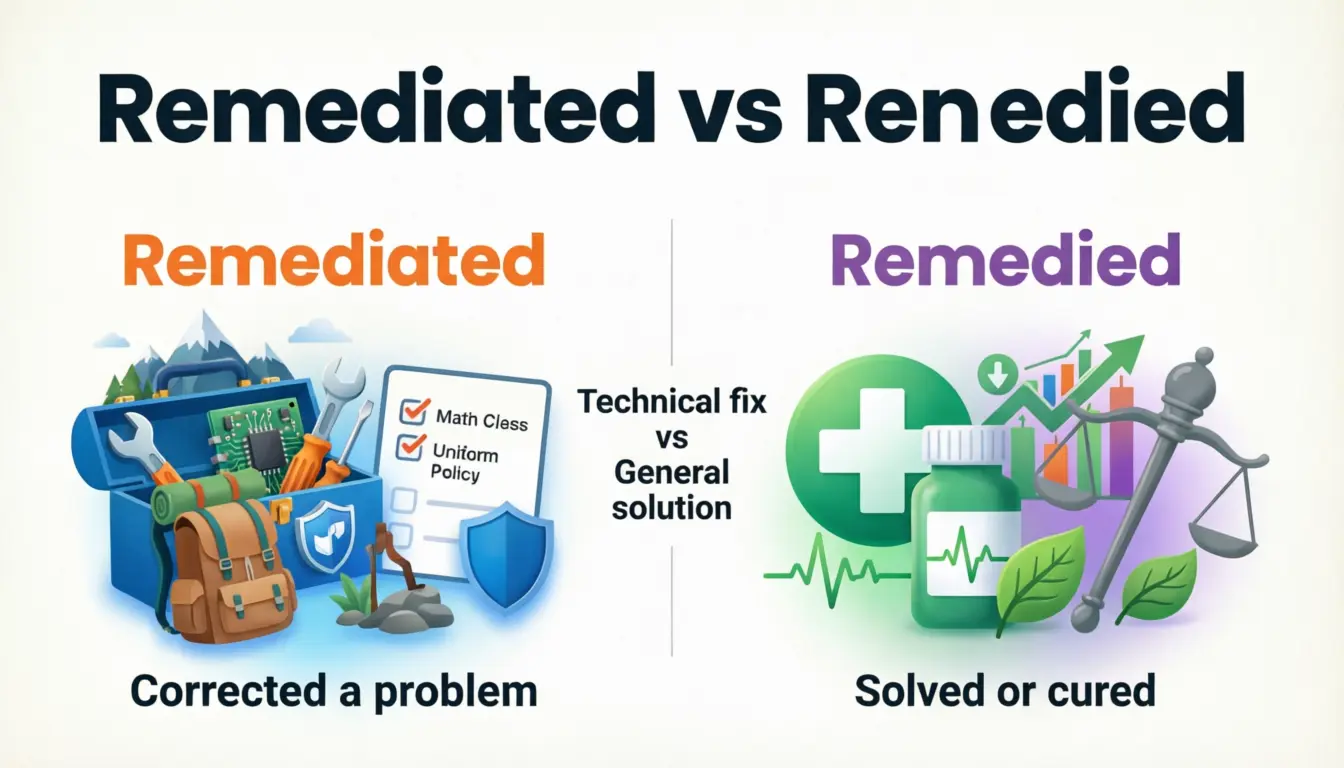
“Remediated” is commonly used in technical, environmental, or educational contexts meaning to correct or clean up a problem, while “remedied” is a more general term meaning to fix, cure, or solve something.
Many English learners and writers get confused by “remediated” vs “remedied.” Both words relate to fixing a problem, but they are not always used in the same way. You may see them in business reports, school papers, medical documents, legal writing, or everyday conversations. Because the meanings are close, people often wonder which word sounds more natural or correct.
The confusion grows because both words come from the idea of correcting something bad. However, the tone and context are different. “Remedied” is more common in general English, while “remediated” is often used in technical or professional settings.
For example, a company may say a cybersecurity issue was “remediated,” while a homeowner may say a leak was “remedied.”
Understanding the difference helps you sound more natural and professional. It also prevents awkward wording in emails, reports, and academic writing. In this guide, you will learn the meanings, origins, spelling differences, common mistakes, and real-life examples of remediated vs remedied so you can confidently choose the right word every time.
Remediated vs Remedied – Quick Answer
Both words mean to fix or correct a problem, but they are used differently.
| Word | Meaning | Common Usage | Example |
| Remediated | Corrected through a process or technical action | Technical, business, IT, environmental fields | “The security flaw was remediated.” |
| Remedied | Fixed or solved | Everyday and formal English | “The issue was remedied quickly.” |
Simple Difference
- Remediated = technical fix or treatment process
- Remedied = general solution or correction
Quick Examples
- The contaminated soil was remediated by experts.
- The customer complaint was remedied within one day.
- The software vulnerability was remediated after testing.
- The mistake in the contract was remedied immediately.
The Origin of Remediated vs Remedied
Both words come from the Latin root “remedium,” meaning “cure” or “solution.”
Origin of “Remedy”
The word “remedy” entered Middle English through Old French. It originally meant a cure for illness or a solution to a problem. Over time, “remedied” became the standard past tense form.
Example:
- The company remedied the error.
Origin of “Remediate”
“Remediate” developed later as a verb meaning “to correct” or “to remove harmful effects.” It became popular in technical industries like:
- Environmental science
- Cybersecurity
- Education
- Engineering
Example:
- The polluted water was remediated.
Why the Words Differ
The spelling difference exists because the verbs are different:
| Base Verb | Past Form |
| Remedy | Remedied |
| Remediate | Remediated |
Even though they share the same root meaning, they evolved into separate words with different usage styles.
British English vs American English Spelling
Unlike words such as “organisation” and “organization,” the spelling of remediated and remedied does not change much between British and American English. The main difference is usage preference.
- American English often uses remediated in business and technology.
- British English more commonly prefers remedied in general writing.
Comparison Table
| Context | American English | British English |
| Cybersecurity | Remediated | Remediated |
| Legal writing | Remedied | Remedied |
| Business reports | Often remediated | Often remedied |
| Everyday speech | Remedied | Remedied |
| Environmental cleanup | Remediated | Remediated |
Examples
American English
- The vulnerability was remediated after review.
British English
- The issue was remedied before publication.
Which Spelling Should You Use?
Choosing between remediated and remedied depends on your audience and context.
Use “Remediated” When:
- Writing technical reports
- Discussing cybersecurity
- Talking about environmental cleanup
- Writing in scientific or engineering fields
Example:
- The malware threat was remediated overnight.
Use “Remedied” When:
- Writing emails
- Speaking casually
- Creating news articles
- Writing general business communication
Example:
- We remedied the delay by adding more staff.
Best Choice by Audience
| Audience | Better Choice |
| US tech companies | Remediated |
| UK readers | Remedied |
| Global audience | Remedied |
| Academic science writing | Remediated |
| Everyday communication | Remedied |
Professional Advice
If you are unsure, use “remedied.” It sounds more natural to most readers and works in almost every situation.
Common Mistakes with Remediated vs Remedied
People often misuse these words because they sound similar.
Mistake 1: Using “Remediated” in Casual Writing
❌ “I remediated my late homework issue.”
✅ “I remedied my late homework issue.”
Why?
“Remediated” sounds too technical for simple situations.
Mistake 2: Using “Remedied” in Technical Reports
❌ “The contaminated land was remedied.”
✅ “The contaminated land was remediated.”
Why?
Environmental cleanup usually uses technical language.
Mistake 3: Confusing the Base Verbs
❌ “The issue was remedyed.”
✅ “The issue was remedied.”
Why?
The correct spelling removes the “y” and adds “-ied.”
Mistake 4: Thinking They Mean Different Things Entirely
Both words involve solving problems. The difference is mainly tone and context.
Remediated vs Remedied in Everyday Examples
Here are real-life examples showing how people use these words.
Emails
- We have remedied the billing error.
- “The IT team has remediated the server issue.”
News Articles
- Officials remediated the polluted site.
- The government remedied the housing shortage.
Social Media Posts
- Finally remedied my slow Wi-Fi problem!
- The IT team remediated the outage quickly.
In Formal Writing
- “The inspection identified and resolved the compliance risks.”
- The company remedied several policy violations.
In Education
- The school remediated learning gaps through tutoring.
- Teachers remedied student confusion with extra lessons.
Remediated vs Remedied – Google Trends & Usage Data
“People use “remedied” more often in daily English, which makes it more popular in search interest.” People commonly search it in:
- Legal topics
- Writing help
- Grammar questions
- News articles
Meanwhile, “remediated” appears more in professional and technical searches, especially in:
- Cybersecurity
- Environmental science
- IT management
- Compliance reporting
Popularity by Country
| Country | More Common Word |
| United States | Remedied overall, remediated in tech |
| United Kingdom | Remedied |
| Canada | Remedied |
| Australia | Remedied |
| Technical industries worldwide | Remediated |
Usage Context
| Situation | Preferred Word |
| Casual writing | Remedied |
| IT security reports | Remediated |
| Pollution cleanup | Remediated |
| Customer service | Remedied |
| Legal correction | Remedied |
The trend suggests that “remedied” is easier for general readers, while “remediated” sounds more specialized.
Comparison Table: Remediated vs Remedied
| Feature | Remediated | Remedied |
| Part of speech | Past tense verb | Past tense verb |
| Base verb | Remediate | Remedy |
| Tone | Technical | General |
| Common fields | IT, science, environment | Everyday English |
| Reader friendliness | Moderate | High |
| Formality | Professional | Neutral |
| Most common usage | Industry reports | Daily communication |
FAQs About Remediated vs Remedied
Is “remediated” a real word?
Yes. “Technical and professional settings often use the word ‘remediated.’”
Which is more common: remedied or remediated?
“Remedied” is more common in everyday English.
Can I use “remedied” in business writing?
Yes. It works well in most business communication unless the context is highly technical.
Why do cybersecurity reports use “remediated”?
The word suggests a structured correction process, which fits technical work.
Is “remediated” more formal?
Yes. It usually sounds more technical and formal than “remedied.”
Are the words interchangeable?
Sometimes, but not always. Context matters.
Which word should students use?
Students should usually use “remedied” unless writing technical or scientific papers.
Is “remedyed” correct?
No. The correct spelling is “remedied.”
Which word sounds more natural?
For most readers, “remedied” sounds more natural.
Conclusion
The difference between remediated vs remedied is small but important. Both words describe fixing a problem, yet they fit different situations. “Remedied” is the more common and flexible choice. It works well in daily communication, business writing, legal documents, and general English. Most readers understand it easily, making it the safer option for global audiences.
“Remediated,” however, belongs more to technical and professional language. It appears often in cybersecurity, environmental cleanup, engineering, and compliance reporting. The word suggests a detailed correction process rather than a simple fix. Because of this, it can sound overly formal in casual writing.
If you write for everyday readers, choose “remedied.”“Technical industries or scientific fields may prefer the term ‘remediated.’” Understanding the audience and context will help you sound clear, professional, and natural.
By learning when to use each word, you can avoid common mistakes and improve the quality of your writing in emails, reports, articles, and conversations.

I am an Emily Carter Brooks U.S.A based linguistics writer known for my clear, reader-friendly explanations of English grammar and vocabulary differences. I have contributed to multiple online language resources and specializes in spelling variations, pronunciation confusion, and British vs American English comparisons. I’m passionate about helping learners improve their English through practical, everyday communication. engaging, and stress-free.