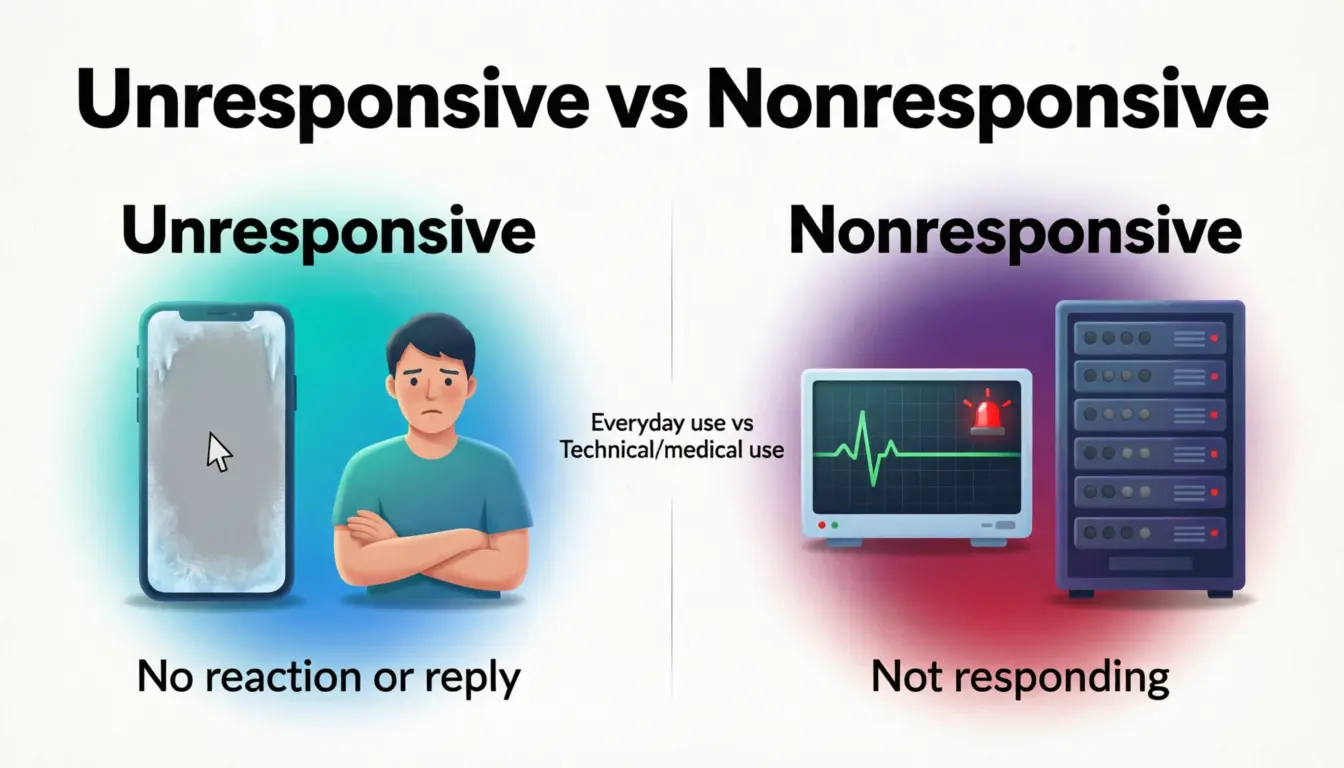
“Unresponsive” usually describes a person, device, or system that does not react or reply, while “nonresponsive” is more formal or technical and often used in medical, scientific, or professional contexts
Many English learners and writers get confused by “unresponsive” vs “nonresponsive.” At first glance, both words seem to mean the same thing. They both describe a person, device, system, or situation that does not react or reply. But there are small differences in tone, style, and usage.
People often search for this keyword because they want to know which spelling is more correct in emails, business writing, healthcare, technology, or daily conversation. For example, should you say a customer is unresponsive or nonresponsive? Is one more formal? Does British English prefer one version over the other?
The good news is that both words are correct. However, they are not always used in the same way. “Unresponsive” is far more common in everyday English, while “nonresponsive” often appears in medical, technical, or formal contexts.
In this guide, you will learn the meaning, origin, spelling differences, common mistakes, and real-world examples of unresponsive vs nonresponsive. By the end, you will know exactly which word fits your audience and writing style.
Unresponsive vs Nonresponsive – Quick Answer
Both unresponsive and nonresponsive mean “not reacting” or “not replying.”
- Unresponsive = more common in daily English.
- Nonresponsive = more formal or technical.
Examples
- The client was unresponsive to our emails.
- The patient became nonresponsive after surgery.
- My phone is unresponsive today.
- The system remained nonresponsive during testing.
Quick Rule
Use unresponsive for normal conversation and general writing.
Use nonresponsive for medical, scientific, or technical writing.
The Origin of Unresponsive vs Nonresponsive
The word responsive comes from the Latin word respondere, meaning “to answer” or “reply.”
English later added prefixes:
- un- = not
- non- = absence of something
So:
- unresponsive literally means “not responsive.”
- nonresponsive also means “not responsive.”
Why Two Forms Exist
English often creates similar words using different prefixes. For example:
| Word with “un-” | Word with “non-” |
| unfair | nonpayment |
| unhappy | nonfunctional |
| unclear | nonspecific |
Over time, unresponsive became the preferred everyday form because it sounds more natural in speech. Meanwhile, nonresponsive stayed popular in professional fields like healthcare and engineering.
British English vs American English Spelling
Unlike many English words, unresponsive and nonresponsive do not change spelling between British and American English. Both regions use the same spellings.
The difference is mainly about style and frequency.
American English
American English uses both words often, especially in medicine and business.
Examples:
- The app became unresponsive.
- The patient was nonresponsive.
British English
British English usually prefers unresponsive in normal writing and speech.
Examples:
- The audience seemed unresponsive.
- The server became unresponsive overnight.
Comparison Table
| Feature | Unresponsive | Nonresponsive |
| Meaning | Not reacting | Not reacting |
| Tone | Natural, common | Formal, technical |
| Common in conversation | Yes | Rare |
| Common in medicine | Sometimes | Very common |
| Common in technology | Very common | Common |
| British English preference | Strong | Moderate |
| American English preference | Strong | Strong in technical writing |
Which Spelling Should You Use?
The best choice depends on your audience and purpose.
Use “Unresponsive” When:
- Writing emails
- Posting on social media
- Talking casually
- Writing blog posts
- Describing devices or people generally
Examples:
The customer has been unresponsive for two weeks.
Use “Nonresponsive” When:
- Writing medical reports
- Creating scientific documents
- Writing technical manuals
- Using formal professional language
Examples:
The patient remained nonresponsive during treatment.
Audience-Based Advice
| Audience | Best Choice |
| United States | Both work |
| United Kingdom | Unresponsive |
| Australia & Canada | Mostly unresponsive |
| Medical professionals | Nonresponsive |
| Global audience | Unresponsive |
Simple Recommendation
If you are unsure, choose unresponsive. It sounds more natural and works in almost every situation.
Common Mistakes with Unresponsive vs Nonresponsive
Many writers misuse these words because they look similar.
1. Using “nonresponsive” in casual writing
❌ My friend was nonresponsive to my texts.
✅ My friend was unresponsive to my texts.
Why?
“Nonresponsive” sounds too formal here.
2. Using “unresponsive” in strict medical language
❌ The patient became unresponsive to stimuli.
✅ The patient became nonresponsive to stimuli.
Why?
Medical writing often prefers “nonresponsive.”
3. Confusing Meaning with “Ignoring”
Sometimes people think these words always mean intentional silence.
But a person or system may be unresponsive because of:
- illness
- technical failure
- delay
- confusion
Not always because they are ignoring someone.
4. Incorrect Hyphenation
❌ non-responsive
❌ un-responsive
✅ nonresponsive
✅ unresponsive
Modern English usually writes these words without hyphens.
Unresponsive vs Nonresponsive in Everyday Examples
Emails
- The supplier has been unresponsive since Monday.
- Our support team noticed a nonresponsive server.
News Reports
- Officials described the victim as nonresponsive at the scene.
- Investors were unresponsive to the new proposal.
Social Media
- My touchscreen is totally unresponsive.
- Why is this app so unresponsive today?
Formal Writing
- The machine became nonresponsive during testing.
- The committee remained unresponsive to complaints.
Healthcare
- Doctors reported the patient was nonresponsive after the accident.
Technology
- The laptop froze and became unresponsive.
Unresponsive vs Nonresponsive – Google Trends & Usage Data
Search and usage data show that unresponsive is much more popular worldwide.
Global Usage Trends
- Unresponsive dominates in:
- the United States
- the United Kingdom
- Canada
- Australia
- Nonresponsive appears more in:
- medical journals
- technical documents
- scientific reports
Why “Unresponsive” Is More Popular
People prefer shorter and more natural-sounding words in daily communication. “Unresponsive” feels easier and more conversational.
Why “Nonresponsive” Still Matters
Professional industries value precision. In medicine, “nonresponsive” can sound more clinical and exact.
Usage Comparison Table
| Context | More Common Word |
| Casual speech | Unresponsive |
| Customer service | Unresponsive |
| Medical reports | Nonresponsive |
| Software issues | Unresponsive |
| Scientific papers | Nonresponsive |
| News articles | Unresponsive |
Comparison Table: Unresponsive vs Nonresponsive
| Aspect | Unresponsive | Nonresponsive |
| Meaning | Not reacting or replying | Not reacting or replying |
| Style | Everyday English | Technical or formal |
| Tone | Friendly, natural | Clinical, professional |
| Popularity | Very high | Moderate |
| Used in medicine | Less common | Very common |
| Used in casual speech | Very common | Rare |
| Best for global readers | Yes | Sometimes |
FAQs About Unresponsive vs Nonresponsive
Is “unresponsive” correct English?
Yes. It is fully correct and very common in modern English.
Is “nonresponsive” a real word?
Yes. It is correct and widely used in medical and technical fields.
Which is more common: unresponsive or nonresponsive?
“Unresponsive” is much more common in everyday writing and speech.
Do both words mean the same thing?
Mostly yes. Both mean “not reacting” or “not replying.”
Which word should I use in an email?
Use unresponsive. It sounds more natural and less formal.
Which word is preferred in medicine?
Medical professionals often use nonresponsive.
Is “non-responsive” correct?
Modern dictionaries usually prefer nonresponsive without a hyphen.
Can I use “unresponsive” for technology problems?
Yes. It is very common for apps, phones, and computers.
Example:
My computer became unresponsive after the update.
Is there a British vs American spelling difference?
No. Both countries use the same spellings.
Conclusion
The debate around unresponsive vs nonresponsive is mostly about style, not correctness. Both words are valid English terms that describe someone or something that does not react, respond, or reply. However, their usage changes depending on context.
In everyday English, unresponsive is the better choice. It sounds natural, clear, and easy to understand. It works well in emails, conversations, blogs, customer service, and technology discussions. Because of its friendly tone and wide acceptance, it is the safest option for most writers.
On the other hand, nonresponsive is more formal and technical. You will often see it in healthcare, engineering, scientific research, and professional reports. In these settings, it gives a more precise and clinical tone.
If your audience is general or international, choose unresponsive. If you are writing for medical or technical professionals, nonresponsive may fit better.
Understanding this small difference helps your writing sound more accurate, professional, and natural in every situation.

I am an Emily Carter Brooks U.S.A based linguistics writer known for my clear, reader-friendly explanations of English grammar and vocabulary differences. I have contributed to multiple online language resources and specializes in spelling variations, pronunciation confusion, and British vs American English comparisons. I’m passionate about helping learners improve their English through practical, everyday communication. engaging, and stress-free.