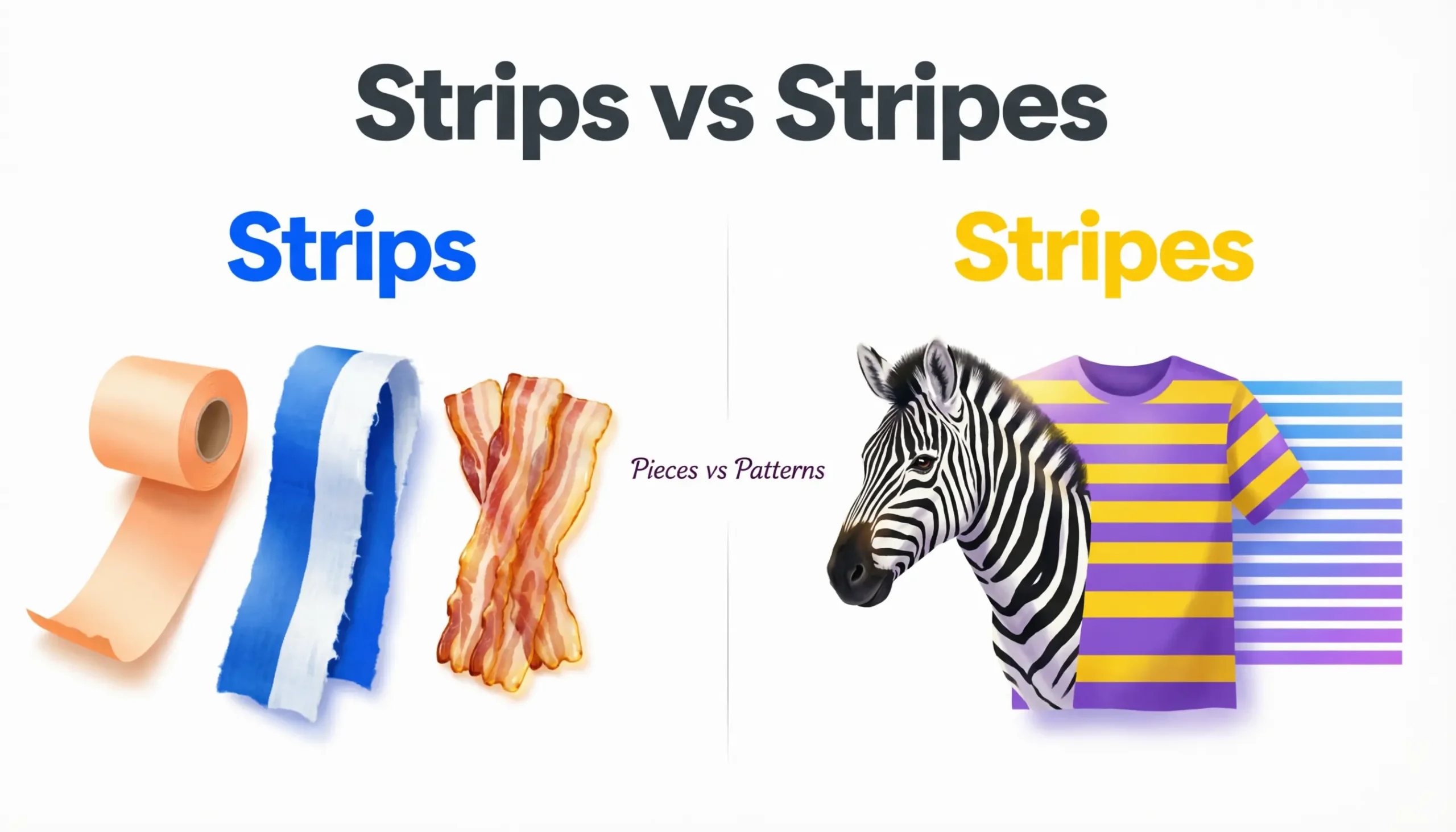
“Strips” are long, narrow pieces cut from something, while “stripes” are long, narrow lines or bands of color or pattern.
Many English learners and writers get confused by strips vs stripes because the two words look similar and sound related. But they do not mean the same thing. One word usually talks about long narrow pieces, while the other describes lines or patterns.
This confusion is common in daily writing, online searches, fashion discussions, sports talk, and even news articles. For example, should you say “zebra strips” or “zebra stripes”? What about paint strips or paint stripes? Small spelling differences can change the meaning completely.
Understanding the difference between these words helps improve grammar, spelling, and communication. It also helps writers avoid awkward mistakes in emails, blogs, school papers, and social media posts.
In this guide, you will learn the meaning of strips vs stripes, where the words came from, how British and American English use them, common mistakes people make, and which spelling fits different situations. You will also see examples, comparison tables, FAQs, and usage tips that make the difference easy to remember.
Strips vs Stripes – Quick Answer
The quick answer is simple:
- Strips = long, narrow pieces of something
- Stripes = long lines or bands of color or pattern
Examples
| Word | Meaning | Example |
| Strips | Narrow pieces | “Cut the paper into strips.” |
| Stripes | Colored lines or patterns | “The tiger has black stripes.” |
Easy Trick to Remember
- If you can cut it, use strips
- If you can see a pattern, use stripes
More Examples
- Bacon strips
- Movie strips
- Cloth strips
But:
- Zebra stripes
- Striped shirts
- Racing stripes on a car
Even though the words are related, they are not interchangeable in most situations.
The Origin of Strips vs Stripes
The words strip and stripe both come from old Germanic roots connected to long narrow shapes. Over time, English gave them different meanings.
Origin of “Strip”
The word strip came from Old English and Germanic languages. It originally meant:
- a narrow piece
- something pulled away
- something long and thin
That meaning still exists today.
Examples:
- paper strips
- comic strips
- strips of cloth
Origin of “Stripe”
The word stripe developed later. It referred to:
- marks
- streaks
- colored bands
This meaning became common in clothing, animals, and decoration.
Examples:
- striped socks
- tiger stripes
- military stripes
Why the Confusion Exists
The confusion happens because:
- The words sound alike
- Both describe long narrow shapes
- Both come from similar language roots
But modern English separates them by meaning:
| Word | Main Idea |
| Strip | A piece |
| Stripe | A pattern |
British English vs American English Spelling
Unlike many English word pairs, strips vs stripes is not mainly a British vs American spelling issue. Both British and American English use the same spellings.
The difference is about meaning, not regional spelling.
Comparison Table
| Context | Correct Word | British English | American English |
| Narrow paper pieces | Strips | Strips | Strips |
| Zebra pattern | Stripes | Stripes | Stripes |
| Bacon pieces | Strips | Strips | Strips |
| Shirt pattern | Stripes | Stripes | Stripes |
Example Sentences
British English
- “The player wore a shirt with blue stripes.”
- “Cut the vegetables into thin strips.”
American English
- “The road has yellow stripes.”
- “The comic strips were funny.”
Key Point
There is no spelling difference between UK and US English here. The challenge is choosing the correct meaning.
Which Spelling Should You Use?
The spelling depends on what you want to say.
Use “Strips” When Talking About Pieces
Choose strips for:
- food pieces
- paper pieces
- thin sections
- narrow cuts
Examples:
- chicken strips
- strips of tape
- fabric strips
Use “Stripes” When Talking About Patterns
Choose stripes for:
- animal markings
- clothing designs
- painted lines
- decorative patterns
Examples:
- zebra stripes
- striped tie
- road stripes
Audience-Based Advice
| Audience | Best Choice |
| US readers | Use normal meaning rules |
| UK readers | Use normal meaning rules |
| Global audience | Keep meanings clear with examples |
Since both spellings are standard worldwide, focus on the correct context.
Common Mistakes with Strips vs Stripes
People often mix these words because they describe similar shapes.
Mistake #1: Using “Strips” for Patterns
❌ The zebra has black strips.
✅ The zebra has black stripes.
Mistake #2: Using “Stripes” for Pieces
❌ Cut the paper into stripes.
✅ Cut the paper into strips.
Mistake #3: Confusing Clothing Terms
❌ I bought stripe cloth pieces.
✅ I bought striped cloth pieces.
Mistake #4: Mixing Singular and Plural Forms
| Incorrect | Correct |
| One stripes | One stripe |
| Two strip | Two strips |
Quick Grammar Tip
| Singular | Plural |
| Strip | Strips |
| Stripe | Stripes |
Strips vs Stripes in Everyday Examples
Here are real-life examples that show how native speakers use the words.
Emails
- “Please cut the labels into small strips.”
- “The company logo has red stripes.”
News Writing
- “The road workers painted fresh yellow stripes.”
- “Police found strips of fabric near the scene.”
Social Media
- “Love this striped sweater!”
- “Chicken strips for dinner tonight.”
Formal Writing
- “The document was divided into narrow strips.”
- “The flag contains horizontal stripes.”
Fashion Examples
| Incorrect | Correct |
| Stripe shirt | Striped shirt |
| Strip design | Stripe design |
Strips vs Stripes – Google Trends & Usage Data
Search interest for strips vs stripes changes based on context.
“Strips” Is Popular In:
- food searches
- movie searches
- DIY projects
- crafting
Examples:
- chicken strips
- comic strips
- wax strips
“Stripes” Is Popular In:
- fashion
- animal descriptions
- sports uniforms
- road markings
Examples:
- tiger stripes
- striped shirts
- racing stripes
Popular Usage by Country
| Country | More Common Search Context |
| United States | Food and fashion |
| United Kingdom | Clothing and road markings |
| Canada | Mixed usage |
| Australia | Fashion and animals |
Usage Trend
Both words are widely used worldwide because they describe different things. Neither word replaces the other.
Comparison Table: Strips vs Stripes
| Feature | Strips | Stripes |
| Meaning | Narrow pieces | Lines or patterns |
| Used For | Paper, food, tape | Clothing, animals, roads |
| Example | Bacon strips | Zebra stripes |
| Verb Form | Strip | Stripe |
| Related Adjective | Stripped | Striped |
| Visual Idea | Separate pieces | Repeated lines |
FAQs About Strips vs Stripes
1. What is the difference between strips and stripes?
Strips are narrow pieces, while stripes are lines or patterns.
2. Is it zebra strips or zebra stripes?
The correct phrase is zebra stripes.
3. Can “strips” and “stripes” mean the same thing?
Not usually. They have different meanings in modern English.
4. Is “striped” related to “stripes”?
Yes. Striped means covered with stripes.
Examples:
- striped shirt
5. What are comic strips?
Comic strips are short comic stories shown in narrow sections.
6. Why do people confuse strips and stripes?
The words sound similar and both describe long narrow shapes.
7. Are stripes always colored?
Usually, yes. Stripes often describe visible colored lines or bands.
8. Which word is used for road markings?
The correct word is stripes.
9. Which word is used for food pieces?
The correct word is strips.
Conclusion
Understanding strips vs stripes is easier once you focus on the main difference. A strip is a long narrow piece of something, while a stripe is a long line or pattern. Even though the words look alike and share similar language roots, they are used in very different ways in modern English.
This distinction matters in daily communication. Using the wrong word can confuse readers, especially in writing about fashion, animals, food, crafts, or design. Saying “zebra strips” sounds unnatural because zebras have patterns, not pieces. In the same way, “paper stripes” sounds incorrect because paper is cut into pieces, not patterns.
The good news is that British English and American English follow the same rules for these words. That means learners only need to remember the meaning difference, not separate regional spellings.
A simple memory trick helps:
- Strips = pieces
- Stripes = patterns
When you keep that rule in mind, choosing the correct word becomes much easier in emails, social media, formal writing, and everyday conversation.

I hold a degree in English Literature and Linguistics and have worked extensively on educational blogs, comparison websites, and digital learning platforms. My writing focuses on simplifying complex language rules, highlighting British vs American English differences, and providing practical examples for everyday usage.