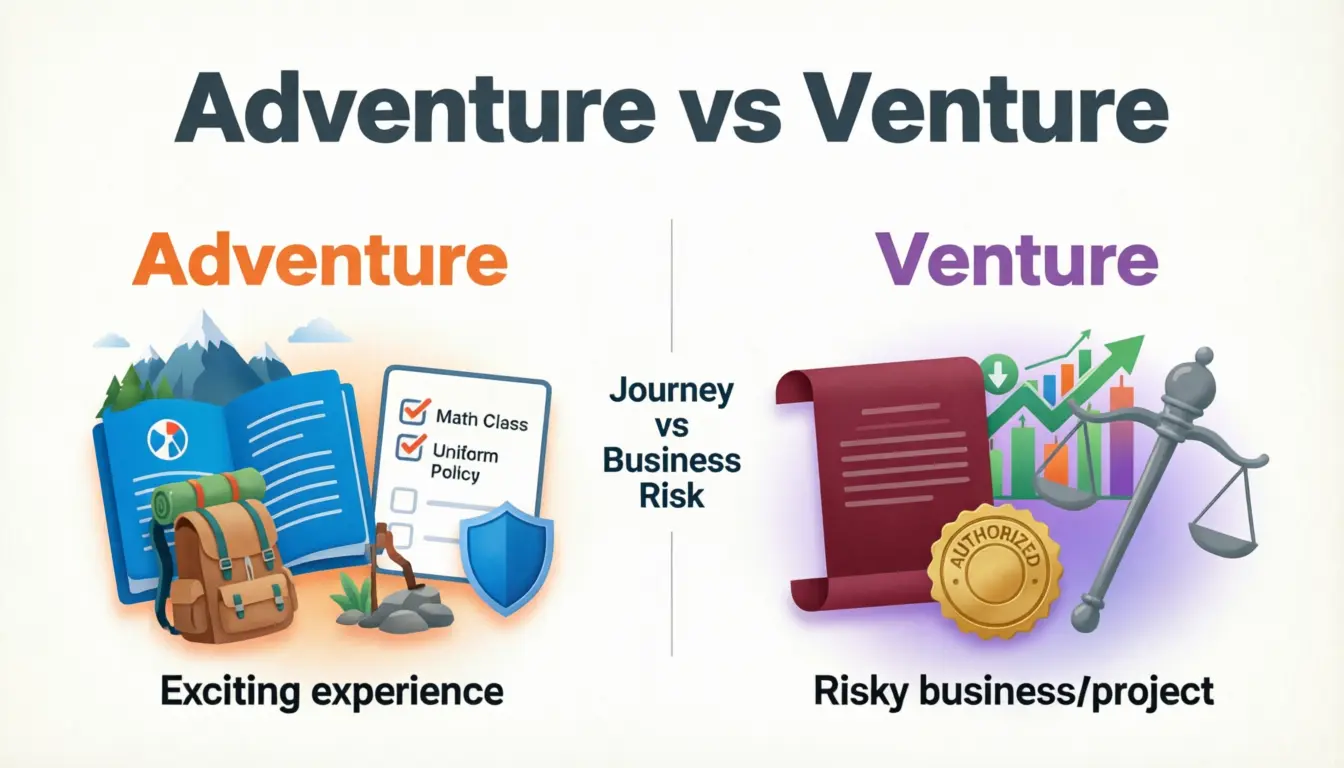
“Adventure” usually refers to an exciting, unusual, or risky experience, while “venture” refers to a risky business project, journey, or undertaking with a goal or purpose.
Many English learners and writers confuse adventure vs venture because both words talk about doing something new, risky, or exciting. They sound similar and sometimes appear in the same type of sentence. But they do not mean the same thing.
An adventure is usually an exciting experience. It often includes travel, danger, or fun. A venture, on the other hand, is more about business, risk, or starting something new for profit or success.
People search for “adventure vs venture” because they want to know which word fits their sentence. Should you say “business adventure” or “business venture”? Is an adventure always fun? Is a venture always serious? These questions can confuse both native and non-native speakers.
This guide explains the difference in simple words. You will learn the meanings, origins, spelling rules, common mistakes, and real-life examples. You will also see comparison tables, FAQs, and Google Trends insights to help you choose the right word with confidence.
Adventure vs Venture – Quick Answer
The main difference between adventure and venture is purpose.
| Word | Meaning | Example |
| Adventure | An exciting or unusual experience | “Our mountain trip was a great adventure.” |
| Venture | A risky business or activity | “She started a new business venture.” |
Simple Examples
- We went on an adventure in the jungle.
- He invested money in a new venture.
- Traveling alone felt like an adventure.
- Their startup became a successful venture.
Easy Tip to Remember
- Adventure = excitement and experience
- Venture = risk and business
Sometimes a venture can also feel like an adventure, but the words are not interchangeable in most cases.
The Origin of Adventure vs Venture
Both words come from the Latin word adventura, which means “something about to happen.”
Origin of Adventure
The word adventure entered English through Old French in the Middle Ages. Early uses described chance events or risky journeys. Over time, it became linked with travel, excitement, and exploration.
Examples from history include:
- sea adventures
- knight adventures
- travel adventures
Today, people use it for fun, exciting, or dangerous experiences.
Origin of Venture
The word venture developed later from the same root. It became connected with taking risks, especially in trade and business.
Merchants used the word when they risked money on ships or trade routes. Later, it became common in:
- business ventures
- joint ventures
- investment ventures
That is why venture today often sounds more professional or financial.
Why the Confusion Exists
The confusion happens because:
- both words come from the same root
- both involve risk or uncertainty
- both can describe “trying something new”
But their modern meanings are different.
British English vs American English Spelling
Unlike many English word pairs, adventure and venture do not change spelling between British and American English.
Same Spelling in Both Forms
| Word | British English | American English |
| Adventure | Adventure | Adventure |
| Venture | Venture | Venture |
Usage Differences
The spelling is the same, but usage can vary slightly.
| Region | Common Usage |
| United States | “Business venture” is very common |
| United Kingdom | “Joint venture” appears often in formal writing |
| Global English | “Adventure” is popular in travel content |
Examples
British English
- The company announced a joint venture.
- Their hiking adventure lasted two weeks.
American English
- He launched a tech venture.
- The road trip became a wild adventure.
So, there are no spelling differences, only small usage preferences.
Which Spelling Should You Use?
Since the spelling stays the same worldwide, the real question is which word you should use.
Use “Adventure” When You Mean:
- excitement
- travel
- exploration
- fun experiences
- dangerous journeys
Examples
- adventure movie
- camping adventure
- adventure tourism
Use “Venture” When You Mean:
- business risk
- investment
- professional projects
- starting something new
Examples
- startup venture
- business venture
- investment venture
Audience-Based Advice
| Audience | Best Choice |
| US business readers | Venture |
| UK business readers | Venture |
| Travel audiences | Adventure |
| Children or storytelling | Adventure |
| Investors or entrepreneurs | Venture |
| Global audience | Choose based on meaning |
Quick Rule
If money or business is involved, use venture.
If excitement or experience is involved, use adventure.
Common Mistakes with Adventure vs Venture
People often mix these words because both involve risk.
Mistake 1: Using “Adventure” for Business
❌ He started a new business adventure.
✅ He started a new business venture.
Mistake 2: Using “Venture” for Fun Travel
❌ Our camping venture was exciting.
✅ Our camping adventure was exciting.
Mistake 3: Thinking They Mean the Same Thing
❌ Venture and adventure are identical words.
✅ They are related but have different meanings.
Mistake 4: Overusing “Venture”
Some writers use venture to sound formal.
❌ We had a venture at the beach.
✅ We had an adventure at the beach.
Mistake 5: Using the Wrong Tone
- Adventure sounds emotional and exciting.
- Venture sounds practical and professional.
Choosing the wrong word changes the tone of your sentence.
Adventure vs Venture in Everyday Examples
Emails
- “Our school trip was a wonderful adventure.”
- “We are planning a new business venture.”
News Headlines
- “Couple Begins Arctic Adventure”
- “Tech Venture Raises Millions”
Social Media
- “Every day is a new adventure!”
- “Excited for my next venture!”
In Formal Writing
- “The venture created hundreds of jobs.”
- “The expedition became a historic adventure.”
In Marketing
| Industry | Preferred Word |
| Tourism | Adventure |
| Finance | Venture |
| Entertainment | Adventure |
| Startups | Venture |
Adventure vs Venture – Google Trends & Usage Data
Search data shows that both words are popular, but they appear in different contexts.
Adventure Trends
The word adventure is searched more in:
- travel blogs
- gaming
- outdoor sports
- movies and books
Countries with high interest:
- United States
- Canada
- Australia
- New Zealand
Venture Trends
The word venture is common in:
- business news
- startup culture
- finance articles
- investment discussions
Countries with high interest:
- United States
- United Kingdom
- Singapore
- India
Context Comparison
| Keyword | Common Context |
| Adventure | Travel, fun, excitement |
| Venture | Business, investment, risk |
Popular Search Phrases
| Adventure Searches | Venture Searches |
| adventure travel | business venture |
| adventure games | venture capital |
| adventure movies | joint venture |
| adventure tourism | startup venture |
This shows that people connect each word with different topics.
Adventure vs Venture Comparison Table
| Feature | Adventure | Venture |
| Main Meaning | Exciting experience | Risky project or business |
| Tone | Fun and emotional | Professional and serious |
| Common Use | Travel and stories | Business and finance |
| Risk Involved | Physical or emotional | Financial or professional |
| Part of Speech | Noun | Noun/Verb |
| Example | “Safari adventure” | “Tech venture” |
| Audience | Travelers, readers | Investors, companies |
FAQs About Adventure vs Venture
1. What is the main difference between adventure and venture?
Adventure is an exciting experience, while venture is a risky business or project.
2. Can adventure and venture be synonyms?
Sometimes they overlap, but they are not true synonyms in most situations.
3. Is “business adventure” correct?
It is uncommon. “Business venture” is the correct and natural phrase.
4. Can venture be used as a verb?
Yes. Example: “He ventured into unknown territory.”
5. Is adventure always positive?
Usually yes, but it can also include danger or difficulty.
6. Which word is more formal?
Venture is more formal and professional.
7. Do British and American English spell them differently?
No. Both use the same spelling.
8. What is a joint venture?
A joint venture is a business project shared by two or more companies.
9. Which word is better for travel writing?
Adventure is the better choice for travel content.
Conclusion
Understanding adventure vs venture is easier once you focus on the purpose behind each word. An adventure is about excitement, experience, and exploration. A venture is about risk, business, or starting something new with a goal in mind.
Even though the words come from the same historical root, modern English uses them differently. Adventure appears more in travel, storytelling, gaming, and entertainment. Venture is more common in finance, startups, and professional settings.
There are no spelling differences between British and American English, which makes things simpler. The key is choosing the word that matches your meaning and audience. If you are writing for travelers or telling a story, “adventure” usually fits best. If you are discussing investments, startups, or professional projects, “venture” is the stronger choice.
Using the correct word improves clarity and makes your writing sound more natural. By remembering the simple rule excitement equals adventure, business risk equals venture you can avoid common mistakes and communicate clearly in any situation.
Discover More Article:
Compair vs Compare – Which Spelling Is Correct?

I hold a degree in English Literature and Linguistics and have worked extensively on educational blogs, comparison websites, and digital learning platforms. My writing focuses on simplifying complex language rules, highlighting British vs American English differences, and providing practical examples for everyday usage.