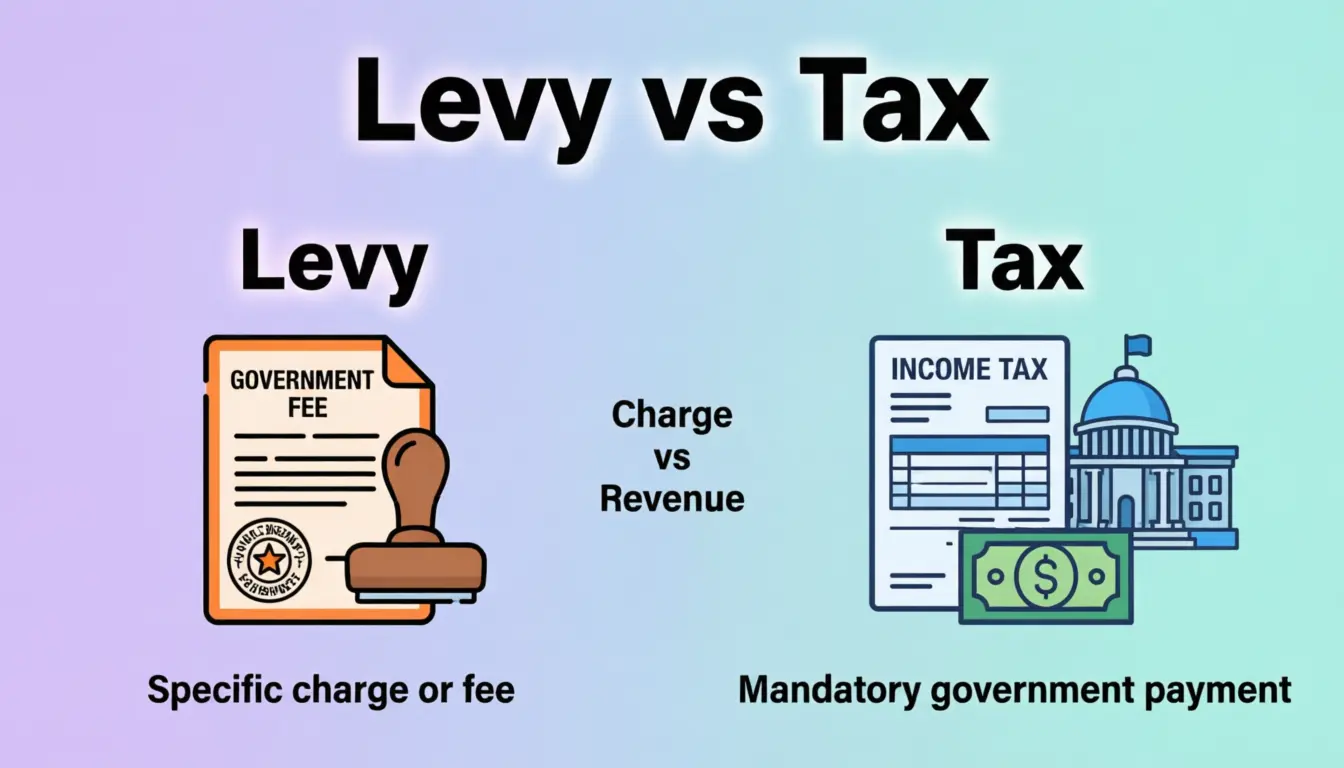
“Tax” is a general term for a compulsory payment collected by the government, while “levy” is a verb or noun meaning to impose or collect a tax, charge, or fine.
Many people use the words “levy” and “tax” as if they mean the same thing. In daily speech, that can seem correct. Governments collect money from people and businesses, so both terms often appear together in news reports, legal papers, and financial discussions. Still, there is an important difference between them.
People search for “levy vs tax” because the two words can be confusing. You may see phrases like “tax levy,” “property tax,” or “government levy” and wonder if they all mean the same thing. Students, business owners, writers, and taxpayers often want a simple answer.
The confusion grows because “levy” can act as both a noun and a verb. A government can levy a tax, but the tax itself is not always called a levy. In some countries, the words are used differently in law and finance.
This guide explains the meaning, history, spelling, and real-life use of “levy” and “tax.” You will also learn common mistakes, regional usage, Google Trends insights, and professional advice on choosing the correct word.
Levy vs Tax – Quick Answer
A tax is money the government collects from people or businesses.
A levy is the act of imposing or collecting a tax, fee, or charge.
Simple Examples
- The government introduced a new tax on fuel.
- The city will levy a fee on plastic bags.
- Income tax increased this year.
- Officials may levy penalties for late payment.
Quick Difference
| Word | Meaning | Example |
| Levy | To impose or collect a charge | The state will levy a fine |
| Tax | The money charged by government | Citizens pay income tax |
In short:
- Tax = the charge itself
- Levy = the action of charging or imposing
The Origin of Levy vs Tax
The word levy comes from the French word lever, which means “to raise” or “collect.” English speakers started using it in the 1500s. Governments used the term when raising money, soldiers, or supplies.
The word tax comes from the Latin word taxare, meaning “to assess” or “charge.” It entered English much earlier and became the common word for government charges.
Why the Difference Exists
The words developed for different purposes:
- Tax became the everyday term for required payments.
- Levy became a formal or legal word describing the act of imposing charges.
That is why you often hear:
- “The government levied a tax.”
- “The company must pay taxes.”
Even today, financial and legal documents use “levy” more often than casual conversation.
British English vs American English Spelling
Unlike words such as “organisation” and “organization,” the spelling of levy and tax stays the same in both British and American English.
The main difference is not spelling. It is usage and context.
British English Usage
In British English:
- “Tax” is more common in everyday language.
- “Levy” often appears in government or business writing.
Example:
- The UK introduced an energy profits levy.
American English Usage
In American English:
- “Tax” is also the common public term.
- “Levy” appears often in legal and financial settings.
Example:
- The IRS may levy a bank account for unpaid debt.
Comparison Table
| Feature | British English | American English |
| Spelling of levy | Levy | Levy |
| Spelling of tax | Tax | Tax |
| Everyday term | Tax | Tax |
| Legal/financial term | Levy | Levy |
| Common phrase | Tax increase | Tax levy |
Which Spelling Should You Use?
Since there are no spelling differences, your choice depends on meaning and audience.
Use “Tax” When:
- Writing for the general public
- Discussing government charges
- Creating simple content
- Writing news headlines
Example:
- The country raised fuel taxes.
Use “Levy” When:
- Writing legal documents
- Discussing penalties or formal charges
- Explaining financial enforcement
- Writing professional business content
Example:
- The authority may levy additional fees.
Audience-Based Advice
| Audience | Best Word |
| US readers | Tax for simple writing, levy for legal topics |
| UK/Commonwealth readers | Same rule applies |
| Global audience | Use tax first, explain levy if needed |
For SEO and readability, “tax” is usually easier for broad audiences to understand quickly.
Common Mistakes with Levy vs Tax
Many writers misuse these terms because they sound similar in financial discussions.
Mistake 1: Using Levy as a Direct Replacement for Tax
❌ The government announced a new levy on income taxes.
✅ The government announced a new income tax.
Mistake 2: Confusing Action with Charge
❌ Citizens must pay levy every year.
✅ Citizens must pay taxes every year.
Mistake 3: Forgetting Levy Can Be a Verb
❌ The city tax a penalty yesterday.
✅ The city levied a penalty yesterday.
Mistake 4: Using Tax as a Verb Incorrectly
While “tax” can be a verb, it means to charge someone financially.
Example:
- The government taxed imported goods.
Still, “levy” sounds more formal in legal writing.
Levy vs Tax in Everyday Examples
Understanding real-world use makes the difference easier.
Emails
- We noticed an unpaid tax balance.
- The agency may levy extra charges next month.
News Headlines
- Government raises property tax.
- New environmental levy announced.
Social Media
- Why are taxes so high this year?
- The city plans to levy parking fines downtown.
In Formal Writing
- Authorities may levy penalties for noncompliance.
- Businesses must submit tax reports annually.
In Business Communication
- The state imposed a sales tax increase.
- Regulators may levy administrative fees.
Levy vs Tax – Google Trends & Usage Data
Search interest for “tax” is much higher worldwide because it is a common everyday word.
“Levy” receives fewer searches but appears strongly in:
- Financial news
- Legal topics
- Debt collection discussions
- Government policy articles
Popular Regions for “Tax”
High search interest appears in:
- United States
- United Kingdom
- Canada
- Australia
- India
Popular Contexts for “Levy”
People often search “levy” when discussing:
- Tax levies
- Bank levies
- Property levies
- Government charges
- Legal enforcement
Usage Trends
| Term | Popularity | Common Context |
| Tax | Very high | Everyday finance |
| Levy | Moderate | Legal and official language |
In online content, “tax” is more SEO-friendly because it matches broader search intent.
Levy vs Tax Comparison Table
| Feature | Levy | Tax |
| Meaning | Imposing a charge | The charge itself |
| Part of Speech | Noun and verb | Noun and verb |
| Tone | Formal/legal | Common/everyday |
| Used By | Lawyers, officials | Everyone |
| Common Context | Fees, penalties, enforcement | Government payments |
| Example | Levy a fine | Pay tax |
| Search Popularity | Lower | Higher |
FAQs About Levy vs Tax
Is a levy the same as a tax?
No. A tax is the payment itself, while a levy is the act of imposing or collecting a charge.
Can levy be used as a verb?
Yes. Example: “The government may levy new fees.”
Which word is more common?
“Tax” is much more common in daily conversation and online searches.
What is a tax levy?
A tax levy is a legal seizure or collection process for unpaid taxes.
Is levy formal language?
Yes. Levy sounds more official and legal than tax.
Do British and American English spell levy differently?
No. Both use the same spelling.
Can tax also be a verb?
Yes. Example: “The state taxed luxury goods.”
Which word should businesses use?
Businesses often use “levy” in contracts and legal writing, but “tax” in customer communication.
Which word is better for content?
“Tax” usually performs better because more people search for it.
Conclusion
The difference between “levy” and “tax” is simple once you understand the roles each word plays. A tax is the actual payment collected by the government. A levy is the action of imposing, charging, or collecting that payment or another fee. Because both words appear in financial and legal discussions, many people confuse them.
In everyday writing, “tax” is the safer and more familiar choice. Most readers immediately understand it, which makes it useful for blogs, news articles, websites, and general communication. “Levy,” however, works better in formal, legal, or professional contexts where precise language matters.
There are no spelling differences between British and American English, so your decision depends on meaning rather than region. If your audience is global, use “tax” for clarity and explain “levy” when needed.
Understanding the distinction helps improve writing accuracy, professional communication, and content performance. Whether you are discussing government policy, finance, or business rules, choosing the correct word makes your message clearer and more trustworthy.

I am an Emily Carter Brooks U.S.A based linguistics writer known for my clear, reader-friendly explanations of English grammar and vocabulary differences. I have contributed to multiple online language resources and specializes in spelling variations, pronunciation confusion, and British vs American English comparisons. I’m passionate about helping learners improve their English through practical, everyday communication. engaging, and stress-free.