“Absence” is a noun meaning the state of being away or not present, whereas “absense” has no accepted meaning in English.
Many people search for “compair vs compare” because the two words look very similar. One spelling appears in typing mistakes, social media posts, and even school work. This creates confusion, especially for English learners and new writers.
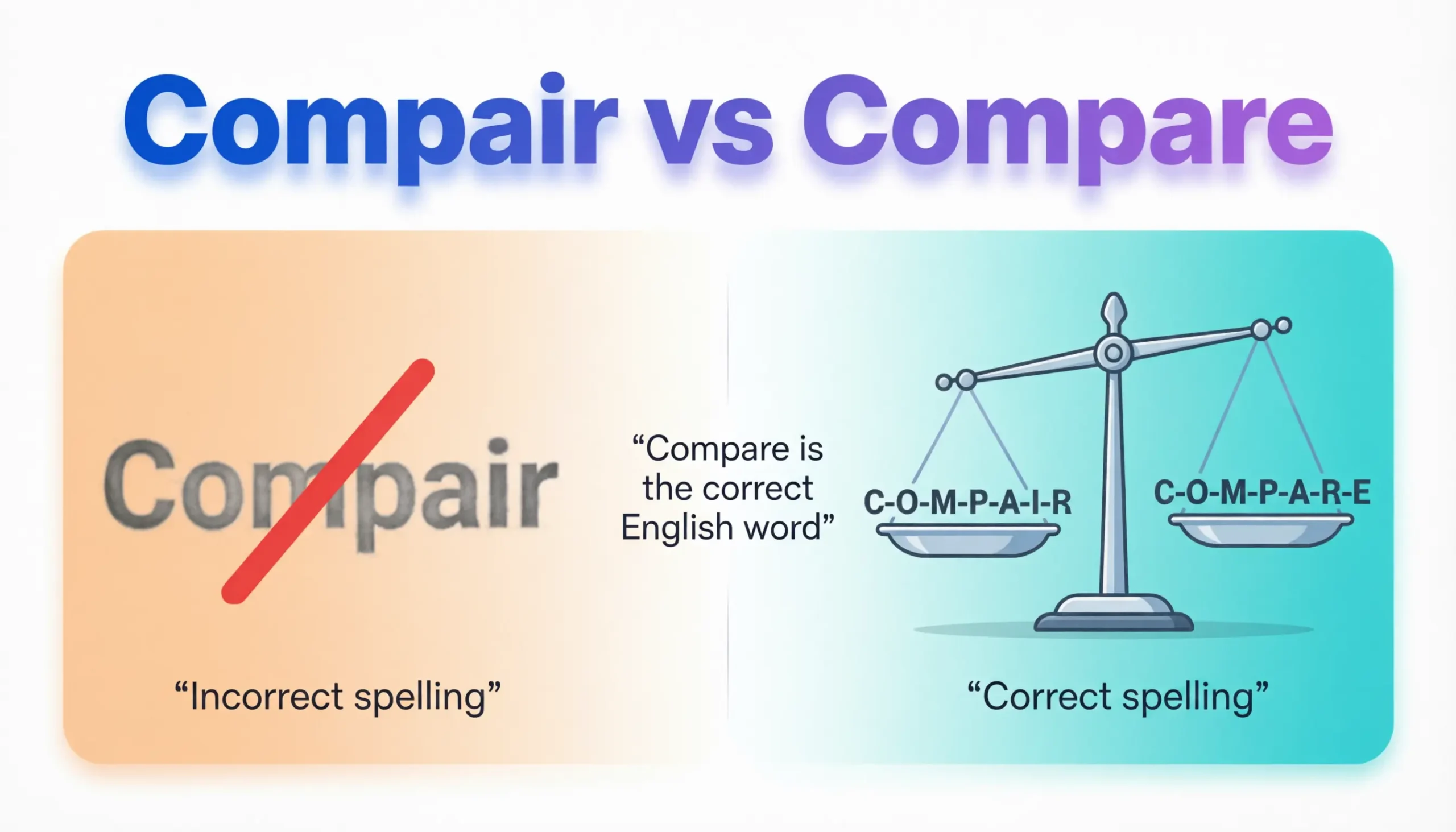
The truth is simple: “compare” is the correct English word, while “compair” is a misspelling in modern English. Still, many people accidentally type “compair” because it sounds similar when spoken aloud.
This confusion matters because spelling affects communication. A wrong spelling in an email, article, or resume can make writing look less professional. Search engines also show many results for “compair,” which causes even more uncertainty.
In this guide, you will learn the difference between compair vs compare, their origins, spelling rules, common mistakes, and how to use the correct form in real life. You will also see examples, FAQs, usage trends, and expert advice for British and American English users.
By the end, you will know exactly which spelling to use and why.
Compair vs Compare – Quick Answer
The correct spelling is compare.
“Compair” is not accepted as a standard English word today. It is usually a spelling mistake.
Correct Example
- Please compare the two reports.
- We need to compare prices before buying.
Incorrect Example
- Please compair the two reports.
- I will compair both phones.
Simple Rule
If you mean:
- checking differences
- checking similarities
- examining two things together
then always use compare.
| Word | Correct? | Meaning |
| Compare | Yes | To examine similarities or differences |
| Compair | No | Misspelling of compare |
The Origin of Compair vs Compare
The word compare comes from the Latin word comparare, which means “to match” or “to examine together.”
Later, it entered:
- Old French as comparer
- Middle English as compare
For hundreds of years, English speakers used compare as the standard spelling.
So where did compair come from?
“Compair” appeared because English spelling and pronunciation do not always match perfectly. Since “compare” sounds a little like “pair,” some writers mistakenly replace “pare” with “pair.”
In older Scottish writing, “compair” once appeared with a different meaning related to “appear” or “present oneself in court.” However, this use is rare and outdated today.
Modern English dictionaries accept compare only.
Key Point
- Compare = modern correct spelling
- Compair = spelling mistake in modern English
British English vs American English Spelling
Unlike some English words, compare has the same spelling in both British English and American English.
For example:
- British English: compare
- American English: compare
There is no regional spelling difference here.
Examples
| British English | American English |
| Compare the documents | Compare the documents |
| Compare both prices | Compare both prices |
| Compare the results | Compare the results |
Comparison Table
| Variation | British English | American English | Correct Today? |
| Compare | Yes | Yes | Yes |
| Compair | No | No | No |
Many users expect “compair” might be British spelling, but that is incorrect.
Which Spelling Should You Use?
You should use compare in all types of English writing.
For American Audiences
Use:
- compare
For British Audiences
Use:
- compare
For Global Audiences
Use:
- compare
In Professional Writing
Always use:
- compare
This includes:
- emails
- reports
- resumes
- academic writing
- business documents
Best Advice
If your spell checker shows “compair” as wrong, trust the correction and use compare.
Common Mistakes with Compair vs Compare
Many writers make small spelling mistakes with “compare.” Here are the most common ones.
1. Using “Compair” Instead of “Compare”
❌ Wrong:
- Let us compair the products.
✅ Correct:
- Let us compare the products.
2. Confusing Sound with Spelling
People hear:
- com-pair
But the spelling is:
- com-pare
English pronunciation can be tricky.
3. Typing Too Fast
Many typing mistakes happen because:
- “pair” is a common word
- autocorrect may miss the error sometimes
4. Using Wrong Forms
❌ Incorrect:
- comparision
✅ Correct:
- comparison
❌ Incorrect:
- compareing
✅ Correct:
- comparing
Compair vs Compare in Everyday Examples
Here is how the correct word appears in daily life.
Emails
- Please compare the sales numbers before the meeting.
- Can you compare these files for errors?
News Writing
- Experts compare inflation rates across countries.
- Analysts compare yearly market trends.
Social Media
- People often compare old phones with new models.
- Users compare streaming services online.
School Writing
- Compare the two poems in your essay.
- Students compare scientific results.
Business Writing
- Compare customer feedback from both stores.
- Managers compare monthly performance reports.
Compair vs Compare – Google Trends & Usage Data
Search engines show that “compare” is far more popular than “compair.”
Usage by Country
| Country | Popular Form |
| United States | Compare |
| United Kingdom | Compare |
| Canada | Compare |
| Australia | Compare |
| India | Compare |
Why “Compair” Still Appears Online
People search for “compair” because:
- they are unsure about spelling
- they type quickly
- English learners follow pronunciation instead of spelling
Online Contexts
| Context | Common Form |
| Professional writing | Compare |
| Academic writing | Compare |
| Casual typing mistakes | Compair |
| Search engine typo queries | Compair |
Google usually corrects “compair” automatically to “compare.”
Comparison Table: Compair vs Compare
| Feature | Compair | Compare |
| Correct English spelling | No | Yes |
| Found in dictionaries | Rare/obsolete | Yes |
| Used in modern writing | No | Yes |
| Accepted in business writing | No | Yes |
| Used in schools | No | Yes |
| Appears in typing mistakes | Yes | Sometimes |
| Standard global spelling | No | Yes |
FAQs About Compair vs Compare
Is “compair” a real word?
In modern English, “compair” is considered incorrect or obsolete.
Which is correct: compair or compare?
The correct spelling is compare.
Why do people write “compair”?
People confuse the sound with the spelling.
Is “compair” British English?
No. British English also uses compare.
Can I use “compair” in formal writing?
No. Use compare only.
Does Google correct “compair”?
Yes. Google often suggests “compare.”
What does “compare” mean?
It means examining similarities or differences between things.
Is “compare” used worldwide?
Yes. It is the standard spelling globally.
How can I remember the correct spelling?
Think of:
- compare
- comparison
- comparable
All use “pare,” not “pair.”
Tips to Remember the Correct Spelling
Memory Trick
Think:
- compare
- comparison
- comparable
They all share:
- “pare”
Not:
- “pair”
Easy Sentence
- “I compare things before I buy.”
Reading and writing the correct form often helps you remember it naturally.
Final Thoughts on Compair vs Compare
The difference between compair vs compare is simple once you know the rule. In modern English, compare is the correct spelling used in both British and American English. The spelling compair is usually just a typing or spelling mistake.
This confusion happens because English pronunciation does not always match spelling. Since “compare” sounds similar to the word “pair,” many people accidentally write “compair.” However, dictionaries, schools, businesses, and professional writers all use compare as the accepted standard.
No matter where you live the United States, the United Kingdom, Canada, Australia, or elsewhere you should always choose compare in formal and casual writing.
Using the correct spelling improves clarity and professionalism. It also helps avoid mistakes in emails, essays, reports, and online content.
A simple way to remember the correct form is to connect it with related words like:
- comparison
- comparable
- compared

I hold a degree in English Literature and Linguistics and have worked extensively on educational blogs, comparison websites, and digital learning platforms. My writing focuses on simplifying complex language rules, highlighting British vs American English differences, and providing practical examples for everyday usage.