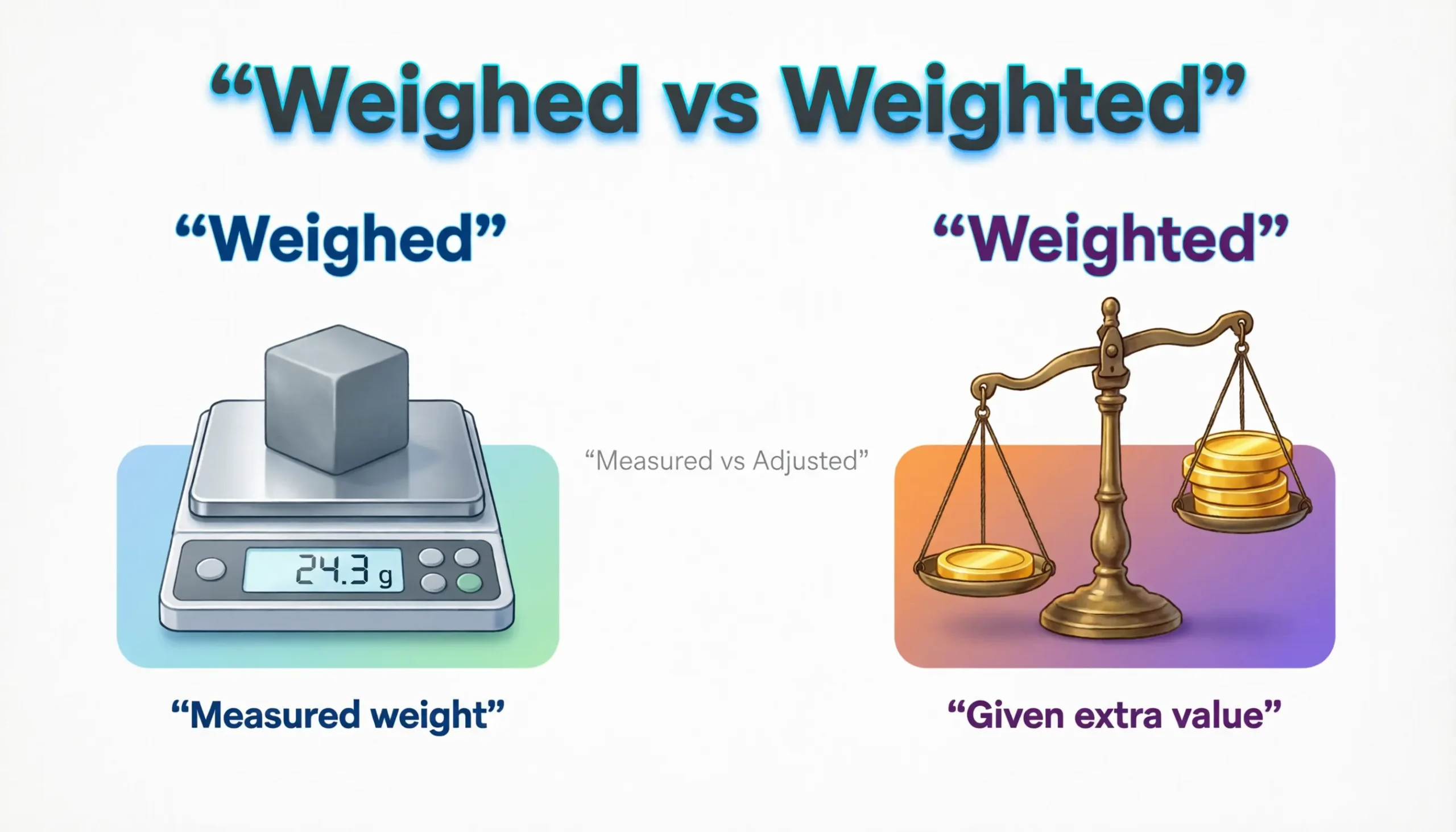
“Weighed” is the past tense of weigh, meaning to measure weight or consider something carefully, while “weighted” is an adjective meaning having extra weight added or adjusted according to importance.
Many English learners and writers get confused by “weighed” vs “weighted.” The two words look similar because both come from the word weight. But they do not mean the same thing.
People often search for this keyword because they see both words used in school, business, sports, science, and daily writing. One sentence may say, “The package was weighed,” while another says, “The survey used weighted scores.” This can make writers wonder which word is correct.
The good news is simple: both words are correct, but they are used in different ways. “Weighed” usually talks about measuring weight or thinking carefully about something. “Weighted” usually means something has extra importance, value, or added weight.
Knowing the difference helps you write better emails, reports, essays, and social media posts. It also helps avoid grammar mistakes in professional writing.
In this guide, you will learn the meaning, origin, spelling differences, examples, common mistakes, and the best way to use weighed vs weighted correctly.
Weighed vs Weighted – Quick Answer
| Word | Meaning | Example |
| Weighed | Measured weight or considered carefully | “She weighed the fruit.” |
| Weighted | Given extra importance or adjusted by value | “The exam is weighted at 40%.” |
Simple Rule
- Use weighed for measuring or thinking carefully.
- Use weighted for importance, scoring, statistics, or systems.
Examples
- “The doctor weighed the baby.”
- “The final test is weighted more heavily than homework.”
The Origin of Weighed vs Weighted
Both words come from the Old English word “gewicht,” related to mass and heaviness.
Weighed
“Weighed” is the past tense of the verb weigh.
It first meant:
- to measure heaviness
- to compare weight
- to think carefully about something
Example:
- “He weighed the options before deciding.”
Weighted
“Weighted” developed later as an adjective and verb form.
It means:
- carrying extra weight
- given more value or importance
- adjusted mathematically
Example:
- “The survey results were weighted by age.”
The spelling difference exists because the words serve different grammar purposes.
British English vs American English Spelling
There is no major spelling difference between British English and American English for these words.
Both countries use:
- weighed
- weighted
The real difference is in meaning, not spelling.
Comparison Table
| Usage | British English | American English |
| Past tense of weigh | weighed | weighed |
| Importance or scoring | weighted | weighted |
| Statistics and math | weighted | weighted |
| Physical measurement | weighed | weighed |
Examples
| Sentence | Correct Word |
| “The parcel was yesterday.” | weighed |
| “The grades are differently.” | weighted |
So unlike words such as colour/color or favour/favor, these words stay the same in both English styles.
Which Spelling Should You Use?
The correct choice depends on meaning, not country.
Use “Weighed” When:
- talking about measuring weight
- discussing careful thinking
- describing physical heaviness
Examples:
- “The chef weighed the ingredients.”
- “She weighed every choice carefully.”
Use “Weighted” When:
- discussing scores or percentages
- talking about statistics
- describing extra importance
Examples:
- “Attendance is weighted at 20%.”
- “The algorithm uses weighted data.”
Audience-Based Advice
| Audience | Best Choice |
| US readers | Use the correct meaning |
| UK readers | Use the correct meaning |
| Global audience | Keep usage simple and clear |
Since both spellings are standard worldwide, focus on context.
Common Mistakes with Weighed vs Weighted
Many writers mix these words because they look alike.
Mistake 1: Using “weighted” for physical measurement
❌ “The nurse weighted the patient.”
✅ “The nurse weighed the patient.”
Reason:
Physical measurement uses weighed.
Mistake 2: Using “weighed” for scoring systems
❌ “The exam is weighed at 50%.”
✅ “The exam is weighted at 50%.”
Reason:
Scoring systems use weighted.
Mistake 3: Confusing figurative meanings
❌ “The report was weighed toward older voters.”
✅ “The report was weighted toward older voters.”
Reason:
Statistics and adjustments use weighted.
Mistake 4: Wrong grammar in business writing
❌ “Our survey weighed customer age.”
✅ “Our survey weighted customer age.”
Reason:
Data analysis uses weighted.
Weighed vs Weighted in Everyday Examples
Emails
- “We weighed all shipping options before choosing one.”
- “They weight customer feedback heavily in our review process.”
News Writing
- “Officials weighed the risks carefully.”
- “The index is weighted toward technology companies.”
Social Media
- “I weighed myself after vacation.”
- “They weight votes based on region.”
In Formal Writing
- “The committee weighed the evidence.”
- “The scoring model uses weighted averages.”
In Education
- “They weight homework less than exams.”
- “The teacher weighed every argument fairly.”
Weighed vs Weighted – Google Trends & Usage Data
Search data shows that both terms are popular, but they appear in different contexts.
“Weighed” Is Common In:
- health
- fitness
- cooking
- decision-making
- shipping
Countries with strong usage:
- United States
- United Kingdom
- Canada
- Australia
“Weighted” Is Common In:
- education
- statistics
- finance
- technology
- economics
Countries with high professional and academic search traffic:
- United States
- India
- United Kingdom
- Singapore
Usage Trend Comparison
| Word | Common Context |
| weighed | measurement and decisions |
| weighted | scoring and analysis |
“Weighted” appears more in technical and academic writing, while “weighed” is more common in daily conversation.
Comparison Table: Weighed vs Weighted
| Feature | Weighed | Weighted |
| Part of speech | Verb | Adjective/Verb |
| Main meaning | Measured or considered | Given extra importance |
| Used in statistics | Rarely | Yes |
| Used for physical weight | Yes | No |
| Used in grading systems | No | Yes |
| Common in daily speech | Very common | Common in academic writing |
FAQs About Weighed vs Weighted
1. Is “weighted” grammatically correct?
Yes. “Weighted” is correct when talking about importance, scoring, or adjusted values.
2. Is “weighed” the past tense of “weigh”?
Yes. “Weighed” is the past tense and past participle of weigh.
Example:
- “She weighed the package.”
3. Can “weighted” mean physically heavy?
Sometimes, but it usually means added importance or adjusted value.
Example:
- “Weighted blanket.”
4. Which word is used in exams and grading?
Use weighted.
Example:
- “They weight final exams more heavily.”
5. Which word is used for measuring body weight?
Use weighed.
Example:
- “The doctor weighed the patient.”
6. Is “weighed carefully” correct?
Yes.
Example:
- “He weighed the pros and cons carefully.”
7. What is a weighted average?
A weighted average gives some values more importance than others.
8. Do British and American English use different spellings?
No. Both use:
- weighed
- weighted
9. Why do people confuse weighed and weighted?
They come from the same root word and look very similar, but they have different meanings.
Conclusion
Understanding weighed vs weighted is easier once you know their main difference. Weighed relates to measuring weight or thinking carefully. Weighted relates to added importance, adjusted values, or scoring systems.
This confusion happens because both words come from the same root word, weight. Still, their usage is very different in real writing. If you are talking about body weight, cooking ingredients, shipping, or careful decisions, use weighed. If you are discussing statistics, grades, finance, surveys, or importance levels, use weighted.
The good news is that British English and American English use the same spellings, so you do not need to worry about regional spelling changes. You only need to choose the correct meaning.
A simple memory trick can help:
- Weighed = measured
- Weighted = importance added
Using the correct word improves clarity in emails, school work, reports, blogs, and professional communication. When in doubt, check whether you are measuring something or giving it extra value. That will quickly tell you whether to use weighed or weighted.

I hold a degree in English Literature and Linguistics and have worked extensively on educational blogs, comparison websites, and digital learning platforms. My writing focuses on simplifying complex language rules, highlighting British vs American English differences, and providing practical examples for everyday usage.