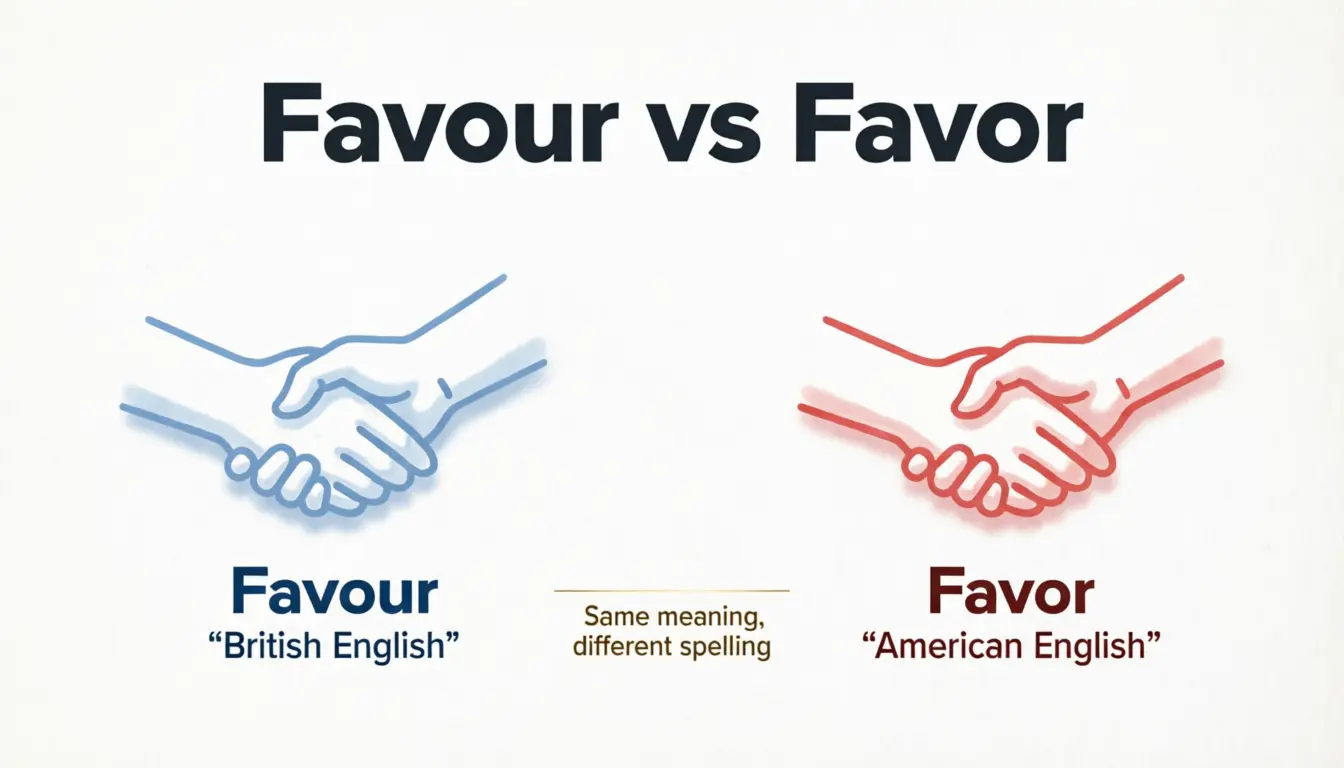
“Favour” is the British English spelling, while “favor” is the American English spelling, and both mean kindness, support, or approval.
Many English learners and even native speakers often get confused between “favour” and “favor.” At first glance, they look like two different words, but in reality, they mean exactly the same thing. The only difference is spelling, not meaning. This confusion happens because English is used in different regions of the world, especially British English and American English, which often follow different spelling rules.
People usually search this keyword when writing emails, academic assignments, job applications, or social media posts and are unsure which spelling is correct. Some worry they might look unprofessional if they choose the wrong version. Others simply want to understand why both forms exist in the first place.
This article clears all confusion. You will learn the meaning, origin, regional spelling differences, correct usage, common mistakes, real-life examples, and global usage trends. By the end, you will know exactly when to use “favour” or “favor” confidently in any situation without hesitation.
Favour or Favor – Quick Answer
Both “favour” and “favor” mean the same thing:
A kind act, support, or preference for someone.
The only difference is spelling:
- Favour → British English (UK, India, Pakistan, Australia, etc.)
- Favor → American English (USA)
Examples:
- British English: Can you do me a favour?
- American English: Can you do me a favor?
- British English: She returned the favour.
- American English: She returned the favor.
Meaning never changes. Only spelling changes.
The Origin of Favour or Favor
The word comes from the Latin word “favor,” which means kindness or good will.
It entered English through Old French as “favour.” At that time, English followed French spelling rules, which often included extra letters like “u.”
Later, in the 18th–19th century, American English started simplifying spellings. Writers like Noah Webster promoted shorter forms to make English easier and more consistent.
That is why:
- British English kept the older form → favour
- American English simplified it → favor
This pattern also appears in other words:
- colour (UK) → color (US)
- honour (UK) → honor (US)
British English vs American English Spelling
The difference between favour and favor is part of a larger spelling system difference.
Key Rule:
British English often keeps -our, while American English drops the “u.”
Comparison Table:
| British English | American English | Meaning |
| favour | favor | kindness or support |
| colour | color | hue or shade |
| honour | honor | respect |
| flavour | flavor | taste |
| labour | labor | work |
This pattern helps you predict spelling in many words.
Which Spelling Should You Use?
The correct spelling depends on your audience.
Use “Favour” if:
- You are writing in British English
- Your audience is in the UK, Pakistan, India, Australia, or New Zealand
- You are writing school or university assignments using British standards
Use “Favor” if:
- You are writing in American English
- Your audience is in the United States or working with US-based companies
- You are writing for global tech or business platforms using US style
Global tip:
If you are unsure, choose one style and stay consistent throughout your writing.
Common Mistakes with Favour or Favor
Many writers make simple errors with this word:
1. Mixing both spellings
❌ I need a favour and a favor
✔ I need a favour (UK) OR I need a favor (US)
2. Using wrong spelling for audience
❌ Writing “favour” in a US job application
✔ Use “favor” instead
3. Confusing meaning with “favorite”
- Favour/favor = kindness or help
- Favorite/favourite = preferred choice
4. Inconsistent writing style
❌ switching between favour and favor in same document
✔ pick one style only
Favour or Favor in Everyday Examples
Emails:
- Could you do me a favour and send the report? (UK)
- Could you do me a favor and send the report? (US)
Workplace:
- We appreciate your favour in approving this request.
- We appreciate your favor in approving this request.
Social Media:
- Can someone do me a favour? I need advice!
- Can someone do me a favor? I need advice!
Formal Writing:
- The committee granted the favour to the applicant.
- The committee granted the favor to the applicant.
Favour or Favor – Google Trends & Usage Data
Search behavior shows a clear regional split:
- “Favour” is most searched in:
- UK
- India
- Pakistan
- Australia
- Canada (mixed usage)
- “Favor” is most searched in:
- United States
- Latin America (US influence)
- Global tech platforms using US English
Insight:
Google Trends data consistently shows:
- “favor” dominates global search volume due to US internet influence
- “favour” remains strong in Commonwealth countries and academic writing
Comparison Table: Favour vs Favor
| Feature | Favour | Favor |
| Language style | British English | American English |
| Meaning | Kindness, help, support | Same meaning |
| Usage region | UK, Asia, Commonwealth | USA |
| Spelling rule | Keeps “u” | Drops “u” |
| Example | Do me a favour | Do me a favor |
FAQs about Favour or Favor
1. Are favour and favor different words?
No. They have the same meaning. Only spelling is different.
2. Is favour British or American English?
“Favour” is British English.
3. Is favor correct spelling?
Yes. “Favor” is correct in American English.
4. Can I mix favour and favor in one document?
No. Always use one style consistently.
5. Which spelling is more common?
“Favor” is more common globally due to US internet usage.
6. What is the noun form of favour/favor?
It is already a noun meaning kindness or help.
7. Is “favorite” related to favour?
Yes. “Favorite” comes from the same root idea of preference.
8. Do exams accept both spellings?
Yes, but you must match the required English style (UK or US).
Conclusion
The confusion between favour and favor is very common, but the answer is simple. Both words mean the same thing: kindness, help, or support. The only difference is spelling style. British English keeps the older form “favour,” while American English uses the simplified “favor.”
Understanding this difference is important for students, professionals, and writers because using the correct spelling shows attention to detail and language consistency. If you are writing for a UK audience, use “favour.” If you are writing for the US, use “favor.” In global writing, consistency matters more than choice.
By learning this small but important rule, you can avoid mistakes in emails, essays, job applications, and online communication. English spelling differences may seem confusing, but once you understand the pattern, they become easy to manage.
Now you can confidently use favour or favor without hesitation in any writing situation.

I am an Emily Carter Brooks U.S.A based linguistics writer known for my clear, reader-friendly explanations of English grammar and vocabulary differences. I have contributed to multiple online language resources and specializes in spelling variations, pronunciation confusion, and British vs American English comparisons. I’m passionate about helping learners improve their English through practical, everyday communication. engaging, and stress-free.