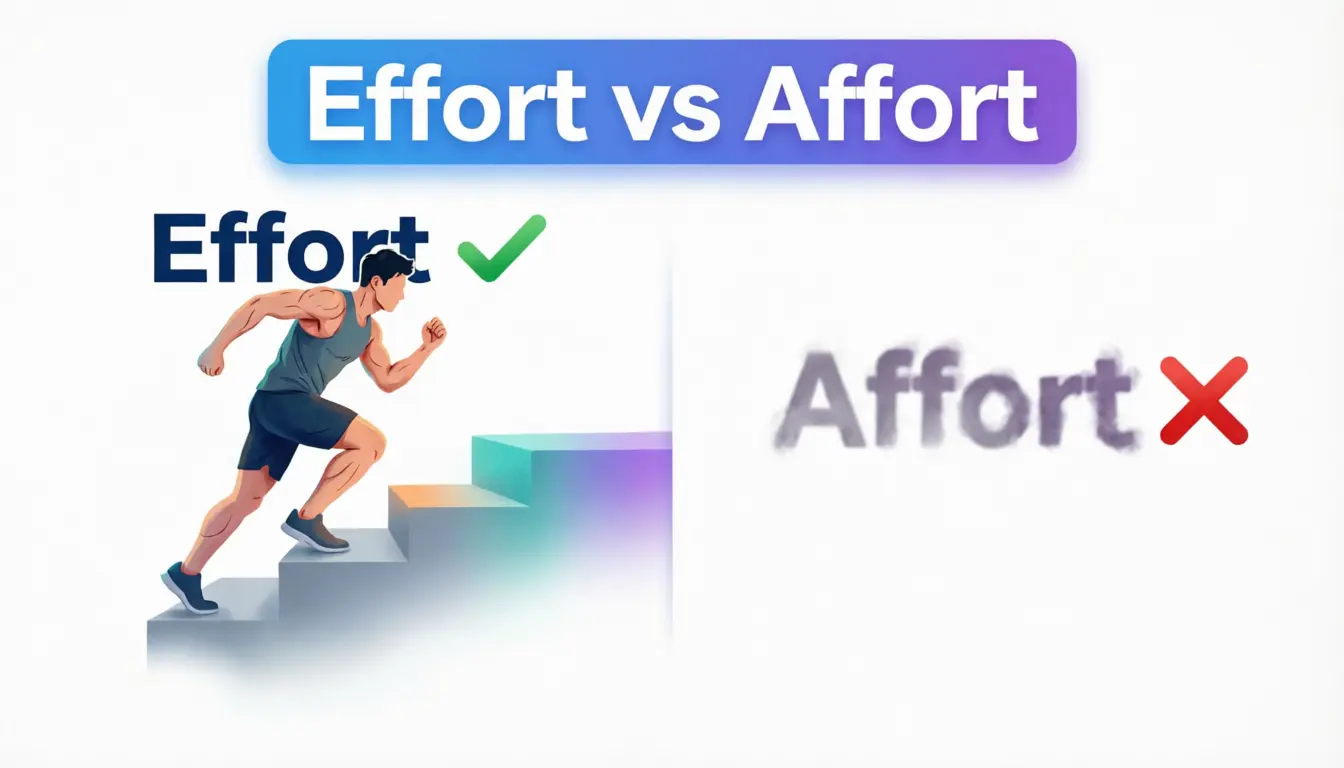
“Effort” is a noun meaning physical or mental energy used to achieve something, whereas “affort” has no accepted meaning in English.
Have you ever typed “affort” instead of “effort” and wondered if both words are correct? You are not alone. Many English learners and even native speakers confuse these spellings because they sound similar when spoken quickly. Search engines often show people looking for “effort vs affort” because they want to know which word is right in school writing, emails, social media posts, and professional documents.
The simple truth is that “effort” is the correct English word, while “affort” is a spelling mistake. Still, the confusion happens often because English spelling rules can be tricky. One small letter change can create a word that looks real but is not accepted in standard English.
This guide explains everything in easy language. You will learn the meaning of “effort,” where the word came from, why “affort” appears online, and which spelling you should use in British and American English.
You will also see common mistakes, real-life examples, FAQs, and usage tips. By the end, you will confidently know when and how to use the correct spelling.
Effort vs Affort – Quick Answer
The correct spelling is effort.
❌ Affort → Incorrect spelling
✅ Effort → Correct spelling
Meaning of “Effort”
“Effort” means hard work or an attempt to do something.
Examples
- She made a big effort to improve her English.
- Your effort will bring success.
- The team put great effort into the project.
“Affort” is not a standard English word and should not be used in formal or informal writing.
The Origin of Effort vs Affort
The word effort comes from Old French and Latin roots.
Word History
- Old French: esforz
- Latin: exfortis
- Meaning: strength, force, or exertion
Over time, English adopted the spelling effort. Dictionaries, schools, and grammar guides all accept this version.
Why Does “Affort” Exist?
“Affort” usually appears because of:
- Typing mistakes
- Pronunciation confusion
- Autocorrect errors
- English learners guessing the spelling
Since “effort” begins with the “ef” sound, some people mistakenly write “af” instead.
British English vs American English Spelling
Unlike many English words, “effort” has the same spelling in both British and American English.
There is no regional spelling difference.
| British English | American English | Correct? |
| effort | effort | ✅ Yes |
| affort | affort | ❌ No |
Examples in British English
- The students showed great effort during exams.
Examples in American English
- Her effort helped the company grow.
Important Note
Some English words change spelling between UK and US English, such as:
| British English | American English |
| colour | color |
| favour | favor |
| organise | organize |
But effort stays the same everywhere.
Which Spelling Should You Use?
You should always use effort.
If Your Audience Is American
Use:
- effort
If Your Audience Is British or Commonwealth
Use:
- effort
If Your Audience Is Global
Use:
- effort
Because “effort” is accepted worldwide, it is the safest and most professional choice for:
- Emails
- School work
- Business writing
- Social media
- News articles
- Blogs
Never use “affort” in professional communication.
Common Mistakes with Effort vs Affort
People often make small spelling mistakes with “effort.”
Common Errors
| Incorrect | Correct |
| affort | effort |
| efort | effort |
| effert | effort |
| efforts | efforts |
| makeing effort | making effort |
Wrong Sentences
❌ She made an affort to help.
❌ I appreciate your affort.
Correct Sentences
✅ She made an effort to help.
✅ I appreciate your effort.
Tip to Remember
Think of:
E for Energy → Effort
Both words start with “E.”
Effort vs Affort in Everyday Examples
Here are real-life examples showing the correct usage of “effort.”
Emails
- Thank you for your effort on this project.
- We appreciate your hard effort.
News Writing
- Rescue teams made every effort to save lives.
- The government increased its effort against pollution.
Social Media
- Success comes with daily effort.
- Your fitness effort is inspiring.
In School Writing
- The student showed strong effort in class.
- Hard effort leads to better grades.
In Business Writing
- The company values teamwork and effort.
- Employee effort improved productivity.
Effort vs Affort – Google Trends & Usage Data
Search data shows that “effort” is extremely popular, while “affort” mainly appears as a misspelling.
Where “Effort” Is Common
The word “effort” is widely used in:
- United States
- United Kingdom
- Canada
- Australia
- India
- Pakistan
Why People Search “Affort”
Users often search “affort” because:
- They heard the word but never saw the spelling
- English pronunciation can sound unclear
- Mobile typing errors happen often
Online Usage Comparison
| Word | Usage Popularity | Accepted English? |
| effort | Very High | ✅ Yes |
| affort | Very Low | ❌ No |
Google search results, dictionaries, and grammar tools all recognize “effort” as the correct spelling.
Comparison Table: Effort vs Affort
| Feature | Effort | Affort |
| Correct spelling | ✅ Yes | ❌ No |
| Dictionary word | ✅ Yes | ❌ No |
| Used in formal writing | ✅ Yes | ❌ No |
| Used in business English | ✅ Yes | ❌ No |
| Accepted in UK English | ✅ Yes | ❌ No |
| Accepted in US English | ✅ Yes | ❌ No |
| Meaning | Hard work or attempt | No standard meaning |
FAQs About Effort vs Affort
1. Is “affort” a real English word?
No. “Affort” is not a standard English word.
2. Which spelling is correct: effort or affort?
The correct spelling is effort.
3. Why do people write “affort”?
People often confuse the pronunciation or make typing mistakes.
4. Is “effort” used in British English?
Yes. British English uses “effort.”
5. Is “effort” used in American English?
Yes. American English also uses “effort.”
6. What does “effort” mean?
It means hard work, energy, or an attempt to do something.
7. Can I use “affort” in casual writing?
No. Even in casual writing, “affort” is considered incorrect.
8. How can I remember the correct spelling?
Remember:
“Effort needs energy.”
Both begin with “E.”
9. Is “effort” a noun or verb?
“Effort” is mainly used as a noun.
Example:
- Her effort was amazing.
Conclusion
The confusion between “effort vs affort” is very common, especially among English learners and fast typists. However, the correct spelling is always effort. The word means hard work, energy, or an attempt to achieve something. In contrast, “affort” is simply a spelling error and is not accepted in standard English.
One helpful fact is that both British and American English use the exact same spelling: effort. This makes the word easier to remember because you do not need to learn regional variations. If you are writing an email, school assignment, business report, blog post, or social media caption, “effort” is the correct and professional choice.
If you often confuse the spelling, try linking the word with “energy.” Both start with the letter “E,” making it easier to remember. Small spelling corrections can greatly improve your English writing quality and help you communicate more clearly.
Always choose effort, and avoid using “affort” in any form of writing.

I am an Emily Carter Brooks U.S.A based linguistics writer known for my clear, reader-friendly explanations of English grammar and vocabulary differences. I have contributed to multiple online language resources and specializes in spelling variations, pronunciation confusion, and British vs American English comparisons. I’m passionate about helping learners improve their English through practical, everyday communication. engaging, and stress-free.