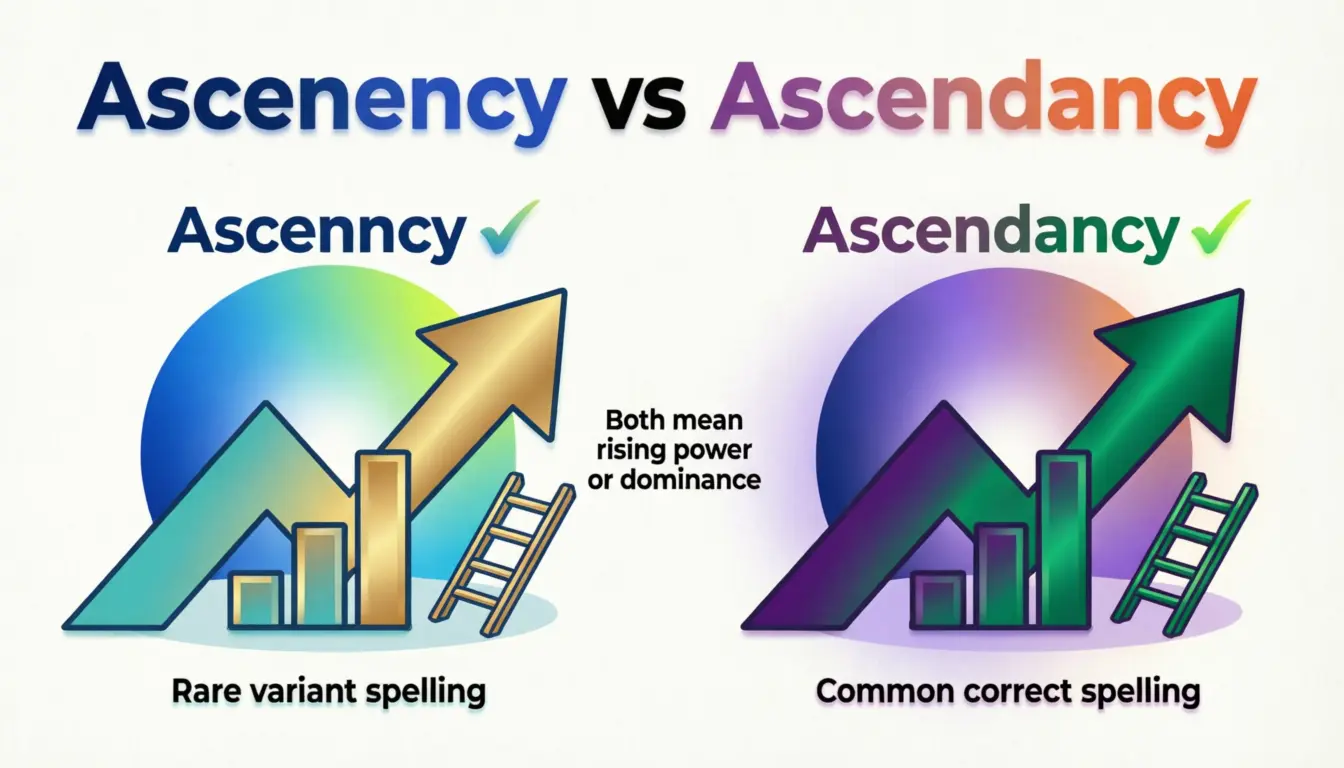
“Ascendancy” is the correct and standard spelling, while “ascendency” is a less common variant.
Many English words look almost the same but have different spellings. One common example is ascendency vs ascendancy. These two words confuse writers, students, bloggers, and even professionals because both are accepted in English. People often search this keyword to learn which spelling is correct, which one sounds more natural, and whether one belongs to British English or American English.
The good news is simple: both ascendency and ascendancy are correct words. They have the same meaning and are used to describe a position of power, control, influence, or dominance. The confusion happens because English developed from different spelling traditions over time. Some dictionaries prefer one form, while others list both equally.
Understanding the difference matters if you write emails, academic papers, news articles, business reports, or online content. Using the right version for your audience can make your writing look more polished and professional.
In this guide, you will learn the meaning, origin, spelling differences, usage examples, common mistakes, Google Trends insights, and expert advice about ascendency vs ascendancy in simple English.
Ascendency vs Ascendancy – Quick Answer
Both ascendency and ascendancy mean:
- A position of power or control
- Strong influence over others
- Dominance or superiority
Example Sentences
- The company gained ascendancy in the market.
- The king achieved political ascendency after the war.
In modern English, ascendancy is much more common than ascendency.
Quick Difference
| Word | Meaning | Usage Popularity |
| Ascendancy | Power or dominance | Very common |
| Ascendency | Same meaning | Less common |
So, if you are unsure, ascendancy is usually the safer choice.
The Origin of Ascendency vs Ascendancy
The words come from the verb ascend, which means “to rise” or “to go upward.”
Both spellings appeared in English during the 18th century. They developed from Latin roots connected to rising, climbing, and gaining higher status.
Why Two Spellings Exist
English often keeps multiple spellings of the same word because of:
- Historical language changes
- Different dictionary preferences
- British and American writing traditions
- Older literary usage
Over time, ascendancy became the preferred spelling in newspapers, books, and academic writing. However, ascendency never disappeared completely.
Historical Usage
Older writers sometimes used ascendency more often. Today, modern publishers usually prefer ascendancy because it sounds more natural to current readers.
British English vs American English Spelling
Unlike words such as “colour” and “color,” both spellings appear in British and American English. Still, ascendancy is more widely accepted in both regions.
British English
British publications strongly favor ascendancy.
Example:
- Britain maintained naval ascendancy for many years.
American English
American writers also prefer ascendancy, though ascendency occasionally appears in older texts.
Example:
- The tech company gained economic ascendancy.
Comparison Table
| Feature | Ascendancy | Ascendency |
| Correct spelling | Yes | Yes |
| More common in UK | Yes | Rare |
| More common in US | Yes | Rare |
| Seen in modern media | Frequently | Occasionally |
| Recommended for formal writing | Yes | Sometimes |
Simple Rule
If you want the most accepted spelling worldwide, choose ascendancy.
Which Spelling Should You Use?
The best spelling depends on your audience and writing style.
Use “Ascendancy” If:
- You write for global readers
- You create SEO content
- You write business or academic documents
- You want modern standard English
- You publish online articles
Use “Ascendency” If:
- You follow older literary style
- Your organization already uses it
- You quote historical material
Audience-Based Advice
| Audience | Recommended Spelling |
| American readers | Ascendancy |
| British readers | Ascendancy |
| Commonwealth countries | Ascendancy |
| Academic writing | Ascendancy |
| Historical writing | Either |
| SEO blogs | Ascendancy |
Professional Tip
For clarity and consistency, most editors recommend sticking with ascendancy throughout your writing.
Common Mistakes with Ascendency vs Ascendancy
People often make small mistakes when using these words.
Mistake 1: Thinking One Word Is Wrong
❌ “Ascendency is incorrect.”
✅ Both spellings are correct.
Mistake 2: Mixing Spellings in One Article
❌ The company gained ascendancy.
❌ Its political ascendency increased later.
✅ Choose one spelling and stay consistent.
Mistake 3: Using the Word Incorrectly
These words describe power or influence.
❌ “She climbed the hill with ascendancy.”
✅ “The leader gained political ascendancy.”
Mistake 4: Confusing with “Ascension”
- Ascendancy = dominance or influence
- Ascension = rising upward
Example:
- The king’s ascendancy lasted decades.
- The balloon’s ascension was slow.
Ascendency vs Ascendancy in Everyday Examples
Seeing real-life examples makes the difference easier to understand.
Emails
- Our brand has gained market ascendancy this year.
- The team achieved clear industry ascendency.
News Articles
- The country seeks military ascendancy in the region.
- The party maintained political ascendency after elections.
Social Media
- Streaming platforms now have cultural ascendancy.
- AI tools are gaining digital ascendency worldwide.
Formal Writing
- Economic ascendancy shifted toward Asia.
- The empire’s ascendency weakened over time.
Business
- The startup reached market ascendancy quickly.
- Brand ascendency depends on innovation.
Ascendency vs Ascendancy – Google Trends & Usage Data
Search trends show that ascendancy is much more popular than ascendency.
Global Usage
Countries where ascendancy is more common:
- United States
- United Kingdom
- Canada
- Australia
- India
Why Ascendancy Wins
- More modern usage
- Preferred by major dictionaries
- Common in journalism
- Stronger SEO visibility
- More natural for readers
Online Writing Trends
Writers, bloggers, and publishers use ascendancy because search engines recognize it more often.
Usage Comparison Table
| Factor | Ascendancy | Ascendency |
| Google searches | High | Low |
| Dictionary preference | Strong | Moderate |
| SEO value | Better | Lower |
| Media usage | Common | Rare |
| Reader familiarity | High | Medium |
Important Note
Even though ascendency is less common, it is still grammatically correct.
Comparison Table: Ascendency vs Ascendancy
| Feature | Ascendancy | Ascendency |
| Meaning | Dominance or power | Same |
| Correct spelling | Yes | Yes |
| Popularity | Very high | Lower |
| Formal writing | Preferred | Accepted |
| SEO friendliness | Better | Weaker |
| Modern usage | Common | Less common |
| British English | Preferred | Rare |
| American English | Preferred | Rare |
FAQs About Ascendency vs Ascendancy
Is ascendency a real word?
Yes. Ascendency is a real English word and is grammatically correct.
Which is more common: ascendancy or ascendency?
Ascendancy is much more common in modern English.
Do both words mean the same thing?
Yes. Both words mean dominance, influence, or control.
Is ascendancy British or American?
Both British and American English prefer ascendancy.
Should I avoid using ascendency?
You do not need to avoid it, but ascendancy is usually the better choice for modern readers.
Which spelling is better for content?
Ascendancy performs better because more people search for it online.
Can I use both spellings in one document?
No. Choose one spelling and stay consistent.
Is ascendency old-fashioned?
Some readers see it as slightly old-fashioned because it appears less often today.
Which spelling do dictionaries prefer?
Most modern dictionaries list ascendancy as the primary form.
Conclusion
The debate around ascendency vs ascendancy is simpler than many people think. Both words are correct, both share the same meaning, and both describe power, influence, or dominance. The real difference is popularity and modern preference.
Today, ascendancy is the dominant spelling in British English, American English, journalism, academic writing, and online publishing. It appears more often in books, websites, business reports, and news articles. Because readers recognize it more easily, it is usually the best choice for professional and growth-focused writing.
Meanwhile, ascendency still exists as a valid alternative. You may see it in historical texts, older literature, or certain organizational styles. There is nothing grammatically wrong with using it, but it can appear less modern to some readers. People also search for Ascendancy government, Ascendancy government, Ascendancy antonyms, Ascendancy synonym and antonym, Ascendancy pronunciation, Ascendancy in a sentence, Moral ascendancy meaning, etc.
The most important rule is consistency. Pick one spelling and use it throughout your document. If your goal is clear communication and global readability, ascendancy is generally the safest option.
Understanding these small spelling differences helps improve your writing confidence, accuracy, and professionalism in everyday English.

I am an Emily Carter Brooks U.S.A based linguistics writer known for my clear, reader-friendly explanations of English grammar and vocabulary differences. I have contributed to multiple online language resources and specializes in spelling variations, pronunciation confusion, and British vs American English comparisons. I’m passionate about helping learners improve their English through practical, everyday communication. engaging, and stress-free.