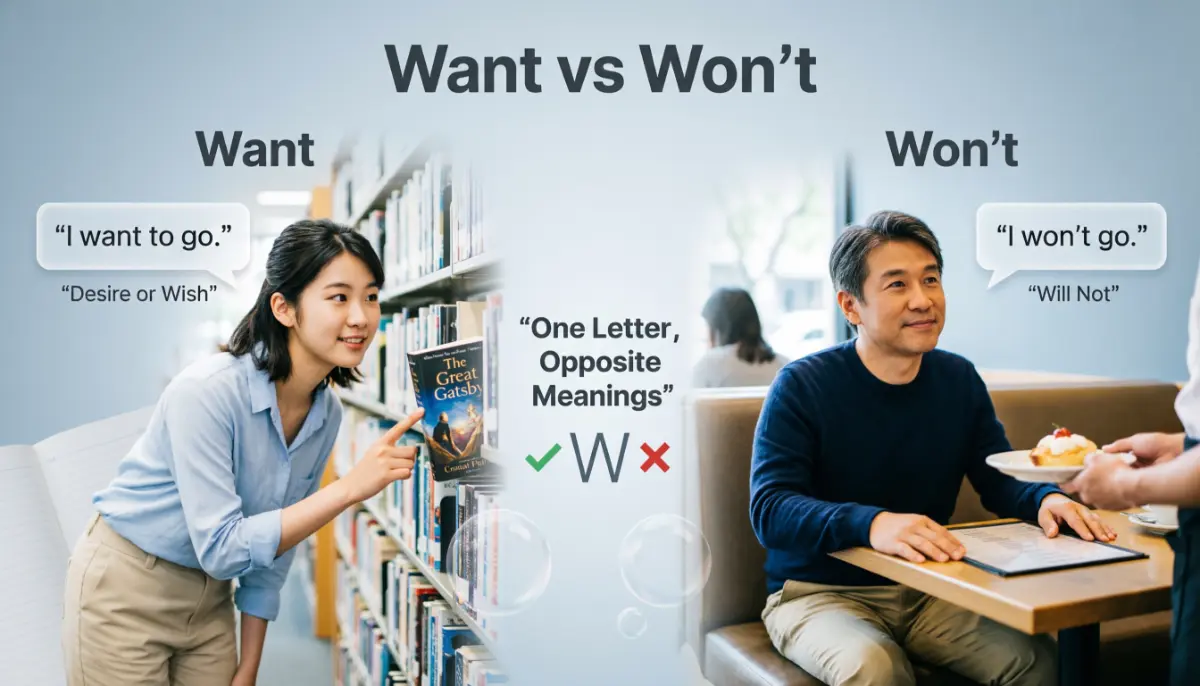
“Want” and “won’t” are both correct words, but they have completely different meanings. “Want” is a verb meaning to desire, need, or wish for something, while “won’t” is the contraction of will not, used to express refusal or a future action that will not happen.
Have you ever typed a sentence and wondered whether to use want or won’t? These two words look somewhat similar, but they have very different meanings. Because of their pronunciation and spelling, many English learners and even native speakers occasionally mix them up.
The confusion often happens in quick conversations, text messages, or informal writing. For example, “I want to go” and “I won’t go” express completely opposite ideas. One shows desire, while the other shows refusal or a future negative action.
Understanding the difference between want vs won’t is important because using the wrong word can change the meaning of a sentence entirely. If you are writing emails, social media posts, academic papers, or business documents, choosing the correct word helps your message stay clear and professional.
In this guide, you’ll learn the meaning, history, usage, common mistakes, examples, trends, and practical tips for using want and won’t correctly.
Want vs Won’t – Quick Answer
The difference is simple:
- Want means to desire, wish for, or need something.
- Won’t is the contraction of will not, meaning something will not happen or someone refuses to do something.
Examples
✅ I want a new laptop.
✅ She wants to learn English.
Quick Comparison
| Word | Meaning | Example |
| Want | Desire or wish for something | I want a coffee. |
| Won’t | Will not | I won’t drink coffee tonight. |
The Origin of Want vs Won’t
Want
The word want comes from Old Norse vanta, meaning “to lack” or “to be missing.” Over time, English speakers began using it to express desire for something they lacked.
Won’t
The word won’t is a contraction of will not. Its spelling may seem unusual because it evolved from older English forms. Instead of becoming “willn’t,” the language gradually adopted “won’t” as the accepted contraction.
Why the Difference Exists
These words are unrelated in origin:
- Want developed from words meaning lack or desire.
- Won’t developed as a shortened form of will not.
Although they look somewhat alike, they serve completely different purposes in English grammar.
British English vs American English Spelling
Unlike many English words, want and won’t are spelled the same way in both British and American English.
There is no regional spelling difference.
Examples
| British English | American English |
| I want some tea. | I want some tea. |
| I won’t be late. | I won’t be late. |
| She wants help. | She wants help. |
| They won’t attend. | They won’t attend. |
Key Point
Whether you write for readers in the United Kingdom, the United States, Canada, Australia, or New Zealand, the spelling remains identical.
Which Spelling Should You Use?
Since both words are standard English words rather than spelling variants, your choice depends entirely on meaning.
Use “Want” When:
- Expressing desire
- Showing preference
- Asking for something
- Describing needs
Examples
- I want a vacation.
- We want better results.
Use “Won’t” When:
- Refusing something
- Describing a future negative action
- Saying something will not happen
Examples
- I won’t sign the contract.
- The machine won’t start.
Audience-Based Advice
| Audience | Recommended Usage |
| US Readers | Use want for desire, won’t for will not |
| UK Readers | Use want for desire, won’t for will not |
| Commonwealth Readers | Same rule |
| Global Audience | Same rule |
Common Mistakes with Want vs Won’t
Many mistakes happen because of pronunciation or typing errors.
Mistake #1
❌ I won’t a new phone.
✅ I want a new phone.
Mistake #2
❌ She want attend the event.
✅ She won’t attend the event.
Mistake #3
❌ We want be there tomorrow.
✅ We won’t be there tomorrow.
Mistake #4
❌ I won’t some water.
✅ I want some water.
Easy Trick
Ask yourself:
Am I talking about a desire?
→ Use want
Am I saying “will not”?
→ Use won’t
Want vs Won’t in Everyday Examples
In Emails
Want
I want to discuss the project timeline.
Won’t
I won’t be available on Friday.
In News Writing
Want
Citizens want lower taxes.
Won’t
Officials say the policy won’t change this year.
On Social Media
Want
I want pizza tonight!
Won’t
I won’t miss this concert.
In Formal Writing
Want
The organization wants to improve efficiency.
Won’t
The proposal won’t affect existing agreements.
In Conversations
- I want to leave early.
- I won’t leave until the work is finished.
Want vs Won’t – Google Trends & Usage Data
Search data shows that both words are widely used across English-speaking countries.
Want
The word want is searched frequently because people look for:
- Meaning
- Grammar rules
- Synonyms
- Sentence examples
Won’t
The word won’t is commonly searched for:
- Contraction rules
- Pronunciation
- Grammar explanations
- Writing guidance
Popular Countries
Both terms are heavily used in:
- United States
- United Kingdom
- Canada
- Australia
- India
Usage Context
| Word | Common Context |
| Want | Requests, desires, needs |
| Won’t | Refusals, future negatives, promises |
Because these words appear in everyday speech, their usage remains consistently high worldwide.
Want vs Won’t Comparison Table
| Feature | Want | Won’t |
| Part of Speech | Verb | Contraction |
| Meaning | Desire something | Will not |
| Positive or Negative | Positive | Negative |
| Formal Writing | Yes | Yes |
| Informal Writing | Yes | Yes |
| Example | I want help. | I won’t help. |
| Expresses Desire | Yes | No |
| Expresses Refusal | No | Yes |
Quick Quiz: Want or Won’t?
Choose the correct word.
Questions
- I _____ buy that car.
- She _____ come to the party.
- We _____ more information.
- The computer _____ turn on.
- They _____ visit Paris next year.
Answers
- want
- won’t
- want
- won’t
- want
Fill in the Blanks Exercise
Complete each sentence.
- I _____ learn Spanish.
- He _____ answer my calls.
- We _____ a bigger office.
- The train _____ arrive on time.
- They _____ improve their skills.
Answers
- want
- won’t
- want
- won’t
- want
FAQs
1. What is the difference between want and won’t?
Want means desire, while won’t means will not.
2. Is won’t short for will not?
Yes. Won’t is the standard contraction of will not.
3. Can want and won’t be used interchangeably?
No. They have completely different meanings.
4. Why do people confuse want and won’t?
Their spelling and pronunciation can seem similar in fast speech.
5. Is won’t formal English?
Yes. It is widely accepted in both formal and informal writing.
6. Is want a verb?
Yes. It is a verb that expresses desire or need.
7. Which is more common, want or won’t?
Want generally appears more often because people frequently express needs and desires.
8. Are there British and American spelling differences?
No. Both words are spelled the same way everywhere.
9. How can I remember the difference?
Think of want as desire and won’t as will not.
Conclusion
Understanding want vs won’t is essential for clear communication. Although these words look somewhat similar, they express completely different ideas. Want shows desire, need, or preference. Won’t, on the other hand, is the contraction of will not and expresses refusal or a future negative action.
The easiest way to choose the correct word is to focus on your meaning. If you are talking about something you desire or hope to have, use want. If you mean that something will not happen or someone refuses to do something, use won’t. This simple rule works in emails, academic writing, social media posts, business communication, and everyday conversations.
Fortunately, there are no spelling differences between British and American English for these words. The same forms are accepted worldwide. By practicing with examples, quizzes, and exercises, you can avoid common mistakes and use both words confidently. Remember: want equals desire, won’t equals will not. Keeping that distinction in mind will help you write and speak English more accurately and naturally.

I hold a degree in English Literature and Linguistics and have worked extensively on educational blogs, comparison websites, and digital learning platforms. My writing focuses on simplifying complex language rules, highlighting British vs American English differences, and providing practical examples for everyday usage.