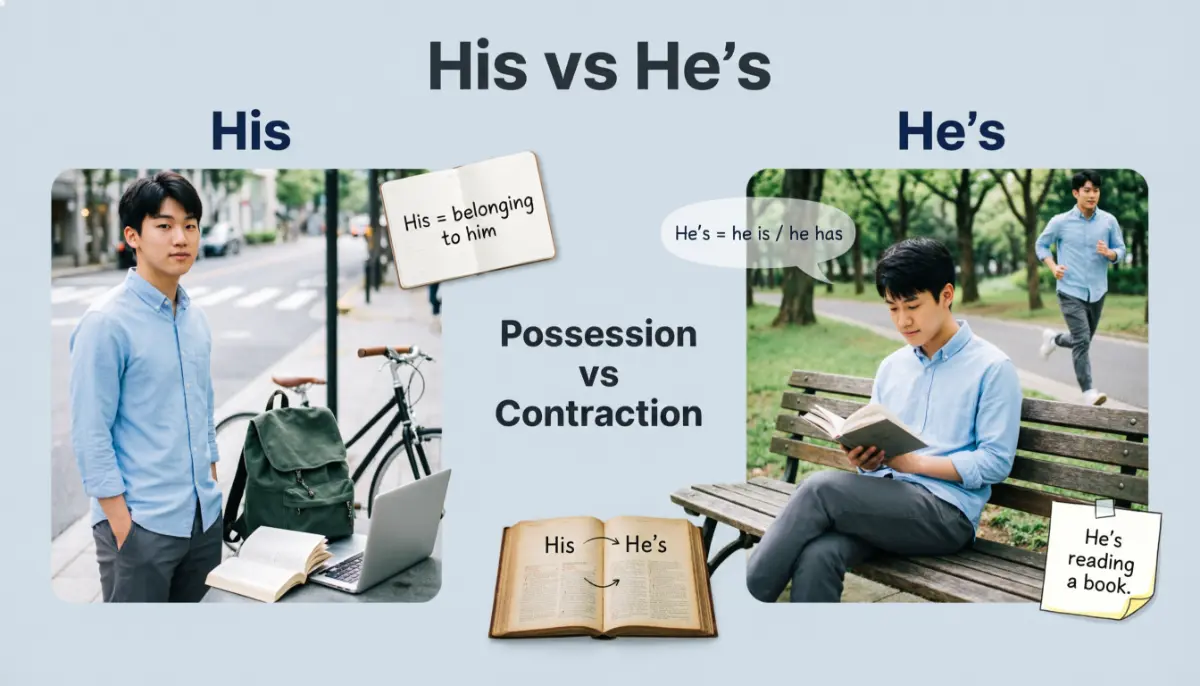
“His” and “he’s” are both correct words, but they have different meanings and uses. “His” is a possessive pronoun showing that something belongs to a male person (e.g., his book), while “he’s” is a contraction of he is or he has (e.g., he’s happy or he’s finished).
Many English learners and even native speakers get confused by his vs he’s. At first glance, these two words look very similar. The only difference is an apostrophe. Yet that small mark changes the meaning completely.
People often search for “his vs he’s” because they want to avoid grammar mistakes in emails, school assignments, social media posts, and professional writing. Using the wrong form can make a sentence unclear and may affect your credibility.
The good news is that the difference is simple. His shows possession. It tells us that something belongs to a male person. He’s is a contraction of he is or he has. It combines two words into one shorter form.
Understanding this distinction will help you write more accurately and speak more confidently. In this guide, you’ll learn the meaning of each word, their history, common mistakes, examples, usage trends, and practical tips to choose the correct spelling every time.
His vs He’s – Quick Answer
The difference is simple:
| Word | Meaning | Example |
| His | Shows ownership or possession | This is his car. |
| He’s | Short form of “he is” or “he has” | He’s happy today. |
Examples
- His dog is very friendly.
- He’s going to school.
- I borrowed his book.
- He’s finished his homework.
Quick Tip: If you can replace the word with he is or he has, use he’s. Otherwise, use his.
The Origin of His vs He’s
His
The word his comes from Old English his, which was used as the possessive form of he. It has been part of the English language for over a thousand years.
Examples:
- His house
- His idea
- His bicycle
He’s
The word he’s appeared later as English speakers began shortening common word combinations. It is a contraction of:
- He is → He’s
- He has → He’s
Examples
- He’s tired. (He is tired.)
- He’s completed the project. (He has completed the project.)
The apostrophe replaces missing letters, making speech and informal writing faster and smoother.
British English vs American English Spelling
Unlike many spelling differences in English, his and he’s are spelled exactly the same way in both British and American English.
The only difference is how people use contractions in formal writing. British and American writers may have different style preferences, but the spelling remains unchanged.
Comparison Table
| Feature | British English | American English |
| Possessive pronoun | His | His |
| Contraction of “he is” | He’s | He’s |
| Contraction of “he has” | He’s | He’s |
| Formal writing preference | Sometimes fewer contractions | Contractions more common |
| Meaning difference | Same | Same |
Examples
British English:
- His office is nearby.
- He’s working today.
American English:
- His office is nearby.
- He’s working today.
Which Spelling Should You Use?
The correct choice depends on what you want to say.
Use His When Showing Ownership
Examples
- His phone is ringing.
- His jacket is on the chair.
- His answer was correct.
Use He’s When Meaning “He Is”
Examples
- He’s a doctor.
- He’s ready to leave.
- He’s very kind.
Use He’s When Meaning “He Has”
Examples
- He’s finished the report.
- He’s already eaten lunch.
- He’s completed the course.
Audience-Based Advice
| Audience | Recommended Usage |
| US Readers | Use both according to meaning |
| UK Readers | Use both according to meaning |
| Commonwealth Countries | Use both according to meaning |
| Global Audience | Follow standard grammar rules |
The choice is based on meaning, not location.
Common Mistakes with His vs He’s
Many writers accidentally mix these words because they sound similar.
Mistake #1: Using His Instead of He’s
❌ His going to school.
✅ He’s going to school.
Reason: The sentence means “He is going.”
Mistake #2: Using He’s Instead of His
❌ I borrowed he’s book.
✅ I borrowed his book.
Reason: The sentence shows ownership.
Mistake #3: Forgetting the Apostrophe
❌ Hes a great teacher.
✅ He’s a great teacher.
Reason: The apostrophe is required in contractions.
Mistake #4: Confusing Possession with Contraction
❌ He’s car is new.
✅ His car is new.
Reason: A car belongs to him, so use the possessive pronoun.
His vs He’s in Everyday Examples
- His presentation was excellent.
- He’s available for a meeting tomorrow.
News Writing
- His comments received attention online.
- He’s expected to announce the decision next week.
Social Media
- His new video is amazing!
- He’s trending again today.
Formal Writing
- His research contributed significantly to the study.
- He is expected to publish further findings.
In very formal writing, some editors prefer writing he is instead of he’s, but both are grammatically correct.
His vs He’s – Google Trends & Usage Data
Search interest for his vs he’s remains steady because many learners struggle with apostrophes and contractions.
Where Searches Are Common
- United States
- United Kingdom
- Canada
- Australia
- India
Why People Search for It
- Grammar homework
- English learning
- Professional writing
- Editing documents
- Social media writing
Usage Context
| Word | Common Context |
| His | Ownership, possession |
| He’s | Conversation, emails, everyday writing |
| He Is | Formal writing |
| He Has | Perfect tense constructions |
In published writing, his generally appears more often because possession is frequently expressed in English.
Comparison Table: His vs He’s
| Feature | His | He’s |
| Part of Speech | Possessive Pronoun | Contraction |
| Meaning | Belonging to him | He is / He has |
| Apostrophe | No | Yes |
| Shows Ownership | Yes | No |
| Shortened Form | No | Yes |
| Example | His bike is blue. | He’s riding a bike. |
Quiz: His or He’s?
Choose the correct word.
Questions
- _____ going to the store.
- I like _____ new laptop.
- _____ already finished dinner.
- _____ teacher is very helpful.
- _____ excited about the trip.
Answers
- He’s
- His
- He’s
- His
- He’s
Fill in the Blanks Exercise
Complete the sentences with his or he’s.
- ______ reading a new book.
- I borrowed ______ pen.
- ______ been working all day.
- ______ car needs repairs.
- ______ very excited.
Answers
- He’s
- His
- He’s
- His
- He’s
FAQs
1. What is the difference between his and he’s?
His shows possession, while he’s means he is or he has.
2. Is he’s a possessive form?
No. He’s is a contraction, not a possessive pronoun.
3. Can I replace he’s with he is?
Yes, in many cases.
Examples:
- He’s happy.
- He is happy.
4. Can he’s mean he has?
Yes.
Examples
- He’s finished the project.
- He has finished the project.
5. Is his always possessive?
Yes. It indicates ownership or belonging.
6. Do British and American English use different spellings?
No. Both use his and he’s in the same way.
7. Which is more formal, he’s or he is?
He is is generally more formal than he’s.
8. Why do people confuse his and he’s?
Because they sound similar when spoken but have different meanings in writing.
9. Is “he’s car” correct?
No. The correct phrase is his car.
Conclusion
Understanding his vs he’s is one of the easiest ways to improve your English grammar. Although these words look similar, they serve completely different purposes. His is a possessive pronoun that shows ownership, while he’s is a contraction of he is or he has. Knowing this distinction helps you avoid common writing mistakes and communicate more clearly.
A simple trick is to expand he’s into he is or he has. If the sentence still makes sense, then he’s is correct. If the sentence shows that something belongs to a male person, use his instead.
Both British and American English use these forms in exactly the same way, so you do not need to worry about regional spelling differences. If you are writing an email, a social media post, a report, or an academic assignment, choosing the correct form will make your writing more professional and easier to understand. With regular practice, using his and he’s correctly will become automatic.

I am an Emily Carter Brooks U.S.A based linguistics writer known for my clear, reader-friendly explanations of English grammar and vocabulary differences. I have contributed to multiple online language resources and specializes in spelling variations, pronunciation confusion, and British vs American English comparisons. I’m passionate about helping learners improve their English through practical, everyday communication. engaging, and stress-free.