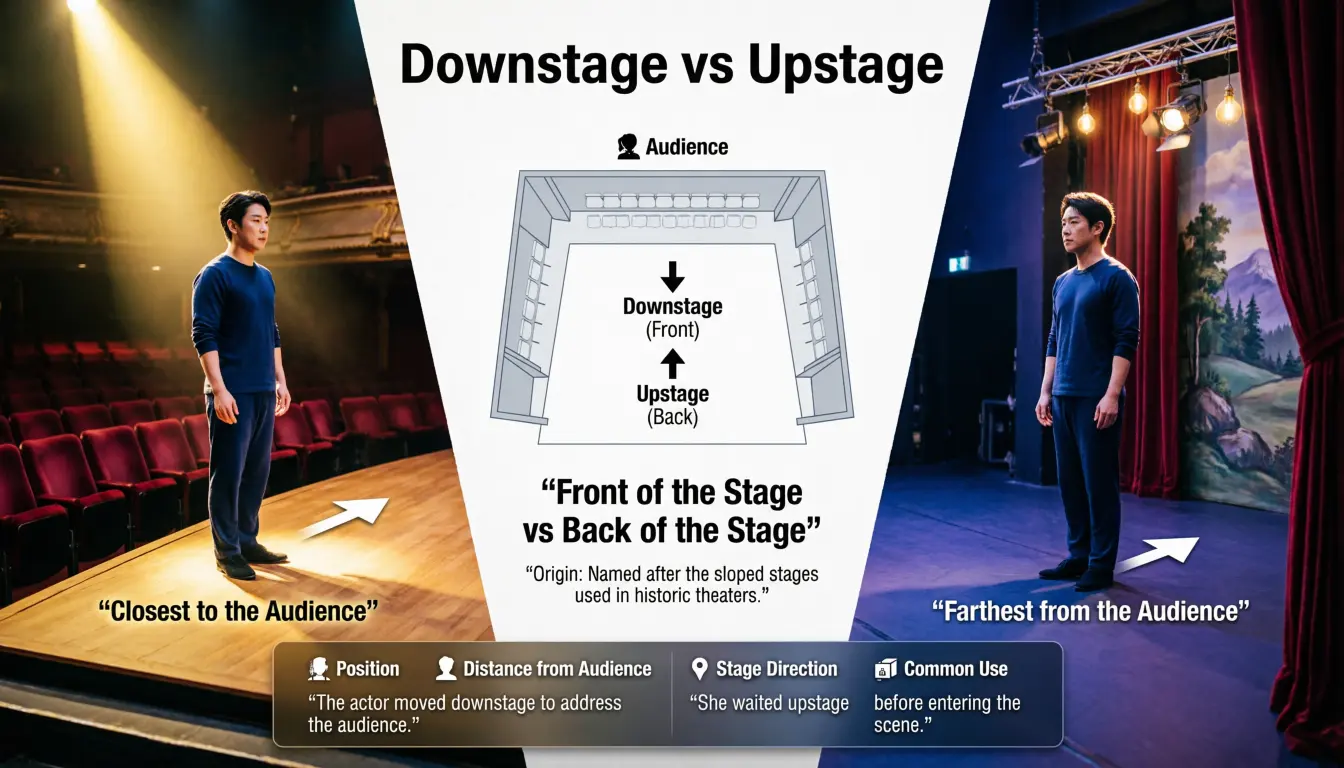
“Downstage” and “upstage” are both theater terms, but they refer to opposite directions on a stage and have different figurative meanings. “Downstage” refers to the area of the stage closest to the audience, while “upstage” refers to the area farthest from the audience. As a verb, “to upstage” also means to draw attention away from someone and become the center of attention.
Have you ever wondered why actors move downstage when they walk toward the audience, even though they seem to be moving forward instead of down? Or why people say someone upstaged another person at an event? These theater terms often confuse readers because they have both literal and figurative meanings.
Many people search for downstage vs upstage to understand the difference between these two words. While both come from the world of theater, only upstage has become a common everyday expression meaning to steal attention from someone else. Learning the correct meaning helps actors, students, writers, and English learners use these terms with confidence.
The good news is that downstage and upstage are not spelling variants. They are two separate words with different meanings. Once you understand where they came from, they become easy to remember.
In this guide, you’ll learn the origins of these terms, their meanings, examples of correct usage, common mistakes, and practical advice on when to use each one.
Downstage vs Upstage – Quick Answer
Downstage refers to the area of a stage that is closest to the audience.
Upstage refers to the area of a stage that is farthest from the audience.
Outside the theater, upstage also means to attract more attention than someone else, while downstage almost never has this figurative meaning.
Quick Examples
Theater
- The lead actor stepped downstage before delivering the final speech.
- The dancers waited upstage until the curtain opened.
Everyday English
- Her exciting announcement upstaged the guest speaker.
- The comedian accidentally upstaged the award winner.
Quick Comparison
| Downstage | Upstage |
| Front of the stage | Back of the stage |
| Closest to the audience | Farthest from the audience |
| Mainly a theater direction | Theater direction and everyday verb |
| Rare outside theater | Common in everyday English |
| Does not mean stealing attention | Can mean stealing attention |
The Origin of Downstage vs Upstage
The terms downstage and upstage date back hundreds of years to the early days of theater.
In many old theaters, the stage was built on a slight incline. The back of the stage was higher than the front so that audience members could see the actors more clearly.
Because of this design:
- Walking toward the audience meant walking down the slope.
- Walking away from the audience meant walking up the slope.
This created the stage directions we still use today:
- Downstage = toward the audience
- Upstage = away from the audience
Although modern stages are usually flat, these traditional names remain standard in theater.
Why Did “Upstage” Gain Another Meaning?
Actors standing behind another performer could accidentally draw the audience’s attention. The actor in front often had to turn around to face them, making the person behind more noticeable.
Over time, to upstage someone came to mean:
To take attention away from another person, intentionally or unintentionally.
Today, this figurative meaning is widely used in news articles, business, entertainment, sports, and everyday conversations.
British English vs American English
Unlike pairs such as colour vs color or analysed vs analyzed, downstage and upstage have exactly the same spelling in both British English and American English.
There are no accepted spelling differences between the two varieties of English.
British English vs American English Comparison
| Feature | British English | American English |
| Downstage | Downstage | Downstage |
| Upstage | Upstage | Upstage |
| Meaning | Same | Same |
| Theater usage | Same | Same |
| Figurative use of “upstage” | Same | Same |
| Spelling difference | None | None |
Only pronunciation may differ slightly depending on regional accents.
Which Should You Use?
Choose the word based on the meaning you want to express not on the type of English you write.
Use downstage when referring to:
- Stage directions
- Theater rehearsals
- Acting classes
- Stage blocking
Example:
Please move downstage before delivering your next line.
Use upstage when referring to:
- The back of the stage
- Stage directions
- Someone taking attention away from another person
Example:
The surprise performance upstaged the main event.
Audience-Based Advice
| Audience | Best Choice |
| Actors | Use both terms according to stage position |
| Theater students | Learn both as standard stage directions |
| Writers | Use “upstage” when describing someone stealing attention |
| Business professionals | Use “upstage” only in its figurative sense |
| Global readers | Both words are universally understood |
Remember, downstage and upstage are complementary terms, not alternatives. Each has its own specific meaning.
Downstage vs Upstage Comparison Table
| Feature | Downstage | Upstage |
| Position on stage | Front | Back |
| Closest to audience | ✔ | ✘ |
| Farthest from audience | ✘ | ✔ |
| Theater direction | ✔ | ✔ |
| Everyday figurative meaning | Rare | Common |
| Means “steal attention” | No | Yes |
| Used in stage blocking | Yes | Yes |
| Same spelling worldwide | Yes | Yes |
Common Mistakes with Downstage vs Upstage
Although these terms are easy to learn, many people use them incorrectly. Here are the most common mistakes and how to avoid them.
| Incorrect Usage | Correct Usage | Why? |
| The actor moved upstage toward the audience. | The actor moved downstage toward the audience. | Downstage is closest to the audience. |
| The dancers stood downstage at the back. | The dancers stood upstage at the back. | Upstage means farther from the audience. |
| She downstaged everyone at the party. | She upstaged everyone at the party. | Only upstage means to steal attention. |
| Downstage means higher on the stage. | Downstage means closer to the audience. | The terms come from old sloped stages. |
| Upstage and downstage mean the same thing. | They describe opposite stage positions. | They are not interchangeable. |
Tips to Remember
- Downstage = Down toward the audience.
- Upstage = Up toward the back of the stage.
- Only upstage has the figurative meaning of taking attention from someone else.
Downstage vs Upstage in Everyday Examples
Even if you never perform on stage, you may hear these words in conversations, movies, or news stories.
In Emails
- Please move downstage before introducing the guest speaker.
- The keynote presentation should not upstage the product launch.
In News Articles
- The celebrity’s surprise appearance upstaged the awards ceremony.
- The actor walked downstage for the final bow.
On Social Media
- My little brother totally upstaged my birthday party with his funny dance.
- The cast moved downstage together for the curtain call.
In Formal Writing
- The director instructed the performers to remain upstage until the lights changed.
- Unexpected events can easily upstage a carefully planned presentation.
In Everyday Conversation
- Her wedding dress upstaged everyone else’s outfit.
- The children waited upstage before entering the scene.
Downstage vs Upstage – Google Trends & Usage Data
Search interest shows that upstage is searched much more often than downstage.
Why?
Because upstage has two meanings:
- A theater direction.
- An everyday verb meaning to steal attention.
People commonly search for:
- What does upstage mean?
- Upstage someone meaning
- Upstage definition
- Downstage meaning
- Stage directions explained
Popular Countries
Searches are common in:
- United States
- United Kingdom
- Canada
- Australia
- India
These terms are most popular among:
- Theater students
- Drama teachers
- Actors
- English learners
- Writers and journalists
Although downstage is mostly used in theater, upstage appears much more often in newspapers, blogs, television, and social media because of its figurative meaning.
Downstage vs Upstage in Academic Writing
Academic writing usually uses these terms when discussing theater, drama, literature, or performance studies.
Correct Examples
- The director positioned the main character downstage to create a stronger connection with the audience.
- The supporting actors remained upstage throughout the opening scene.
- The researcher explained how one performer attempted to upstage another during live performances.
Academic Tips
- Use downstage only when describing stage position.
- Use upstage carefully when referring to attention or theatrical movement.
- Define the terms if your readers may not be familiar with theater vocabulary.
Downstage vs Upstage in Business English
In business communication, upstage is much more common than downstage.
Business Examples
- The company’s new announcement upstaged its competitors.
- The marketing campaign accidentally upstaged the product launch.
- The CEO asked presenters not to upstage one another during the conference.
Downstage is rarely used unless the discussion involves stage layouts, presentations, or event planning.
Example:
- The presenter should stand downstage during the keynote speech.
Common Style Guide Recommendations
Major English style guides do not treat downstage and upstage as spelling variants because they are different words.
Here are some general recommendations:
| Style Guide | Recommendation |
| AP Style | Use both words according to their standard meanings. |
| Chicago Manual of Style | Keep traditional theater terminology unchanged. |
| MLA Style | Use theater terms accurately when analyzing plays. |
| APA Style | Define theater terms if readers may not know them. |
Best Practice
- Use downstage for stage position near the audience.
- Use upstage for stage position or for stealing attention.
- Avoid using downstage as a figurative verb.
Real Examples from Published Sources
Here are examples similar to those found in newspapers, theater reviews, books, and magazines.
Theater Review
“The lead actor moved downstage before delivering the emotional closing speech.”
Entertainment News
“The surprise guest upstaged the headline performer.”
Business Article
“The unexpected product launch upstaged the competition.”
Drama Textbook
“Actors should avoid blocking performers who are positioned downstage.”
Lifestyle Magazine
“Her elegant outfit nearly upstaged the bride.”
These examples show that:
- Downstage is mainly used in theater and performance writing.
- Upstage appears in both theater and everyday English because of its figurative meaning.
Downstage vs Upstage Quiz
Test your understanding by choosing the correct answer.
1. Which part of the stage is closest to the audience?
A. Upstage
B. Downstage
C. Center stage
Answer: B. Downstage
2. Which word can also mean “to steal attention from someone”?
A. Downstage
B. Upstage
C. Both
Answer: B. Upstage
3. Which sentence is correct?
A. The actor walked upstage to greet the audience.
B. The actor walked downstage to greet the audience.
C. The actor walked backstage to greet the audience.
Answer: B. The actor walked downstage to greet the audience.
4. Which statement is true?
A. Downstage and upstage are different spellings of the same word.
B. Downstage and upstage have different meanings.
C. Upstage is only used in British English.
Answer: B. Downstage and upstage have different meanings.
5. Which sentence uses upstage correctly?
A. She upstaged the audience.
B. The surprise guest upstaged the main speaker.
C. The curtain was upstage.
Answer: B. The surprise guest upstaged the main speaker.
Fill in the Blanks
Complete each sentence using downstage or upstage.
- The director asked the lead actor to move __________ before speaking.
- The dancers waited __________ until the music began.
- The comedian accidentally __________ the award winner.
- The actress stepped __________ to thank the audience.
- The surprise announcement __________ the company’s new product launch.
Answers
- downstage
- upstage
- upstaged
- downstage
- upstaged
FAQs
1. What is the difference between downstage and upstage?
Downstage is the area closest to the audience, while upstage is the area farthest from the audience. In everyday English, upstage can also mean to take attention away from someone else.
2. Why is it called downstage?
Early theaters had stages built on a slight slope. Actors walked down the slope when moving toward the audience, creating the term downstage.
3. Can upstage mean stealing attention?
Yes. Outside theater, upstage commonly means to attract more attention than another person, either on purpose or by accident.
Example:
Her speech completely upstaged the evening’s main event.
4. Is downstage used outside theater?
Very rarely. Most people use downstage only when discussing stage directions, acting, or live performances.
5. Are downstage and upstage opposites?
Yes. They describe opposite areas of a stage.
- Downstage = front of the stage
- Upstage = back of the stage
6. Do British and American English spell these words differently?
No. Both varieties of English use the same spellings: downstage and upstage.
7. Which word is more common in everyday English?
Upstage is much more common because it is widely used to describe someone stealing attention from another person.
8. How can I remember the difference?
A simple trick is:
- Downstage = Down toward the audience.
- Upstage = Up toward the back of the stage.
Remember that these names come from the sloped stages used in older theaters.
Conclusion
Understanding downstage vs upstage is easier once you know their theatrical origins. Downstage refers to the part of the stage closest to the audience, while upstage refers to the area farthest away. These terms have remained part of theater vocabulary for centuries, even though modern stages are usually flat.
Outside the theater, upstage has gained a second meaning. It now commonly describes someone who takes attention away from another person, if intentionally or accidentally. This figurative use appears often in news stories, business writing, entertainment reporting, and everyday conversations. Downstage, however, is still used mainly in theatrical settings.
The key is to remember that these words are not spelling variants or interchangeable terms. They describe different positions on a stage and, in the case of upstage, an additional figurative idea. By learning their meanings, origins, and proper usage, you can speak and write with greater confidence, whether you’re discussing drama, reviewing a performance, or describing someone who stole the spotlight.

I hold a degree in English Literature and Linguistics and have worked extensively on educational blogs, comparison websites, and digital learning platforms. My writing focuses on simplifying complex language rules, highlighting British vs American English differences, and providing practical examples for everyday usage.