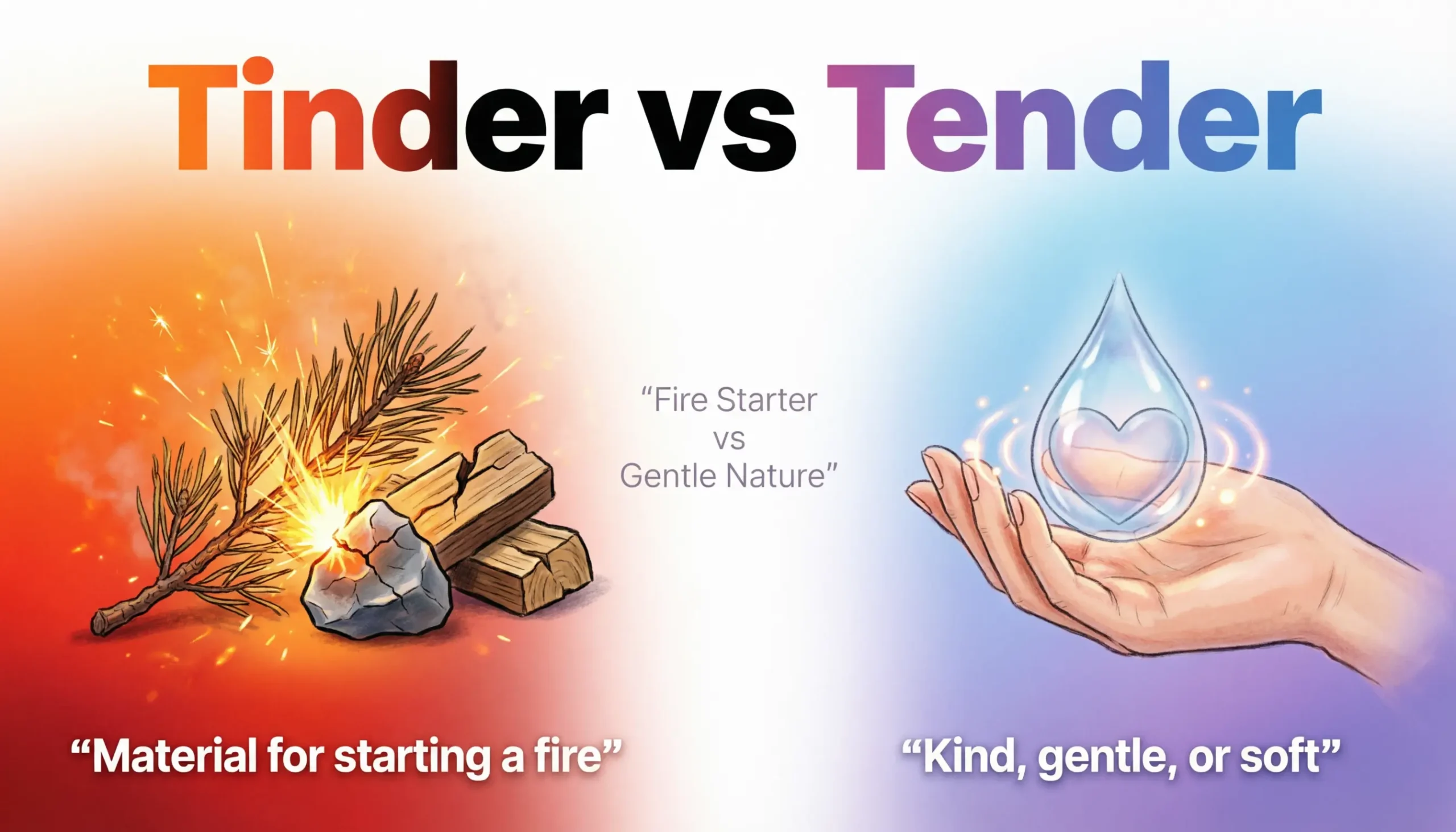
“Tinder” is a noun meaning dry material used to start a fire (and is also the name of the dating app Tinder), while “tender” is an adjective meaning gentle, soft, caring, or easily chewed.
English has many words that look similar but mean completely different things. One common example is tinder vs tender. Because these words differ by only one letter, many people accidentally use the wrong spelling in writing, emails, social media posts, and online searches.
The confusion has become even more common because Tinder is also the name of a popular dating app, while tender is a frequently used English word with several meanings. Someone searching for “tinder vs tender” may want to know whether the words are related, which spelling is correct, or when each one should be used.
The good news is that the difference is simple. Although the words look alike, they have different origins, meanings, and uses. Understanding these differences can help you avoid spelling mistakes and communicate more clearly.
In this guide, you’ll learn the meaning of each word, their history, spelling differences, common mistakes, real-life examples, and practical advice on choosing the correct word in every situation.
Tinder vs Tender – Quick Answer
Tinder and tender are different words with different meanings.
| Word | Meaning | Example |
| Tinder | Dry material used to start a fire, or the dating app name | “He collected tinder to build a campfire.” |
| Tender | Gentle, soft, caring, or easy to chew | “She gave her child a tender hug.” |
Quick Examples
- Correct: The campers gathered tinder before lighting the fire.
- Correct: The steak was very tender.
- Correct: He met his partner on Tinder.
- Incorrect: The campers gathered tender before lighting the fire.
A simple trick:
- Tinder = fire or dating app
- Tender = gentle, soft, caring
The Origin of Tinder vs Tender
Although these words look similar, they come from different historical roots.
Origin of Tinder
The word tinder comes from Old English tynder, meaning material used to catch fire easily. For centuries, people used dry grass, bark, wood shavings, and cloth as tinder when starting fires.
Today, the word is still used in camping, survival skills, and outdoor activities. It also gained a new meaning when the dating app Tinder launched in 2012.
Origin of Tender
The word tender comes from Old French tendre and Latin tener, meaning soft, delicate, or gentle.
Over time, English speakers used tender to describe:
- Kind emotions
- Soft meat
- Gentle care
- Delicate situations
Why the Difference Exists
The words developed from different language families. Their similar appearance is largely a coincidence, which explains why many people confuse them.
British English vs American English Spelling
Unlike many English words, tinder and tender have the same spelling in both British and American English.
There are no regional spelling variations.
Comparison Table
| Meaning | British English | American English |
| Fire-starting material | Tinder | Tinder |
| Dating app | Tinder | Tinder |
| Gentle or caring | Tender | Tender |
| Soft meat | Tender | Tender |
Examples
British English:
- The hikers gathered tinder.
- The chicken was tender.
American English:
- The campers packed tinder.
- The beef was tender.
In both countries, the spelling remains identical.
Which Spelling Should You Use?
The correct spelling depends entirely on the meaning you want.
Use “Tinder” When:
- Talking about fire-starting materials
- Discussing camping or survival
- Referring to the dating app Tinder
Examples
- We collected dry leaves as tinder.
- She downloaded Tinder yesterday.
Use “Tender” When:
- Describing kindness or affection
- Talking about soft food
- Discussing delicate situations
Examples
- He spoke in a tender voice.
- The meat became very tender after cooking.
Audience-Based Advice
| Audience | Recommended Usage |
| US readers | Use the meaning-based spelling |
| UK readers | Use the meaning-based spelling |
| Australia, Canada, New Zealand | Use the meaning-based spelling |
| Global audience | Choose according to context |
There is no regional preference because both words are standard English.
Common Mistakes with Tinder vs Tender
Many mistakes happen because of typing errors or autocorrect.
Mistake #1
❌ The campers collected tender before making a fire.
✅ The campers collected tinder before making a fire.
Mistake #2
❌ The chicken was very tinder.
✅ The chicken was very tender.
Mistake #3
❌ She gave him a tinder smile.
✅ She gave him a tender smile.
Mistake #4
❌ The wood was dry and made good tender.
✅ The wood was dry and made good tinder.
Easy Memory Trick
Think:
- Tinder starts fires.
- Tender shows care.
Tinder vs Tender in Everyday Examples
Emails
Tinder
- Please bring dry tinder for the camping trip.
Tender
- Thank you for your tender support during this difficult time.
News Articles
Tinder
- The company behind Tinder announced new features.
Tender
- The chef is known for serving tender steaks.
Social Media
Tinder
- I finally joined Tinder today!
Tender
- What a tender moment between parent and child.
In Formal Writing
Tinder
- The survival guide explains how to identify natural tinder.
Tender
- The letter contained a tender expression of gratitude.
Tinder vs Tender – Google Trends & Usage Data
Search behavior shows that both words are popular, but for different reasons.
Tinder
Interest in Tinder is strongest in:
- United States
- United Kingdom
- Canada
- Australia
- India
Most searches relate to:
- Online dating
- Relationships
- App features
- User profiles
Tender
Interest in tender is spread across many industries:
- Food and cooking
- Business contracts
- Construction bids
- Emotional writing
- Healthcare
Usage Comparison
| Word | Main Context |
| Tinder | Dating app, camping, fire-making |
| Tender | Food, emotions, business, care |
Because tender has several meanings, it appears in a wider range of written content.
Tinder vs Tender Comparison Table
| Feature | Tinder | Tender |
| Part of Speech | Noun | Adjective, noun, verb |
| Main Meaning | Fire-starting material | Gentle, soft, caring |
| Modern Association | Dating app | Kindness and softness |
| Used in Cooking | No | Yes |
| Used in Camping | Yes | No |
| Emotional Meaning | No | Yes |
| Business Meaning | No | Yes |
| Same in UK & US | Yes | Yes |
FAQs
1. Is tinder the same as tender?
No. Tinder refers to fire-starting material or the dating app, while tender means gentle, soft, or caring.
2. Which spelling is correct: tinder or tender?
Both are correct. The right choice depends on the meaning you want to express.
3. Is Tinder a real English word?
Yes. Long before the dating app existed, tinder referred to materials used for starting fires.
4. Can tender describe food?
Yes. Tender is commonly used to describe soft and easy-to-chew meat or food.
5. Why do people confuse tinder and tender?
They look and sound somewhat similar, differing by only one letter.
6. Is there a British spelling of tinder?
No. British and American English both use the spelling tinder.
7. Is there a British spelling of tender?
No. The spelling tender is the same worldwide.
8. Can tinder be used as an adjective?
Typically, tinder is used as a noun. Example: “The dry grass served as tinder.”
9. What is the easiest way to remember the difference?
Remember:
- Tinder = fire or dating app
- Tender = gentle, soft, caring
Conclusion
Understanding the difference between tinder vs tender is easier once you focus on meaning rather than spelling. While the two words look similar, they are not interchangeable. Tinder refers to material used for starting fires and is also widely recognized as the name of a popular dating application. Tender, on the other hand, describes something gentle, soft, caring, delicate, or easy to chew.
The confusion usually happens because only one letter separates the words. However, their origins, uses, and meanings are completely different. Whenever you’re discussing camping, survival, fire-making, or the dating platform, use tinder. When you’re describing kindness, emotions, food texture, or delicate situations, use tender.
Fortunately, there are no British-versus-American spelling differences to worry about. Both spellings remain the same across English-speaking countries. The key is simply matching the word to the correct context.
By remembering that tinder starts fires and tender shows care, you can avoid common mistakes and use both words confidently in everyday communication, professional writing, and online content.

I am an Emily Carter Brooks U.S.A based linguistics writer known for my clear, reader-friendly explanations of English grammar and vocabulary differences. I have contributed to multiple online language resources and specializes in spelling variations, pronunciation confusion, and British vs American English comparisons. I’m passionate about helping learners improve their English through practical, everyday communication. engaging, and stress-free.