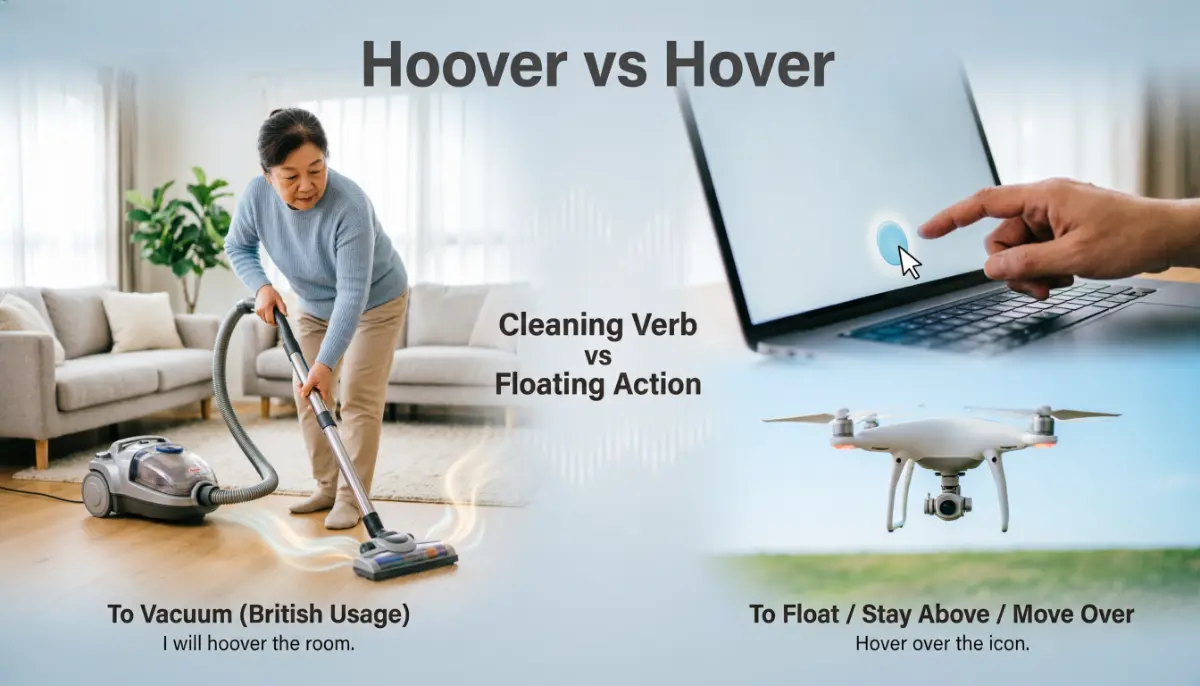
“Hoover” and “hover” are both correct words, but they have very different meanings. “Hoover” is a noun or verb referring to a vacuum cleaner (especially in British English) or to vacuum-cleaning, while “hover” is a verb meaning to remain in one place in the air or to linger around something.
The confusion between “hoover” vs “hover” is more common than you might think. Many people search this keyword because the two words look similar, sound slightly alike, and appear in very different contexts.
One is often linked to cleaning appliances, while the other is used in technology, aviation, and everyday movement descriptions. This mix-up can easily lead to spelling errors in writing, misunderstandings in communication, and even mistakes in professional documents.
Another reason people search for this keyword is regional language differences. In British English, “hoover” is often used as a verb meaning to vacuum, while in American English, it is less common and usually refers to a brand. On the other hand, “hover” is widely used in both UK and US English, especially in digital and technical contexts like “hover your mouse” or “helicopter hovering.”
This article clears up the confusion in a simple way. You will learn the correct meanings, origins, spelling differences, and real-life usage. By the end, you will know exactly when to use hoover and when to use hover, without hesitation or mistakes.
Hoover vs Hover – Quick Answer
Hoover usually refers to a vacuum cleaner or the action of cleaning floors (mainly in British English).
Hover means to stay in one place in the air or above something without moving away.
Simple Examples:
- I need to hoover the carpet. (cleaning)
- The drone can hover in the sky. (staying in air)
- Move your mouse and hover over the icon. (digital use)
In short:
- Hoover = cleaning / vacuum (mostly UK usage)
- Hover = floating / staying above / digital interaction
The Origin of Hoover vs Hover
The word “Hoover” comes from the Hoover Company, a famous brand that produced vacuum cleaners in the early 1900s. In the UK, the brand became so popular that people started using “hoover” as a general verb for vacuuming, even if the machine is not a Hoover brand. This is called a generic trademark.
The word “hover” comes from Old English “hofian”, meaning to float or remain in the air. Over time, it evolved into “hover,” which is now used widely in modern English for things that stay suspended or move lightly above a surface.
So, while hoover is brand-based language evolution, hover is a natural linguistic development describing movement or position.
British English vs American English Spelling
The difference between hoover and hover is not exactly British vs American spelling—it is more about usage and meaning. However, British English does use “hoover” more commonly as a verb.
Comparison Table: British vs American Usage
| Word | British English Usage | American English Usage |
| Hoover | Commonly used as verb (vacuum) | Rare, mostly brand reference |
| Hover | Used in tech, aviation, daily speech | Same usage as UK English |
Key Point:
- “Hover” is universal in both dialects
- “Hoover” is culturally stronger in the UK as a household verb
Which Spelling Should You Use?
Choosing between hoover and hover depends entirely on context:
Use “Hoover” when:
- You are referring to vacuuming (especially UK audience)
- Writing informal British English content
- Talking about cleaning the floor
Use “Hover” when:
- Referring to movement in air (birds, drones, helicopters)
- Using technology terms (mouse hover, UI design)
- Writing formal or international English
Global Advice:
- UK/Commonwealth: “hoover” is acceptable in daily speech
- US English: prefer “vacuum” instead of hoover
- Global/professional writing: always use “hover” correctly in technical contexts
Common Mistakes with Hoover vs Hover
Many learners mix these words because of spelling similarity.
Common Errors:
- ❌ I need to hover the carpet
- ✔️ I need to hoover the carpet
- ❌ The bird was hoovering in the sky
- ✔️ The bird was hovering in the sky
- ❌ Hover the floor after dinner
- ✔️ Hoover the floor after dinner
Why This Happens:
- Similar spelling
- Lack of context awareness
- Influence of British informal speech
Hoover vs Hover in Everyday Examples
Emails:
- “Please hoover the office before the meeting.”
- “Kindly hover your cursor over the link for details.”
News Writing:
- “The helicopter continued to hover above the accident site.”
- “Households still prefer to hoover daily in many UK regions.”
Social Media:
- “That drone can literally hover for hours!”
- “Mum told me to hoover the whole house today ”
Formal Writing:
- “The device can hover steadily in controlled environments.”
- “The cleaning staff will hoover all carpeted areas.”
Hoover vs Hover – Google Trends & Usage Data
Search behaviour shows clear differences in how users use these words:
- “Hover” has global usage across tech, aviation, and design industries
- “Hoover” spikes mainly in the UK and Ireland
- Searches for “hoover vs hover” often come from students, writers, and ESL learners
Observations:
- Tech-related searches = hover dominates
- Household cleaning searches in UK = hoover appears frequently
- Confusion searches = rising steadily among learners
This shows that the confusion is mostly educational rather than professional.
Comparison Table: Hoover vs Hover Variations
| Aspect | Hoover | Hover |
| Meaning | Vacuum / clean floors | Float in air / stay above |
| Origin | Brand name (Hoover Company) | Old English origin |
| Usage | Mainly UK informal speech | Global standard usage |
| Context | Cleaning | Tech, aviation, movement |
| Formal writing | Less preferred | Fully acceptable |
| Example | Hoover the carpet | Hover over the button |
FAQs about Hoover vs Hover
1. What is the main difference between hoover and hover?
Hoover refers to cleaning with a vacuum, while hover means staying in one place in air or above something.
2. Is hoover a correct English word?
Yes, but mainly in British English as an informal verb for vacuuming.
3. Can I use hover for cleaning?
No, hover is not related to cleaning. Use “vacuum” or “hoover” instead.
4. Why do British people say hoover?
Because of the Hoover vacuum brand becoming so popular that it became a common verb.
5. Is hover used in technology?
Yes, “hover” is widely used in computing, such as “hover over the icon.”
6. Is hoover used in America?
Rarely. Americans usually say “vacuum” instead.
7. Which word is more formal?
Hover is more formal and widely accepted globally.
8. Are hoover and hover related?
No, they come from completely different origins and meanings.
Conclusion
The confusion between hoover vs hover comes from their similar spelling but completely different meanings. “Hoover” is strongly tied to British informal language and refers to vacuum cleaning, thanks to the famous Hoover brand. On the other hand, “hover” is a universal English word used in technology, aviation, and everyday descriptions of floating or staying above something.
Understanding the difference helps improve both writing clarity and communication accuracy. If you are writing for a global audience, “hover” is the safer and more professional choice in most contexts. However, if you are speaking informally in the UK, “hoover” is still commonly used and widely understood.
By remembering the simple rule hoover for cleaning, hover for floating or digital movement you can avoid one of the most common spelling and usage mistakes in English. This small distinction can significantly improve your grammar accuracy, especially in academic, professional, or online writing. Clear usage builds clearer communication, and that always leaves a stronger impression.
Discover More Article:
- Imput or Input – Which Spelling Is Correct? For 2026
- Glamor or Glamour – Which One Is Correct?
- Brake or Breakr – Which One is Correct?

I hold a degree in English Literature and Linguistics and have worked extensively on educational blogs, comparison websites, and digital learning platforms. My writing focuses on simplifying complex language rules, highlighting British vs American English differences, and providing practical examples for everyday usage.