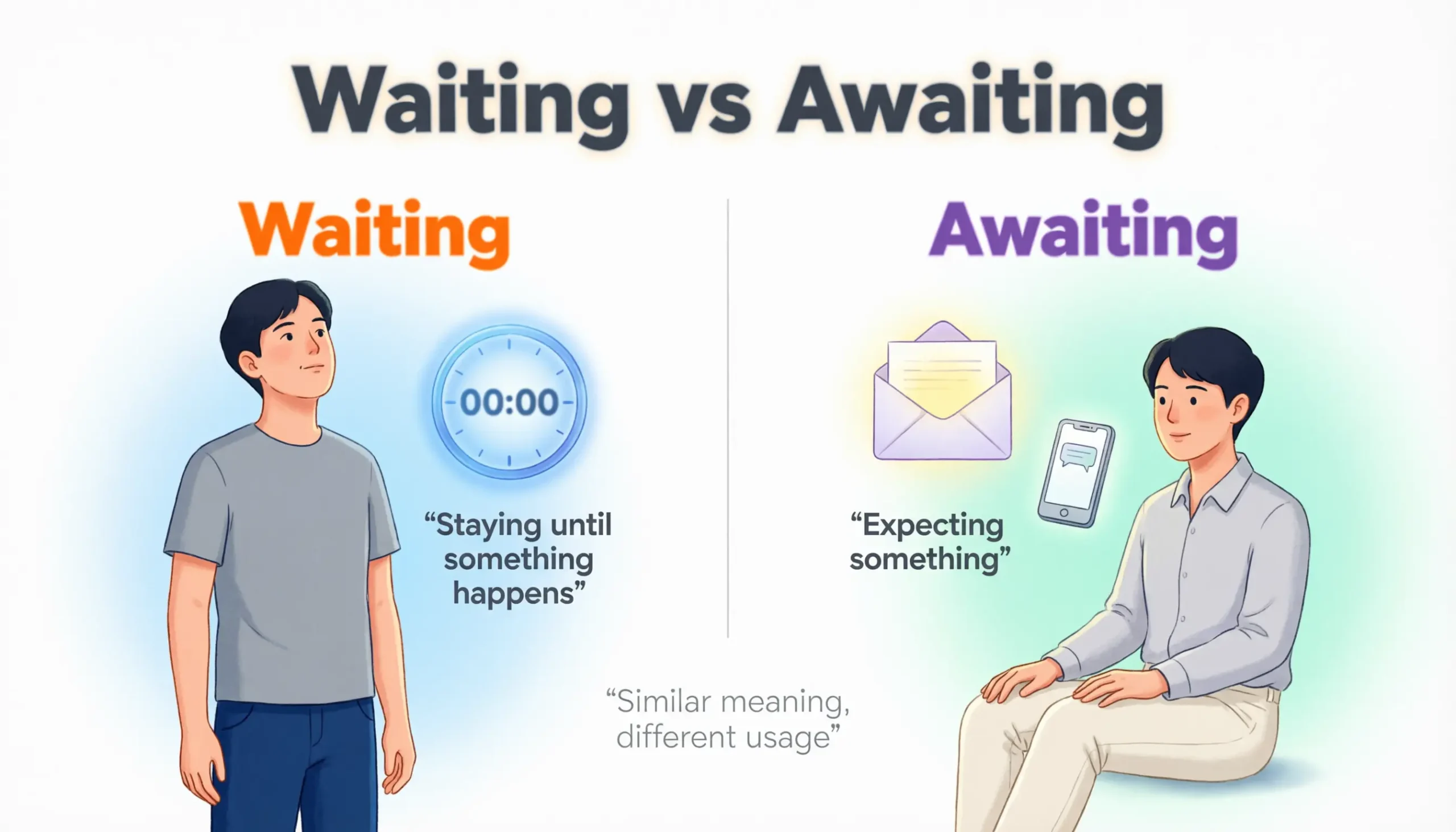
“Waiting” usually needs a preposition like for (waiting for someone), while “awaiting” directly takes an object without a preposition (awaiting your reply).
Many English learners and writers get confused by waiting and awaiting. Both words talk about expecting something to happen. But they are not always used in the same way. That is why people often search for “waiting or awaiting” online.
For example, should you say:
- “I am waiting your reply”
- or “I am awaiting your reply”?
The answer matters because one sounds natural and correct, while the other may sound awkward or wrong. This confusion is common in emails, business writing, school work, and even social media posts.
The good news is that the difference is simple once you understand the grammar pattern. “Waiting” usually needs an extra word like for, while “awaiting” does not. They also differ in tone. One is more casual, and the other sounds more formal.
In this guide, you will learn:
- the quick difference between waiting and awaiting,
- where the words came from,
- how British and American English use them,
- common mistakes to avoid,
- and which word fits best in real-life writing.
By the end, you will know exactly when to use each word with confidence.
Waiting or Awaiting – Quick Answer
Waiting and awaiting both mean expecting something to happen. But they are used differently in sentences.
Basic Rule
- Waiting usually needs for
- Awaiting does not need for
Correct Examples
| Word | Correct Example |
| Waiting | I am waiting for your reply. |
| Awaiting | I am awaiting your reply. |
Simple Difference
- Waiting sounds more natural and casual.
- Awaiting sounds more formal and professional.
Easy Tip
If you use waiting, add for after it.
✔ “We are waiting for the results.”
✔ “We are awaiting the results.”
✘ “We are waiting the results.”
The Origin of Waiting or Awaiting
The word waiting comes from the Old French word waitier, which meant “to watch” or “stay ready.” Over time, English speakers used it for staying in one place until something happened.
The word awaiting comes from the verb await, which combines:
- a- meaning “toward”
- wait meaning “expect”
The word await has been used in English since the Middle Ages. It became common in formal and literary writing.
Why the Difference Exists
The main difference is grammar style.
- Wait became a common everyday verb.
- Await stayed more formal and direct.
That is why modern English often uses:
- “wait for something”
instead of: - “await something”
Both forms are correct, but they fit different situations.
British English vs American English Spelling
Unlike words such as “colour” and “color,” waiting and awaiting have the same spelling in both British and American English.
The difference is mostly about style and tone, not spelling.
General Usage Trends
- American English uses “waiting for” more often in daily speech.
- British English also prefers “waiting for” in casual writing.
- Awaiting appears more in legal, academic, and official writing in both regions.
Comparison Table
| Style | British English | American English |
| Casual speech | Waiting for | Waiting for |
| Formal email | Awaiting | Awaiting |
| News reports | Awaiting results | Awaiting results |
| Everyday texting | Waiting for | Waiting for |
Examples
British English
- “We are waiting for the train.”
- “The company is awaiting approval.”
American English
- “I’m waiting for my package.”
- “The court is awaiting the decision.”
Which Spelling Should You Use?
The best choice depends on your audience and writing style.
Use “Waiting” When:
- writing casually,
- texting friends,
- posting on social media,
- speaking in daily conversation,
- or writing simple emails.
Example:
- “I’m waiting for your message.”
Use “Awaiting” When:
- writing formal emails,
- creating business reports,
- writing academic papers,
- or sounding professional.
Example:
- “We are awaiting your confirmation.”
Audience-Based Advice
| Audience | Best Choice |
| US readers | Waiting for |
| UK readers | Waiting for |
| Business audience | Awaiting |
| Global audience | Waiting for |
| Legal or official writing | Awaiting |
Professional Tip
If you want your writing to sound simple and friendly, use waiting for.
If you want it to sound formal and polished, use awaiting.
Common Mistakes with Waiting or Awaiting
Many people mix these words because they follow different grammar patterns.
Mistake 1: Forgetting “for”
✘ “I am waiting your reply.”
✔ “I am waiting for your reply.”
Mistake 2: Adding “for” after awaiting
✘ “I am awaiting for your reply.”
✔ “I am awaiting your reply.”
Mistake 3: Using awaiting in casual texting
Formal:
- “Awaiting your response.”
Natural casual version:
- “Waiting for your reply.”
Mistake 4: Thinking They Mean Different Things
Both words mean expecting something. The real difference is grammar and tone.
Waiting or Awaiting in Everyday Examples
Emails
- “We are awaiting your approval.”
- “I am waiting for your response.”
News Reports
- “The country is awaiting election results.”
- “Fans are waiting for the final match.”
Social Media
- “Still waiting for my food delivery.”
- “Everyone is awaiting the trailer launch.”
In Formal Writing
- “The office is awaiting further instructions.”
- “The patient is awaiting medical results.”
In Daily Conversation
- “I’m waiting for the bus.”
- “She’s waiting for her friend.”
Waiting or Awaiting – Google Trends & Usage Data
Search data shows that people use waiting for much more often than awaiting.
Popularity by Context
| Phrase | Common Use |
| Waiting for | Daily conversation |
| Awaiting | Formal communication |
| Waiting for reply | Casual emails |
| Awaiting response | Professional emails |
Popular Countries
- The United States strongly prefers waiting for in normal speech.
- The United Kingdom also uses waiting for more often.
- India, Pakistan, and other Commonwealth countries use awaiting more in business English.
Why “Awaiting” Sounds Formal
Many companies and offices use “awaiting” in:
- customer support,
- legal notices,
- business emails,
- and official announcements.
That repeated use makes it sound more professional.
Comparison Table: Waiting vs Awaiting
| Feature | Waiting | Awaiting |
| Meaning | Expecting something | Expecting something |
| Needs “for”? | Yes | No |
| Tone | Casual | Formal |
| Common in speech | Yes | Less common |
| Common in business writing | Sometimes | Very common |
| Example | Waiting for news | Awaiting news |
FAQs About Waiting or Awaiting
Is “awaiting” more formal than “waiting”?
Yes. “Awaiting” sounds more professional and formal.
Can I say “awaiting for”?
No. That is incorrect grammar.
✔ “Awaiting your response”
✘ “Awaiting for your response”
Is “waiting your reply” correct?
No. You should say:
- “waiting for your reply”
Which is better in emails?
For formal emails, “awaiting” works well.
For friendly emails, “waiting for” sounds more natural.
Do waiting and awaiting mean the same thing?
Yes. Both mean expecting something to happen.
Is “awaiting” old-fashioned?
Not exactly. It is still common in professional and official writing.
Which word is more common?
“Waiting for” is much more common in everyday English.
Can I use awaiting in conversation?
Yes, but it may sound overly formal in casual speech.
Why do businesses use “awaiting”?
Because it sounds polite, professional, and direct.
Conclusion
The difference between waiting and awaiting is mainly about grammar and tone. Both words mean expecting something to happen, but they are used in different ways.
The easiest rule to remember is this:
- waiting usually needs for
- awaiting does not
For example:
- “I am waiting for your call.”
- “I am awaiting your call.”
In everyday conversation, emails, and social media, most people prefer waiting for because it sounds natural and friendly. In formal writing, business communication, and official notices, awaiting is often the better choice because it sounds more professional.
There is no major British or American spelling difference here. Both English styles use the same spellings. The real difference is how formal the sentence sounds.
If you want clear and simple English, use “waiting for.” If you want a polished business tone, use “awaiting.” Knowing this small grammar rule can make your writing look much more natural and correct.

I hold a degree in English Literature and Linguistics and have worked extensively on educational blogs, comparison websites, and digital learning platforms. My writing focuses on simplifying complex language rules, highlighting British vs American English differences, and providing practical examples for everyday usage.