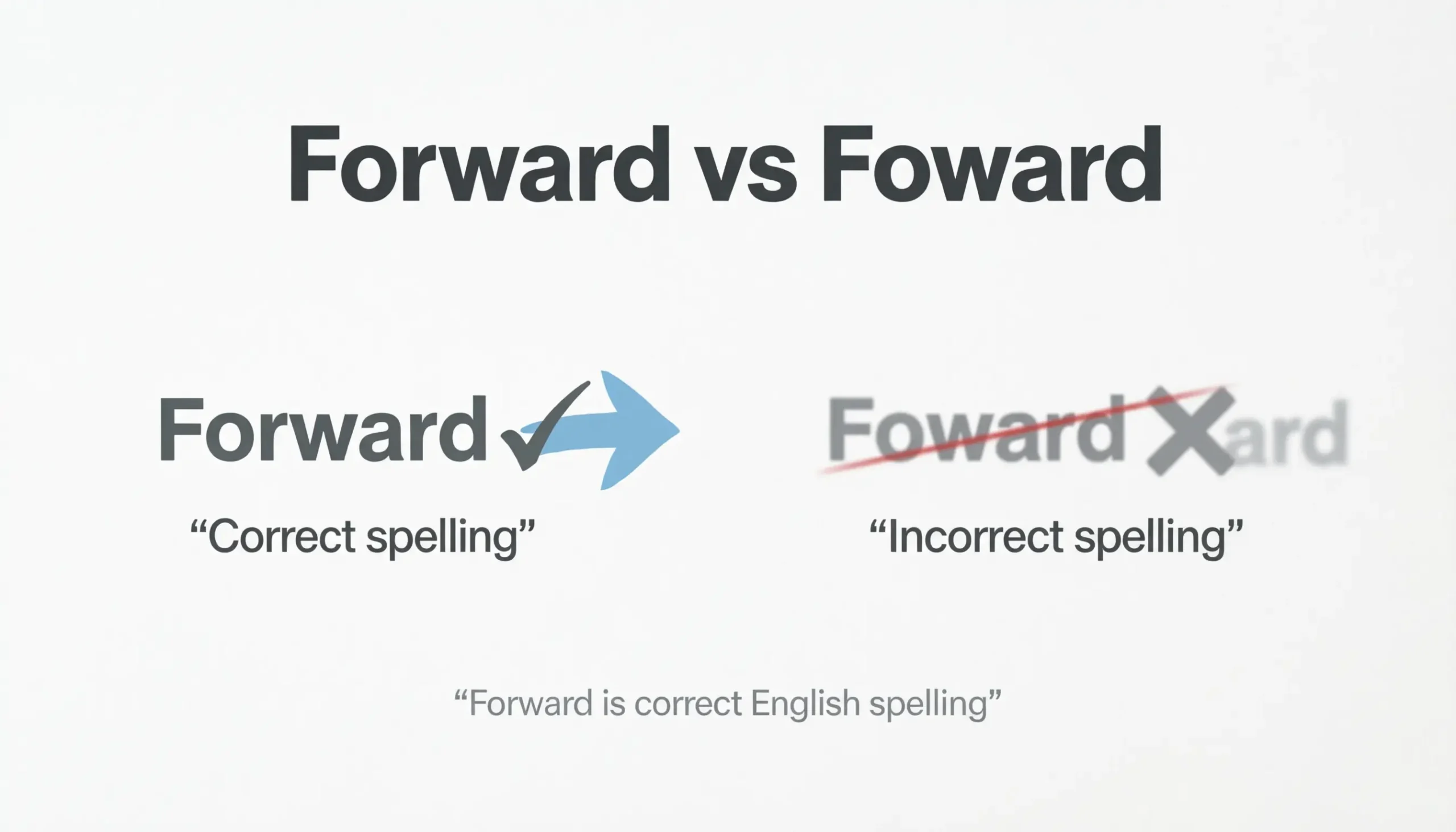
“Forward” is an adjective, adverb, or verb meaning toward the front or in the direction ahead, whereas “foward” has no accepted meaning in English.
Have you ever typed “foward” and wondered if it was right? You are not alone. Many people search for “foward or forward” because the words look very close, but only one is correct.
This spelling mistake happens a lot in emails, school work, blog posts, and even business writing. Since the word is common in daily English, using the wrong spelling can make your writing look less polished.
The confusion usually comes from fast typing. People often skip the “r” in the middle and write foward instead of forward. It seems small, but spelling matters.
In this guide, you will learn the correct spelling, where the word came from, how British and American English use it, and how to avoid mistakes. You will also see real examples, quick tips, and common questions.
By the end, you will know exactly when and how to use forward the right way.
Foward or Forward – Quick Answer
The correct spelling is forward.
Foward is a spelling mistake.
✅ Correct:
- Please move forward.
- I look forward to meeting you.
- The team pushed forward.
❌ Wrong:
- Please move foward.
- I look foward to hearing from you.
Quick rule:
If you mean moving ahead or progressing, always use forward.
| Word | Correct? | Meaning |
| Forward | Yes | Ahead, onward |
| Foward | No | Misspelling |
The Origin of Foward or Forward
The word forward is very old. It comes from Old English forweard.
The word has two parts:
- for = in front
- weard = toward or facing
Together, it meant moving toward the front.
Over time, English changed, but the spelling stayed close to its root. That is why forward has the extra r.
The misspelling foward happens because people drop that middle r when typing fast.
So the history of the word explains why forward is the only real spelling.
British English vs American English Spelling
Good news: both British and American English use forward.
There is no spelling difference here.
But there is a small style difference in some cases.
In British English, forwards is often used as an adverb.
Example:
- Move forwards.
In American English, forward is more common.
Example:
- Move forward.
Comparison Table
| Usage | British English | American English |
| Main spelling | Forward | Forward |
| Adverb form | Forward / Forwards | Forward |
| Common in writing | Yes | Yes |
| Foward | Wrong | Wrong |
So whether you write for the UK or the US, forward is correct.
Which Spelling Should You Use?
The answer is simple: use forward.
Here is quick advice based on your audience:
For US readers
Use forward
Example:
We are moving forward with the plan.
For UK readers
Use forward or forwards depending on style.
Example:
She stepped forwards.
For global readers
Use forward because it is simple and widely accepted.
Best professional advice:
Use forward in formal writing, business emails, blogs, and school work.
Common Mistakes with Foward or Forward
Many writers make small mistakes with this word.
Mistake 1: Missing the “r”
❌ I look foward to your reply.
✅ I look forward to your reply.
Mistake 2: Fast typing
People type too quickly and skip letters.
❌ Moving foward
✅ Moving forward
Mistake 3: Not proofreading
Spellcheck may miss context mistakes.
❌ Going foward in life
✅ Going forward in life
Quick Fix Tip
Remember this:
FOR + WARD = FORWARD
Think of “ward” as direction.
That makes the spelling easy to remember.
Foward or Forward in Everyday Examples
Here is how forward is used in real life.
Emails
- I look forward to your response.
- Please forward this email to the team.
News
- The company plans to move forward with the project.
- Leaders look forward to new talks.
Social Media
- Looking forward to the weekend!
- Moving forward, things will change.
Formal Writing
- The research moves forward in a new direction.
- We must move forward carefully.
In Daily Speech
- Step forward please.
- Let’s move forward.
These examples show that forward is common everywhere.
Foward or Forward – Google Trends & Usage Data
Search data shows that many people type foward by mistake.
Why?
Because it is a common typo.
Here is what usage shows:
| Word | Search Type | Status |
| Forward | Real word | Correct |
| Foward | Search typo | Incorrect |
Countries where “foward” is often searched:
- United States
- United Kingdom
- Canada
- Australia
- India
This shows many English learners and native speakers make the same mistake.
In books, news, and formal writing, forward is used almost all the time.
That proves forward is the standard form.
Foward vs Forward Comparison Table
| Feature | Foward | Forward |
| Correct spelling | No | Yes |
| Dictionary word | No | Yes |
| Used in formal writing | No | Yes |
| Used in emails | No | Yes |
| Used in books | No | Yes |
| Safe for content writing | No | Yes |
FAQs About Foward or Forward
1. Is foward a real word?
No. It is a spelling mistake.
2. Which is correct, foward or forward?
Forward is correct.
3. Why do people write foward?
Because they forget the middle r.
4. Is forward correct in British English?
Yes. It is correct in British English.
5. Is forward correct in American English?
Yes. It is correct in American English.
6. What does forward mean?
It means ahead, onward, or toward the front.
7. Can I use forwards instead of forward?
Yes, mostly in British English in some cases.
Example: Move forwards.
8. Is “looking forward” correct?
Yes.
Example: I am looking forward to it.
9. How can I remember forward?
Remember: Forward has the “r” because real progress moves right.
Conclusion
The choice between foward or forward is very easy once you know the rule. The correct spelling is always forward. The word foward is simply a typo and should be avoided in all writing.
This mistake is common because people type quickly and miss the middle r. But in professional writing, school work, emails, and online content, correct spelling matters. It makes your writing clear and trustworthy.
The good thing is that both British and American English use forward, so you do not need to worry about regional spelling differences. Only the style of forwards may change in British English.
A simple way to remember it is this: forward always moves ahead, and it always carries its “r.”
So next time you write it, check your spelling before sending or publishing.
Using forward the right way will help your writing look clean, smart, and professional.

I am an Emily Carter Brooks U.S.A based linguistics writer known for my clear, reader-friendly explanations of English grammar and vocabulary differences. I have contributed to multiple online language resources and specializes in spelling variations, pronunciation confusion, and British vs American English comparisons. I’m passionate about helping learners improve their English through practical, everyday communication. engaging, and stress-free.