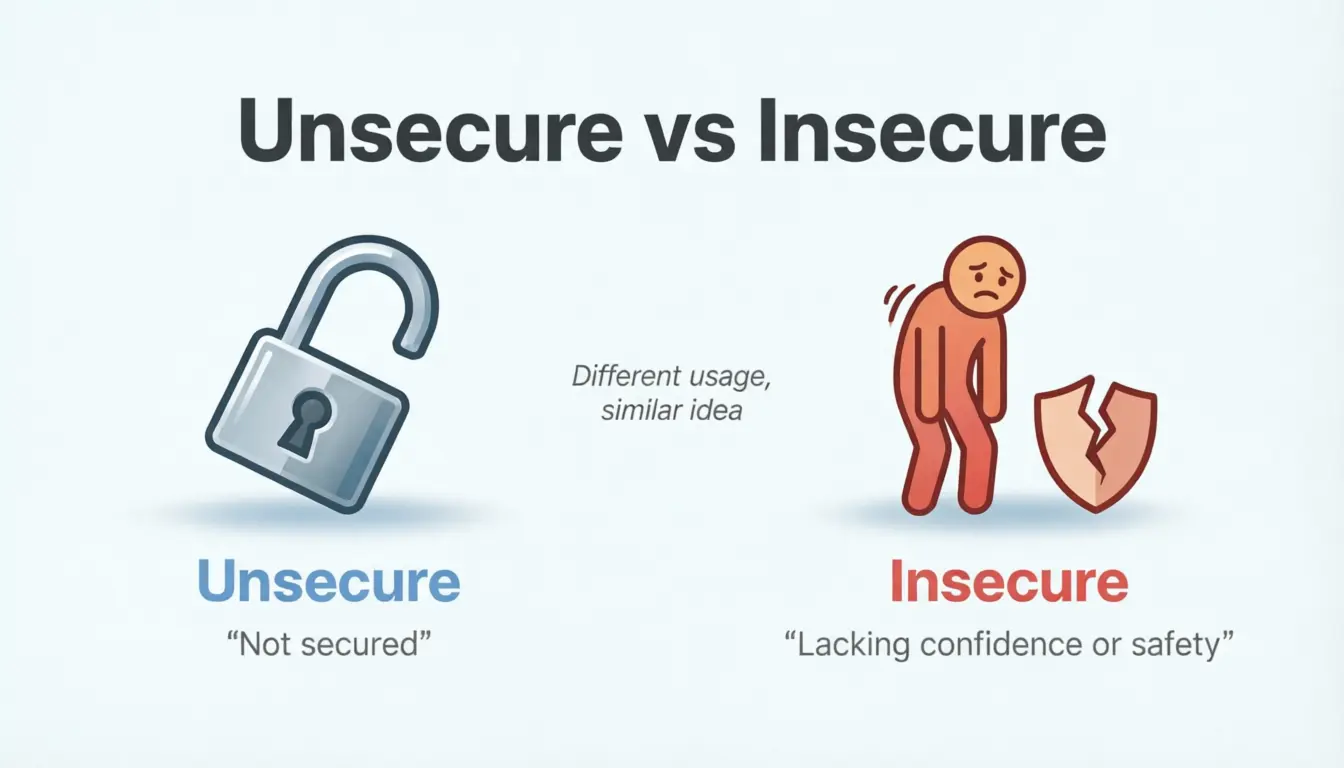
“Insecure” is an adjective meaning not safe, confident, or stable, whereas “unsecure” is rarely used and generally avoided in professional writing.
Have you ever seen the words “unsecure” and “insecure” and wondered which one is correct? Many people search for “unsecure or insecure” because both words seem similar. They both relate to safety, protection, or confidence. But only one is commonly accepted in standard English.
This confusion happens often in writing, online security, business emails, and even social media posts. For example, should you say “an insecure website” or “an unsecure website”? What about describing a person who lacks confidence? These questions make English spelling and word choice tricky for learners and native speakers alike.
The good news is that the difference is simple once you understand how each word works. In most cases, “insecure” is the correct and natural word. “Unsecure” exists, but it is rare and sounds unusual in modern English.
In this guide, you will learn the meaning, history, spelling rules, examples, common mistakes, and best usage advice for “unsecure” and “insecure.” By the end, you will know exactly which word to use in every situation.
Unsecure or Insecure – Quick Answer
“Insecure” is the correct and commonly used word in modern English.
“Unsecure” is rare and usually avoided in professional writing.
Examples
✅ Correct:
- The website is insecure.
- She feels insecure about her job.
- An insecure connection can expose data.
❌ Unnatural or uncommon:
- The website is unsecure.
- He feels unsecure.
Simple Rule
Use insecure for:
- unsafe things
- weak protection
- lack of confidence
Use unsecure only in very rare technical or informal situations.
The Origin of Unsecure or Insecure
The word secure comes from the Latin word securus, meaning “safe” or “free from danger.”
English later added prefixes to create opposite meanings:
- in- = not
- un- = not
So both “insecure” and “unsecure” technically mean “not secure.”
However, English usage changed over time.
Why “Insecure” Became Popular
“Insecure” entered English much earlier and became the standard word in books, newspapers, schools, and formal writing.
People used it for:
- emotional insecurity
- unsafe systems
- unstable situations
Because it became common first, English speakers naturally preferred it.
Why “Unsecure” Sounds Strange
“Unsecure” formed later and never became widely accepted. It appears sometimes in:
- old documents
- technical discussions
- casual online writing
Today, most dictionaries label it as uncommon or nonstandard.
British English vs American English Spelling
Unlike words such as “color” and “colour,” the difference between “unsecure” and “insecure” is not mainly about British or American spelling.
Both British and American English strongly prefer insecure.
Comparison Table
| Usage | American English | British English |
| Standard word | Insecure | Insecure |
| Rare alternative | Unsecure | Unsecure |
| Used in formal writing | Yes | Yes |
| Used in emotional meaning | Yes | Yes |
| Common in cybersecurity | Yes | Yes |
Examples
American English
- The app is insecure.
- He feels insecure at work.
British English
- The network is insecure.
- She sounded insecure during the interview.
Both forms follow the same rule.
Which Spelling Should You Use?
The best choice depends on your audience, but in nearly every case, “insecure” is the safer option.
For American Audiences
Use insecure.
Example:
- The connection is insecure.
For British or Commonwealth Audiences
Use insecure.
Example:
- The company used insecure software.
For Global Readers
Always choose insecure because it is universally understood.
Professional Advice
Use insecure in:
- blogs
- school writing
- business emails
- cybersecurity content
- social media
- academic writing
Avoid “unsecure” unless you are quoting a source or using a special technical term.
Common Mistakes with Unsecure or Insecure
People often misuse these words because both seem grammatically possible.
Mistake 1: Using “Unsecure” for Feelings
❌ He feels unsecure.
✅ He feels insecure.
“Insecure” is the accepted word for emotions and confidence.
Mistake 2: Using “Unsecure” in Formal Writing
❌ The website is unsecure.
✅ The website is insecure.
Professional writing almost always prefers “insecure.”
Mistake 3: Thinking It Is a US vs UK Difference
❌ Americans use insecure, but British people use unsecure.
✅ Both countries mainly use insecure.
Mistake 4: Confusing “Insecure” with “Unsafe”
“Insecure” often means unsafe, but not always.
Example:
- An insecure person lacks confidence.
- An insecure password lacks protection.
Context matters.
Unsecure or Insecure in Everyday Examples
Here are real-life situations where these words appear.
Emails
✅ Correct:
- Your account may be insecure.
- Please avoid insecure networks.
❌ Incorrect:
- Your account may be unsecure.
News Articles
✅ Correct:
- Experts warned about insecure servers.
- Citizens felt insecure after the event.
Social Media
✅ Common:
- I feel insecure today.
- This app looks insecure.
❌ Rare:
- I feel unsecure.
In Formal Writing
✅ Preferred:
- The company fixed insecure connections.
- Researchers studied insecure systems.
Formal English strongly prefers “insecure.”
Unsecure or Insecure – Google Trends & Usage Data
Search data and writing databases show that “insecure” is far more popular than “unsecure.”
Countries Where “Insecure” Is Most Common
- United States
- United Kingdom
- Canada
- Australia
- India
Common Contexts for “Insecure”
- cybersecurity
- psychology
- relationships
- technology
- finance
Why “Unsecure” Appears Online
“Unsecure” sometimes appears because:
- people guess the spelling
- non-native speakers translate directly
- technical users create informal terms
Still, “insecure” dominates modern English usage.
Comparison Table: Unsecure vs Insecure
| Feature | Unsecure | Insecure |
| Common in English | Rare | Very common |
| Accepted in formal writing | Usually no | Yes |
| Used for emotions | Rarely | Yes |
| Used for technology | Sometimes | Yes |
| Preferred by dictionaries | No | Yes |
| Natural sounding | Less natural | Natural |
| Best choice for SEO writing | No | Yes |
FAQs About Unsecure or Insecure
Is “unsecure” a real word?
Yes, but it is uncommon and rarely used in standard English.
Which is correct: unsecure or insecure?
“Insecure” is correct in most situations.
Can I say “unsecure website”?
You can, but “insecure website” sounds more natural and professional.
Why do people use “unsecure”?
Some people form it from the word “secure” using the prefix “un-.”
Is “insecure” used for feelings?
Yes. It often describes lack of confidence.
Example:
- She feels insecure about speaking in public.
Do British people say “unsecure”?
Not usually. British English also prefers “insecure.”
Is “unsecure” grammatically wrong?
Not completely, but it is considered nonstandard or uncommon.
Which word should I use in business writing?
Use “insecure.”
Which spelling is better for content?
“Insecure” is better because it is searched and recognized more often.
Conclusion
The difference between “unsecure” and “insecure” is simple once you know how English uses them. Both words technically mean “not secure,” but modern English strongly prefers “insecure.” It is the accepted choice in professional writing, everyday conversation, technology, and emotional contexts.
“Insecure” works naturally when talking about unsafe systems, weak passwords, low confidence, or unstable situations. It is widely recognized in both American and British English. On the other hand, “unsecure” is rare and often sounds awkward or outdated. While it is not completely wrong, it is usually avoided in formal communication.
If you want clear and professional writing, choose “insecure” almost every time. This is especially important for blogs, academic work, emails, content, and business documents. Readers expect the standard form, and search engines also recognize it more easily.
The easiest rule to remember is this: when in doubt, use “insecure.” It is safer, clearer, and more natural for global audiences.

I am an Emily Carter Brooks U.S.A based linguistics writer known for my clear, reader-friendly explanations of English grammar and vocabulary differences. I have contributed to multiple online language resources and specializes in spelling variations, pronunciation confusion, and British vs American English comparisons. I’m passionate about helping learners improve their English through practical, everyday communication. engaging, and stress-free.