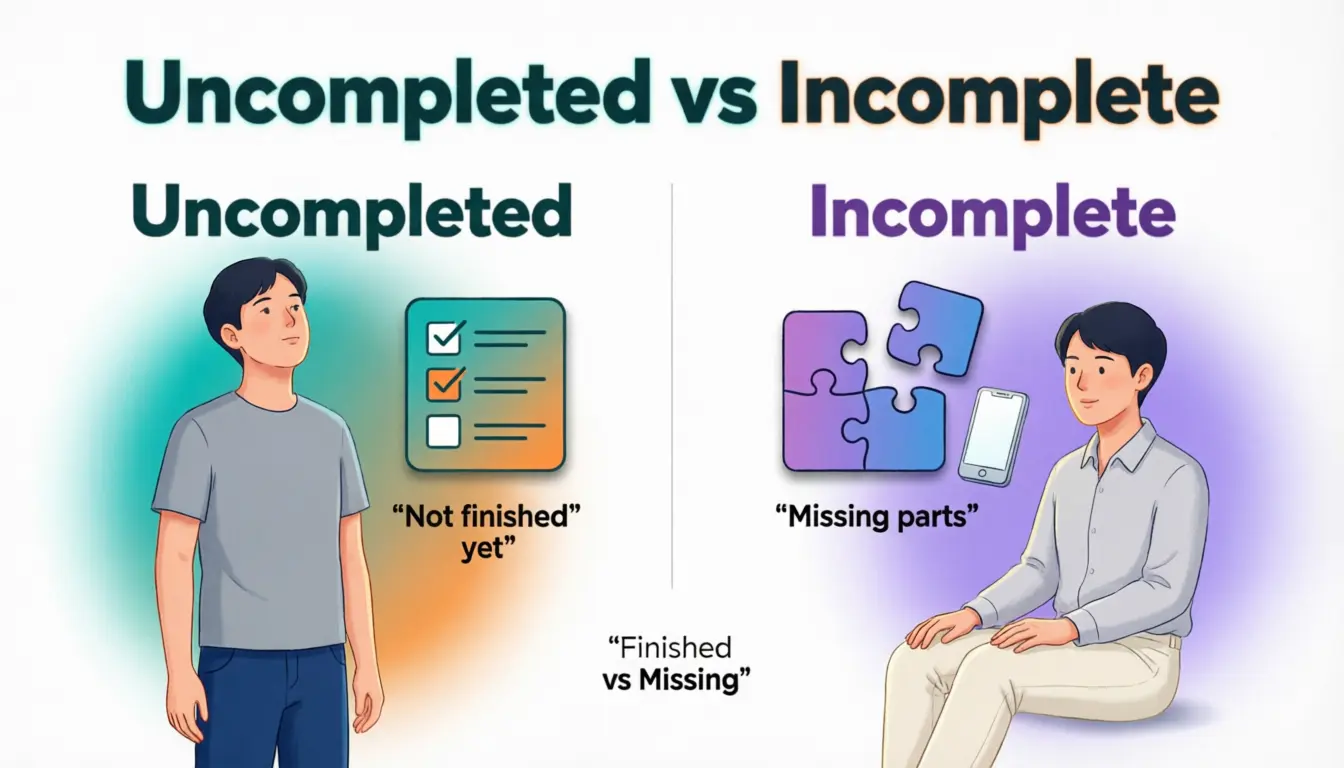
“Incomplete” is an adjective meaning not finished or lacking parts, whereas “uncompleted” usually refers specifically to something that has not yet been completed.
Have you ever written “the task is uncompleted” and wondered if it sounds right? Many English learners and even native speakers search for “uncompleted or incomplete” because both words seem similar. They both describe something unfinished, but they are not always used in the same way.
The confusion comes from how English forms negative words. “Uncompleted” looks logical because it combines “un-” with “completed.” But in real English usage, “incomplete” is far more common and natural. People often want to know which word fits better in emails, school work, business writing, and daily conversation.
This guide explains the difference between uncompleted and incomplete in simple English. You will learn the meaning, origin, spelling differences, grammar rules, and real-life examples. We will also compare British and American English usage and show which term sounds more professional.
By the end, you will know exactly when to use “uncompleted,” when to use “incomplete,” and which word most English speakers prefer.
Uncompleted or Incomplete – Quick Answer
Incomplete is the correct and more common word in most situations.
“Uncompleted” is not wrong, but it is rare and sounds unnatural in everyday English.
Examples
✅ Correct and natural:
- The report is incomplete.
- Your application is incomplete.
- This project remains incomplete.
Less common:
- The report is uncompleted.
- The task is uncompleted.
Simple Rule
- Use incomplete for something unfinished or missing parts.
- Use uncompleted only in rare formal or technical contexts.
The Origin of Uncompleted or Incomplete
The word incomplete comes from the Latin word incompletus, which means “not finished.” English speakers have used it for hundreds of years.
The prefix “in-” means “not.”
The word complete means finished or whole.
So:
- incomplete = not complete
The word uncompleted came later. It follows another English pattern:
- un + completed = not completed
Even though the structure is logical, English speakers naturally preferred “incomplete.” Over time, it became the standard word in writing, education, business, and media.
That is why “incomplete” sounds more natural today.
British English vs American English Spelling
Both British English and American English use incomplete as the standard word. There is no major spelling difference between the two regions for this term.
“Uncompleted” exists in both forms of English, but it is uncommon everywhere.
Comparison Table
| Word | British English | American English | Common Usage |
| Incomplete | ✔ Common | ✔ Common | Very common |
| Uncompleted | Rare | Rare | Mostly formal/technical |
Examples in British English
- The form is incomplete.
- Your homework is incomplete.
Examples in American English
- The project is incomplete.
- The application is incomplete.
Both countries strongly prefer “incomplete.”
Which Spelling Should You Use?
Your choice depends on your audience and writing style.
Use “Incomplete” If:
- You write for US readers
- You write for UK readers
- You write globally
- You want natural English
- You write emails, blogs, essays, or business documents
Use “Uncompleted” If:
- You work in technical systems
- You use database or software labels
- Your company already uses the term internally
Best Advice
For most people, incomplete is the safest and most professional choice.
Common Mistakes with Uncompleted or Incomplete
Many learners make small grammar mistakes with these words.
Mistake 1: Using “Uncompleted” in Normal Conversation
❌ The assignment is uncompleted.
✅ The assignment is incomplete.
Mistake 2: Confusing Meaning
Some people think both words always mean exactly the same thing.
- Incomplete often means missing parts.
- Uncompleted focuses more on something not finished.
Mistake 3: Using the Wrong Tone
“Uncompleted” can sound robotic or awkward in professional writing.
❌ Your profile is uncompleted.
✅ Your profile is incomplete.
Mistake 4: Overusing Rare Words
Simple English is usually better.
✅ incomplete
❌ uncompleted
Uncompleted or Incomplete in Everyday Examples
Here are real-life examples showing how English speakers use these words.
Emails
✅ Your application is incomplete. Please upload the missing document.
⚠ Your application is uncompleted.
News Writing
✅ The road project remains incomplete after two years.
School
✅ The student submitted an incomplete assignment.
On Social Media
✅ My weekend goals are still incomplete.
In Business Writing
✅ Several sections of the report are incomplete.
In Software Systems
Status: Uncompleted
This technical use is more acceptable because software labels often follow direct action patterns.
Uncompleted or Incomplete – Google Trends & Usage Data
Search data and language usage show that incomplete is much more popular worldwide.
Countries Where “Incomplete” Is Common
- United States
- United Kingdom
- Canada
- Australia
- India
Why “Incomplete” Is More Popular
- Easier to read
- Older and established word
- Used in schools and dictionaries
- Common in professional writing
Where “Uncompleted” Appears
You may see “uncompleted” in:
- Software dashboards
- Technical systems
- Academic databases
- Internal business tools
Still, general English strongly prefers “incomplete.”
Comparison Table: Uncompleted vs Incomplete
| Feature | Uncompleted | Incomplete |
| Meaning | Not completed | Not complete |
| Common in daily English | Rare | Very common |
| Sounds natural | Sometimes awkward | Natural |
| Used in professional writing | Rarely | Frequently |
| Used in software systems | Sometimes | Yes |
| Preferred globally | No | Yes |
| Dictionary acceptance | Limited | Standard |
When to Use “Incomplete”
Use “incomplete” when:
- Something is unfinished
- Information is missing
- A task lacks parts
- You want clear professional English
Examples
- The form is incomplete.
- The project is incomplete.
- Your answer is incomplete.
When to Use “Uncompleted”
Use “uncompleted” only in special situations.
Examples
- Uncompleted transactions
- Uncompleted records
- Uncompleted tasks in software
Even here, many writers still prefer “incomplete.”
FAQs About Uncompleted or Incomplete
1. Is “uncompleted” a real word?
Yes, “uncompleted” is a real word, but it is uncommon in normal English.
2. Which is more correct: uncompleted or incomplete?
“Incomplete” is more correct in most situations because it sounds natural and professional.
3. Do Americans use “uncompleted”?
Rarely. Americans mostly use “incomplete.”
4. Do British people say “uncompleted”?
Very rarely. British English also prefers “incomplete.”
5. Can I use “uncompleted” in an email?
You can, but “incomplete” is better and more natural.
6. Is “incomplete” formal or informal?
It works in both formal and informal English.
7. Why does “uncompleted” sound strange?
English speakers historically adopted “incomplete” as the standard word, so “uncompleted” feels less natural.
8. Is “incomplete” better for content writing?
Yes. More people search for and recognize “incomplete.”
9. What is the opposite of incomplete?
The opposite is “complete.”
Conclusion
The debate between uncompleted or incomplete is easy to solve once you understand real English usage. Both words technically exist, but they are not equally common. In modern English, incomplete is the clear winner. It appears in schools, workplaces, websites, news articles, and everyday conversation across the world.
“Uncompleted” may still appear in technical systems or formal process labels, but it often sounds unnatural in normal writing. That is why professional writers, teachers, editors, and businesses usually choose “incomplete.”
If you want simple, correct, and globally accepted English, use incomplete. It works well in emails, reports, homework, applications, and casual speech. Readers immediately understand it, and it sounds polished.
Remember this quick rule:
- Incomplete = standard and natural
- Uncompleted = rare and technical
Using the right word improves clarity and makes your writing look more professional. When in doubt, choose incomplete.

I am an Emily Carter Brooks U.S.A based linguistics writer known for my clear, reader-friendly explanations of English grammar and vocabulary differences. I have contributed to multiple online language resources and specializes in spelling variations, pronunciation confusion, and British vs American English comparisons. I’m passionate about helping learners improve their English through practical, everyday communication. engaging, and stress-free.