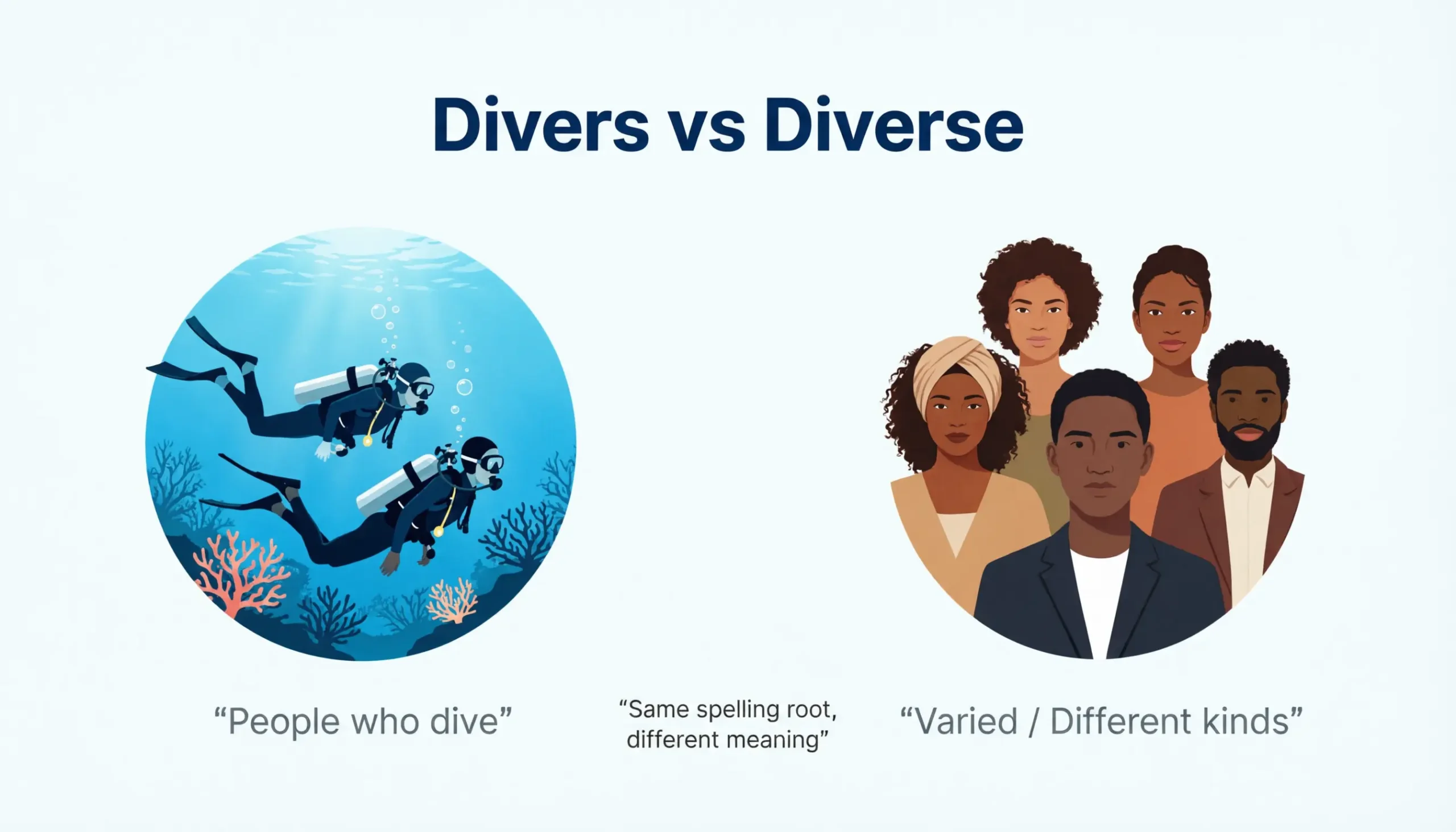
“Divers” is an older or less common word meaning various or several different types, while “diverse” is the modern adjective meaning showing a great variety or difference.
Many English learners and writers search for “divers or diverse” because the two words look very similar. At first glance, they may seem like different spellings of the same word. But they are not always interchangeable. One word is common in modern English, while the other is formal, old-fashioned, or used in special contexts.
This confusion happens often in emails, essays, social media posts, and business writing. For example, should you say “a diverse group of people” or “a divers group of people”? Which one sounds natural in American English? Which spelling appears in British English? These are common questions.
Understanding the difference matters because using the wrong word can make your writing sound strange or outdated. In professional writing, word choice also affects clarity and credibility.
In this guide, you will learn the meaning of “divers” and “diverse,” their origins, spelling differences, correct usage, and common mistakes. You will also see examples, comparison tables, FAQs, and usage advice for different audiences around the world.
Divers or Diverse – Quick Answer
“Diverse” is the correct and most common word in modern English when talking about variety or differences.
“Divers” is an older or formal word that also means “several” or “various,” but it is rarely used today except in legal, literary, or historical writing.
Correct Examples
- We work with a diverse team.
- The city has a diverse culture.
- The company hires people from diverse backgrounds.
Older/Formal Examples
- The report discussed divers issues.
- The law mentions divers cases.
Quick Rule
| Word | Meaning | Modern Usage |
| Diverse | Different, varied | Very common |
| Divers | Several, various | Rare and old-fashioned |
In everyday English, you should almost always use diverse.
The Origin of Divers or Diverse
Both “divers” and “diverse” come from the Latin word diversus, which means “different” or “turned apart.”
Over time, English developed two related forms:
- Divers became an adjective meaning “several” or “various.”
- Diverse developed into the modern adjective meaning “showing variety” or “different from each other.”
Historical Use of “Divers”
In Middle English and Early Modern English, writers often used “divers.”
Example from older English:
- “Divers people attended the meeting.”
This meant:
- “Several people attended the meeting.”
Today, this wording sounds old-fashioned.
Modern Shift Toward “Diverse”
Modern English prefers “diverse” because it is clearer and more natural. The word became popular in education, business, media, and social discussions.
Now, people commonly use phrases like:
- diverse cultures
- diverse opinions
- diverse communities
This change happened because English evolved toward simpler and more direct communication.
British English vs American English Spelling
Unlike words such as “colour/color” or “favour/favor,” “divers” and “diverse” are not mainly a British vs American spelling difference.
Both British English and American English strongly prefer “diverse” in modern writing.
“Divers” exists in both forms of English, but it is uncommon and usually appears in:
- legal writing
- historical texts
- literature
- religious documents
Comparison Table
| Usage Type | British English | American English |
| Diverse cultures | Correct and common | Correct and common |
| Diverse opinions | Correct and common | Correct and common |
| Divers reasons | Rare/formal | Rare/formal |
| Divers matters | Old-fashioned | Old-fashioned |
Example Sentences
British English
- London is a diverse city.
American English
- New York has a diverse population.
Both countries use the same modern spelling: diverse.
Which Spelling Should You Use?
The best choice depends on your audience and writing style.
Use “Diverse” For:
- Business writing
- Emails
- Academic papers
- Blog posts
- Social media
- News articles
- Everyday conversation
Use “Divers” Only For:
- Historical writing
- Legal documents
- Literary style
- Quoting old texts
Audience-Based Advice
| Audience | Best Choice |
| United States readers | Diverse |
| United Kingdom readers | Diverse |
| Canada & Australia | Diverse |
| Global audience | Diverse |
| Historical or legal audience | Divers may appear |
Professional Advice
If you are unsure, choose diverse. It is safer, clearer, and accepted worldwide.
Common Mistakes with Divers or Diverse
People often confuse these words because they look similar. Here are the most common errors.
Mistake 1: Using “Divers” in Normal Writing
❌ The company has a divers workforce.
✅ The company has a diverse workforce.
Mistake 2: Thinking They Are Regional Spellings
❌ Divers is British English and diverse is American English.
✅ Both regions mainly use diverse.
Mistake 3: Using “Divers” in Casual Speech
❌ We talked about divers topics at lunch.
✅ We talked about diverse topics at lunch.
Mistake 4: Confusing “Divers” with “Divers” Meaning Scuba Divers
The word “divers” can also be the plural of “diver.”
Example:
- The divers explored the ocean.
This meaning is completely different from the adjective form.
Divers or Diverse in Everyday Examples
Here is how people use these words in real life.
Emails
✅ We welcome applicants from diverse backgrounds.
✅ Our team values diverse ideas.
News Articles
✅ The city is known for its diverse population.
✅ The university supports diverse communities.
Social Media
✅ I love trying diverse foods from around the world.
✅ This show has a diverse cast.
In Formal Writing
✅ Researchers studied diverse cultural traditions.
✅ The conference included diverse viewpoints.
Old-Style or Legal Writing
Divers claims were presented before the court.
This usage is rare in modern communication.
Divers or Diverse – Google Trends & Usage Data
Search data and online usage show that “diverse” is far more popular than “divers” when discussing variety or differences.
Popularity by Region
| Country | Preferred Word |
| United States | Diverse |
| United Kingdom | Diverse |
| Canada | Diverse |
| Australia | Diverse |
| India | Diverse |
Why “Diverse” Is More Popular
- Easier to understand
- Used in modern education
- Common in media and business
- Preferred in global English
Where “Divers” Still Appears
You may still see “divers” in:
- legal records
- old books
- historical translations
- religious texts
In internet searches, many people type “divers or diverse” because they want to confirm which word is correct for modern writing.
Comparison Table: Divers vs Diverse
| Feature | Divers | Diverse |
| Meaning | Several, various | Different, varied |
| Modern popularity | Rare | Very common |
| Tone | Old-fashioned | Modern |
| Common in speech | No | Yes |
| Common in business writing | No | Yes |
| Used in legal texts | Sometimes | Yes |
| Best for daily writing | No | Yes |
FAQs About Divers or Diverse
Is “divers” a real English word?
Yes. “Divers” is a real English word, but it is old-fashioned and rarely used today.
Which is correct: divers or diverse?
For modern English, “diverse” is usually correct.
Is “divers” British English?
No. Both British and American English mainly use “diverse.”
Can I use “divers” in professional writing?
It is better to avoid it unless you are writing legal or historical content.
What does “diverse” mean?
“Diverse” means varied, different, or including many types.
Why do people confuse divers and diverse?
The words look similar and come from the same root word.
Is “divers” wrong?
Not exactly. It is correct in limited and formal contexts, but uncommon.
Which word should students use?
Students should use “diverse” in essays, assignments, and presentations.
Can “divers” mean scuba divers?
Yes. “Divers” can also mean more than one diver.
Example:
- The divers entered the water.
Conclusion
The confusion between “divers or diverse” comes from their similar spelling and shared history. However, modern English clearly favors “diverse.” It is the standard word used in schools, workplaces, media, and everyday conversation. When people talk about different cultures, ideas, opinions, or communities, “diverse” is almost always the correct choice.
“Divers,” on the other hand, is an older word that means “several” or “various.” While it still exists in English, it mainly appears in legal documents, historical writing, and older literature. Using it in casual or professional communication can sound outdated or unnatural.
For global communication, business writing, academic work, and online content, “diverse” is the safest and most professional option. It is easy to understand and accepted in both British and American English.
If you remember one simple rule, make it this: use “diverse” for modern writing and reserve “divers” for special historical or formal contexts. This small choice will make your English clearer, more natural, and more professional.

I am an Emily Carter Brooks U.S.A based linguistics writer known for my clear, reader-friendly explanations of English grammar and vocabulary differences. I have contributed to multiple online language resources and specializes in spelling variations, pronunciation confusion, and British vs American English comparisons. I’m passionate about helping learners improve their English through practical, everyday communication. engaging, and stress-free.