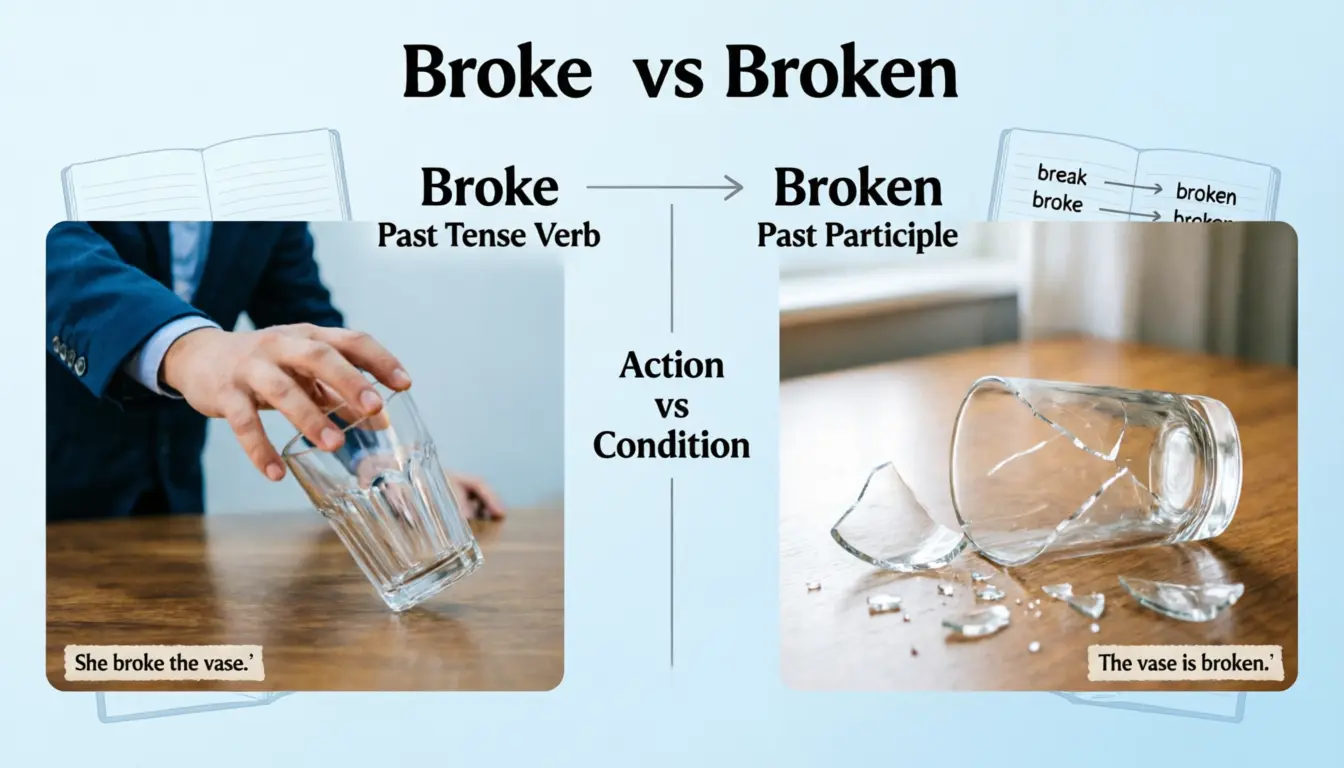
“Broke” is the simple past tense (used alone), while “broken” is the past participle (used with helping verbs like has, have, had or as an adjective).
Have you ever wondered whether you should say “I broke my phone” or “My phone is broken”? Many English learners and even native speakers get confused by broke vs broken because both words come from the same verb, break. They look similar, but they have different jobs in a sentence.
This confusion appears in everyday conversations, emails, school assignments, and business writing. Using the wrong form can make a sentence sound awkward or grammatically incorrect. That is why people often search for broke vs broken to understand when each word should be used.
The good news is that the difference is simple once you know the rule. Broke is usually the past tense of the verb break, while broken is the past participle and often works as an adjective.
In this guide, you will learn the meaning of each word, their history, common mistakes, real-life examples, and practical tips for choosing the correct form. By the end, you will know exactly when to use broke and when to use broken.
Broke vs Broken – Quick Answer
The quick answer is:
- Broke = simple past tense of break
- Broken = past participle of break or an adjective
Examples
✅ I broke my glasses yesterday.
✅ She broke the window by accident.
Quick Comparison
| Word | Grammar Role | Example |
| Broke | Past tense verb | I broke my phone. |
| Broken | Past participle/adjective | My phone is broken. |
A simple trick:
- If the action happened in the past, use broke.
- If you describe the condition or use a helping verb, use broken.
The Origin of Broke vs Broken
Both words come from the Old English verb brecan, which meant “to shatter,” “split,” or “destroy.”
Over time, English developed different verb forms:
| Form | Word |
| Base Verb | Break |
| Past Tense | Broke |
| Past Participle | Broken |
This pattern follows many irregular English verbs.
Examples
| Base Verb | Past Tense | Past Participle |
| Speak | Spoke | Spoken |
| Wake | Woke | Woken |
| Break | Broke | Broken |
The spelling difference exists because English preserves older verb patterns. Instead of adding -ed, the verb changes internally.
That is why we say:
- I broke it.
- It is broken.
Both words share the same root but serve different grammatical purposes.
British English vs American English Spelling
Unlike words such as colour/color or labour/labor, broke and broken are spelled exactly the same in British and American English.
The difference is not about spelling. It is about grammar and usage.
Comparison Table
| Usage | British English | American English |
| Past tense | I broke the vase. | I broke the vase. |
| Adjective | The vase is broken. | The vase is broken. |
| Present perfect | I have broken the vase. | I have broken the vase. |
| Informal meaning of poor | I’m broke. | I’m broke. |
Key Point
Both countries use:
- broke
- broken
The grammar rules remain identical.
Which Spelling Should You Use?
Because there is no regional spelling difference, the choice depends on grammar.
Use “Broke” When:
- Describing a completed action in the past.
- No helping verb is present.
Examples
- I broke my laptop.
- They broke the rules.
- He broke the record.
Use “Broken” When:
- Using perfect tenses.
- Describing a condition.
- Following helping verbs.
Examples:
- I have broken my laptop.
- The laptop is broken.
- The rules were broken.
Audience-Based Advice
| Audience | Recommended Usage |
| US readers | Follow standard grammar rules |
| UK readers | Follow standard grammar rules |
| Commonwealth countries | Follow standard grammar rules |
| Global audience | Use the form that matches the sentence structure |
The rule is universal across English-speaking countries.
Common Mistakes with Broke vs Broken
Many writers mix these forms because they both relate to the verb break.
Mistake #1
❌ I have broke my phone.
✅ I have broken my phone.
Why?
The present perfect tense requires a past participle.
Mistake #2
❌ My phone is broke.
✅ My phone is broken.
Why?
When describing a condition, use broken.
Mistake #3
❌ Yesterday I broken the chair.
✅ Yesterday I broke the chair.
Why?
Simple past tense requires broke.
Mistake #4
❌ The window was broke.
✅ The window was broken.
Why?
Passive voice uses the past participle.
Mistake #5
❌ She has broke the record.
✅ She has broken the record.
Why?
Perfect tenses always need broken.
Broke vs Broken in Everyday Examples
Seeing real-life examples helps make the difference clear.
Emails
Broke
I accidentally broke the attachment link yesterday.
Broken
The attachment link appears to be broken.
News Writing
Broke
The athlete broke the world record.
Broken
The world record has been broken.
ocial Media
Broke
I broke my screen again!
Broken
My screen is completely broken.
In Formal Writing
Broke
The company broke several industry standards.
Broken
Several industry standards were broken during the investigation.
In Everyday Conversation
- I broke my favorite mug.
- The mug is broken now.
- She broke her phone.
- Her phone has been broken for days.
Broke vs Broken – Google Trends & Usage Data
Search data shows that broke vs broken remains a common grammar question worldwide.
People often search this phrase because:
- English learners struggle with irregular verbs.
- Writers want to avoid grammar mistakes.
- Students need help with past tense forms.
- Professionals want accurate business writing.
Usage by Context
| Context | More Common Form |
| Past actions | Broke |
| Perfect tenses | Broken |
| Describing condition | Broken |
| Passive voice | Broken |
| Informal meaning of poor | Broke |
Popular Countries for Searches
Interest is commonly seen in:
- United States
- United Kingdom
- Canada
- Australia
- India
- Pakistan
Most searches focus on grammar rather than spelling differences.
Broke vs Broken Comparison Table
| Feature | Broke | Broken |
| Part of Speech | Verb (past tense) | Past participle/adjective |
| Base Verb | Break | Break |
| Describes Action | Yes | Sometimes |
| Describes Condition | No | Yes |
| Used with Have/Has/Had | No | Yes |
| Used in Passive Voice | No | Yes |
| Example | I broke it. | It is broken. |
Frequently Asked Questions
Is it correct to say “I have broke”?
No. The correct phrase is “I have broken.”
Examples:
✅ I have broken my glasses.
Is “My phone is broke” correct?
In standard grammar, no.
✅ My phone is broken.
However, broke can mean “having no money” in informal speech.
Examples:
✅ I am broke this week.
What is the difference between broke and broken?
Broke is the past tense verb.
Broken is the past participle or adjective.
Can broken be used as an adjective?
Yes.
Examples:
- A broken chair
- A broken heart
- A broken window
Why is break irregular?
It comes from older Germanic language patterns that changed vowel sounds instead of adding -ed.
Is “He broke the rule” correct?
Yes.
It describes a completed action in the past.
Is “The rule was broken” correct?
Yes.
This is passive voice and requires the past participle.
Can broke mean poor?
Yes.
Examples:
- I’m broke until payday.
This meaning is informal and unrelated to physically breaking something.
Which is more common, broke or broken?
Both are common. The choice depends on grammar and context.
Conclusion
Understanding broke vs broken is easier than many people think. Both words come from the verb break, but they perform different roles in English grammar. Broke is the simple past tense and describes an action that happened in the past. For example, “I broke the vase.” Broken is the past participle and is also used as an adjective. For example, “The vase is broken.”
One of the most common mistakes is using broke after helping verbs such as have, has, had, is, or was. In those situations, broken is the correct choice. Remember that if you are talking about a completed action, use broke. If you are describing a condition, using passive voice, or forming a perfect tense, use broken.
The good news is that British English and American English follow the same rules, so you do not need to worry about regional spelling differences. By applying these simple guidelines, you can write and speak more confidently, avoid common grammar mistakes, and choose the correct form every time.
Overview:
People often search for “broke vs broken” worksheets, examples, quizzes, and grammar rules because these two words are commonly confused in everyday English. A broke vs broken worksheet helps learners practice how “broke” (simple past of break) and “broken” (past participle or adjective) are used in sentences.
For better understanding, broke vs broken examples show real-life usage like “He broke the glass” versus “The glass is broken.” Many students also look for a broke vs broken quiz to test their knowledge and improve accuracy in grammar. In broke vs broken grammar, the key difference is that “broke” is used for completed actions in the past, while “broken” describes a state or condition.
People also search meanings like “it is broken meaning”, which refers to something that is damaged or not working, and “it broke meaning”, which simply describes the action of something getting damaged in the past.

I am an Emily Carter Brooks U.S.A based linguistics writer known for my clear, reader-friendly explanations of English grammar and vocabulary differences. I have contributed to multiple online language resources and specializes in spelling variations, pronunciation confusion, and British vs American English comparisons. I’m passionate about helping learners improve their English through practical, everyday communication. engaging, and stress-free.