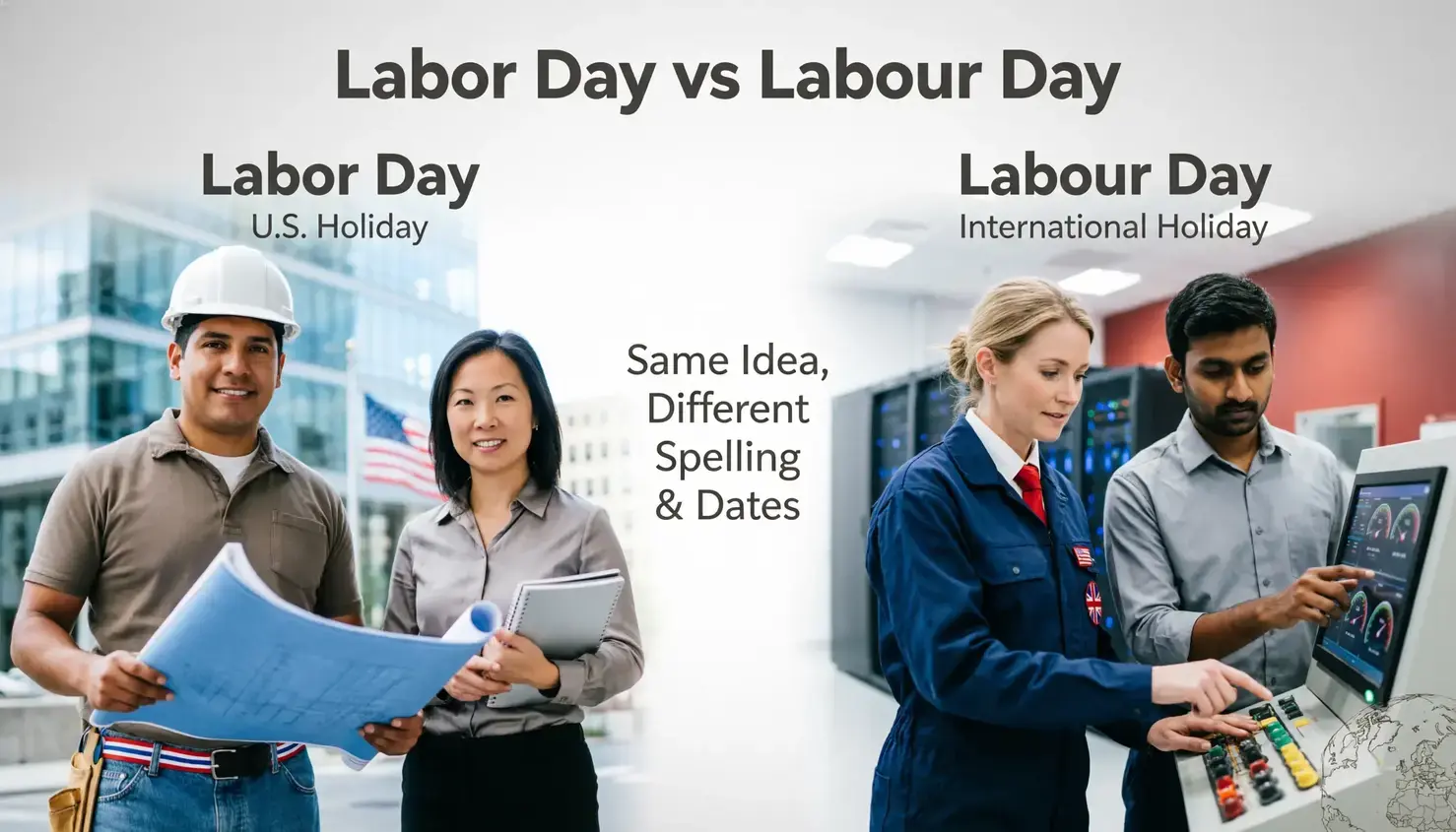
“Labor Day” is the American English spelling used in the United States, while “Labour Day” is the British English spelling used in countries like the United Kingdom, Canada, Australia, and others.
Have you ever seen “Labor Day” written in one place and “Labour Day” in another and wondered which one is correct? You are not alone. Many people search for labor day vs labour day because the two terms look almost identical but use different spellings.
The confusion comes from the differences between American English and British English. In the United States, the holiday is called Labor Day, while many other English-speaking countries use Labour Day when referring to workers’ celebrations or labor-related observances.
Understanding the difference is important for writers, students, businesses, and content creators. Using the correct spelling helps you match your audience and avoid mistakes in professional communication.
In this guide, you’ll learn the meaning of both terms, where the spellings come from, how they differ across countries, and which version you should use. By the end, you’ll know exactly when to write Labor Day and when to write Labour Day.
Labor Day vs Labour Day – Quick Answer
Labor Day and Labour Day refer to worker-related holidays, but the spelling depends on the country.
| Spelling | Common Usage |
| Labor Day | United States |
| Labour Day | United Kingdom, Canada, Australia, New Zealand, and other Commonwealth countries |
Examples
- Labor Day is a federal holiday in the United States.
- Labour Day is celebrated in Canada on the first Monday in September.
- Many countries observe Labour Day on May 1 as International Workers’ Day.
The meaning is the same. The difference is mainly spelling and regional usage.
The Origin of Labor Day vs Labour Day
The word labour comes from the Latin word labor, meaning work, effort, or hardship.
For centuries, English speakers used the spelling labour. When American English developed, many words ending in -our were simplified to -or.
Examples include:
| British English | American English |
| Labour | Labor |
| Colour | Color |
| Honour | Honor |
| Neighbour | Neighbor |
This spelling reform became popular through American dictionaries and publishing standards.
As a result:
- The United States adopted Labor Day.
- Britain and most Commonwealth countries continued using Labour Day.
The spelling difference reflects language conventions rather than a difference in meaning.
British English vs American English Spelling
The distinction between labor and labour follows a common spelling pattern.
American English
American English often removes the letter u from words ending in -our.
Examples
- Labor
- Color
- Favor
- Honor
British English
British English keeps the traditional -our ending.
Examples
- Labour
- Colour
- Favour
- Honour
Comparison Table
| British English | American English |
| Labour Day | Labor Day |
| Labour market | Labor market |
| Labour laws | Labor laws |
| Labour union | Labor union |
| Labour force | Labor force |
If you are writing for a specific audience, follow the spelling convention used in that region.
Which Spelling Should You Use?
The correct choice depends on who will read your content.
Use “Labor Day” If:
- Your audience is in the United States.
- You are writing for American businesses.
- You follow American English style guides.
- You refer to the U.S. federal holiday.
Examples
Our office will be closed on Labor Day.
Use “Labour Day” If:
- Your audience is in the UK.
- Your readers are in Canada, Australia, or New Zealand.
- You follow British English spelling standards.
Examples
Canadians celebrate Labour Day in September.
For Global Audiences
Choose one spelling and stay consistent throughout the content. Consistency is more important than switching between versions.
Common Mistakes with Labor Day vs Labour Day
Many writers accidentally mix spellings.
Mistake #1: Mixing Styles
❌ The company will close for Labour Day in New York.
✅ The company will close for Labor Day in New York.
Mistake #2: Using the Wrong Regional Form
❌ Labor Day celebrations across Canada.
✅ Labour Day celebrations across Canada.
Mistake #3: Inconsistent Writing
❌ Labor Day is important. Many workers enjoy Labour Day events.
✅ Labor Day is important. Many workers enjoy Labor Day events.
Mistake #4: Assuming They Mean Different Holidays
Some people think the words describe different events.
✅ In most cases, they refer to the same worker-focused holiday tradition. The spelling changes by region.
Labor Day vs Labour Day in Everyday Examples
Here are common situations where the terms appear.
Emails
American English:
Our offices will be closed for Labor Day weekend.
British/Commonwealth English:
Happy Labour Day to all employees.
News Articles
American:
Labor Day travel is expected to increase this year.
Canadian:
Labour Day celebrations will take place nationwide.
Social Media
American:
Enjoy your Labor Day holiday!
British/Commonwealth:
Wishing everyone a happy Labour Day.
Formal Writing
American:
Labor Day is recognized as a federal holiday in the United States.
British/Commonwealth:
Labour Day events honor workers and labor movements.
Labor Day vs Labour Day – Google Trends & Usage Data
Search data consistently shows that Labor Day dominates searches in the United States because it is the official spelling used by government agencies, schools, businesses, and media outlets.
Meanwhile, Labour Day is more common in:
- Canada
- United Kingdom
- Australia
- New Zealand
- South Africa
- Other Commonwealth countries
Usage often depends on geography rather than meaning.
Popularity by Region
| Country | Common Form |
| United States | Labor Day |
| Canada | Labour Day |
| United Kingdom | Labour Day |
| Australia | Labour Day |
| New Zealand | Labour Day |
People typically search for the spelling they see in local media and education systems.
Labor Day vs Labour Day Comparison Table
| Feature | Labor Day | Labour Day |
| Meaning | Holiday honoring workers | Holiday honoring workers |
| English Style | American English | British English |
| Main Countries | United States | UK, Canada, Australia, New Zealand |
| Official Spelling | Yes in the US | Yes in Commonwealth countries |
| Pronunciation | Same | Same |
| Correct Usage | US audiences | British/Commonwealth audiences |
Frequently Asked Questions
Is Labor Day or Labour Day correct?
Both are correct. The choice depends on whether you use American English or British English.
Why does America use Labor instead of Labour?
American English simplified many -our words to -or, creating forms such as labor, color, and honor.
Do Labor Day and Labour Day mean the same thing?
Yes. Both refer to worker-related holidays and celebrations.
Which spelling is used in Canada?
Canada generally uses Labour Day.
Which spelling is used in the United States?
The United States officially uses Labor Day.
Is Labour Day celebrated on the same date everywhere?
No. Different countries celebrate worker-related holidays on different dates.
Can I use Labor Day in British English?
It is understandable, but Labour Day is the preferred spelling in British English.
Is one spelling more correct than the other?
No. Both are correct within their respective language standards.
Which version is better for content?
Use the version that matches your target audience and geographic market.
Conclusion
The debate over labor day vs labour day is really a question of regional spelling rather than meaning. Both expressions refer to holidays that recognize workers and their contributions to society. The key difference lies in the language standard being used.
If you are writing for readers in the United States, Labor Day is the correct spelling. It follows American English conventions that simplify many words ending in -our to -or. On the other hand, if your audience is in the United Kingdom, Canada, Australia, New Zealand, or another Commonwealth nation, Labour Day is the preferred form.
For businesses, bloggers, marketers, and students, the most important rule is consistency. Select the spelling that matches your audience and use it throughout your content. Mixing both versions can appear unprofessional and may confuse readers.
When people search for “Labor Day vs Labour Day Wikipedia,” they usually want a simple explanation of why the spelling differs and how both terms refer to similar workers’ celebrations in different regions, while “Labor Day vs Labour Day quotes” is often related to inspirational sayings about workers’ rights and dignity.
In many countries, “1st May Labour Day” is observed as International Labour Day, also called International Workers’ Day, which is different from “Labour Day America,” because in the United States it is celebrated in September instead of May. Similarly, “Labour Day Canada” follows the September tradition like the US, while “Labor Day vs Labour Day 2022” is commonly searched to compare how the celebration was observed in different countries in that year.
On a global level, “International Labour Day” highlights solidarity among workers worldwide, whereas regional observances differ in date and customs. In South Asia, many people also ask “When is Labour Day in Pakistan,” where it is observed on 1st May every year as a public holiday honoring workers’ contributions.

I hold a degree in English Literature and Linguistics and have worked extensively on educational blogs, comparison websites, and digital learning platforms. My writing focuses on simplifying complex language rules, highlighting British vs American English differences, and providing practical examples for everyday usage.