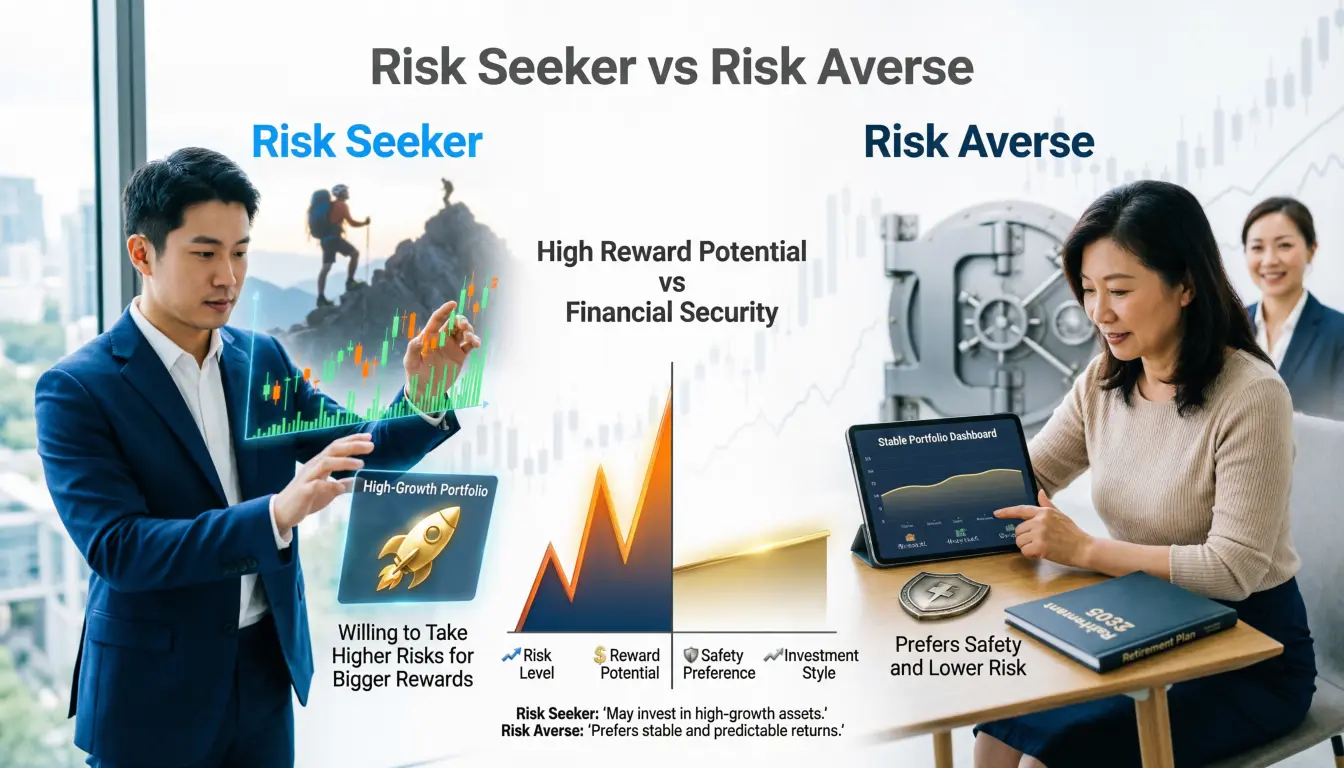
“Risk seeker” and “risk averse” are opposite terms used to describe attitudes toward risk. A risk seeker is someone who is willing to take chances for the possibility of higher rewards, while a risk-averse person prefers safety, certainty, and lower-risk options even if the potential rewards are smaller.
Why do some people invest in high-risk stocks while others prefer keeping money in a savings account? Why does one person enjoy extreme sports while another avoids them? The answer often comes down to being a risk seeker or risk averse.
Many people search for risk seeker vs risk averse because these terms appear in finance, business, psychology, and everyday decision-making. While both concepts relate to how people respond to uncertainty, they describe very different attitudes toward risk.
Understanding the difference can help you make better financial decisions, improve business strategies, and recognize your own decision-making style. Investors, students, business professionals, and researchers often encounter these terms and want a simple explanation.
This guide explains the meaning of risk seeker and risk averse, their origins, common uses, examples, and practical applications. By the end, you’ll clearly understand when each term applies and how these attitudes influence real-world choices.
Risk Seeker vs Risk Averse – Quick Answer
A risk seeker is someone who prefers options with higher potential rewards, even when they involve greater uncertainty.
A risk-averse person prefers safer options and tries to avoid uncertainty, even if it means accepting lower rewards.
Examples
| Risk Seeker | Risk Averse |
| Invests in startup companies | Invests in government bonds |
| Enjoys extreme sports | Prefers safer activities |
| Starts a new business despite uncertainty | Chooses a stable job |
| Buys volatile stocks | Keeps money in savings accounts |
In simple terms, risk seekers embrace uncertainty, while risk-averse individuals try to minimize it.
The Origin of Risk Seeker vs Risk Averse
The word risk comes from the Italian word risco or rischio, meaning danger or hazard.
Risk Seeker
The term “risk seeker” developed in economics and psychology to describe people who actively choose uncertain outcomes when the potential reward is attractive.
Risk Averse
The term “risk averse” comes from the word averse, which originates from the Latin aversus, meaning “turned away from.”
A risk-averse person is literally someone who turns away from risk.
Unlike spelling differences such as “analysed” and “analyzed,” these terms are not alternative spellings. They describe two opposite behavioral preferences.
British English vs American English Spelling
Unlike many English words, risk seeker and risk averse do not have major spelling differences between British and American English.
Comparison Table
| British English | American English | Meaning |
| Risk seeker | Risk seeker | Person who prefers higher risk |
| Risk averse | Risk averse | Person who avoids risk |
| Risk-taking | Risk-taking | Willingness to take risks |
| Risk aversion | Risk aversion | Tendency to avoid risk |
Both regions use the same spellings.
Which Spelling Should You Use?
Since there are no significant spelling variations, use the standard forms:
- Risk seeker for someone who prefers risk.
- Risk averse for someone who avoids risk.
Audience-Based Advice
| Audience | Recommended Usage |
| United States | Risk seeker, Risk averse |
| United Kingdom | Risk seeker, Risk averse |
| Australia | Risk seeker, Risk averse |
| Canada | Risk seeker, Risk averse |
| Global Audience | Risk seeker, Risk averse |
The terms are accepted worldwide.
Common Mistakes with Risk Seeker vs Risk Averse
Many people confuse these terms because they both involve risk.
Mistake 1: Using Them as Synonyms
❌ She is risk averse because she likes gambling.
✅ She is a risk seeker because she likes gambling.
Mistake 2: Assuming Risk Seekers Ignore Danger
❌ Risk seekers never think about consequences.
✅ Risk seekers often understand risks but accept them for potential rewards.
Mistake 3: Thinking Risk-Averse Means Fearful
❌ Risk-averse people are always scared.
✅ Risk-averse people simply prefer predictable outcomes.
Mistake 4: Confusing Risk Aversion with Inaction
❌ Risk-averse individuals never take risks.
✅ They take calculated risks when benefits outweigh costs.
Risk Seeker vs Risk Averse in Everyday Examples
In Emails
Risk Seeker Example
“We should launch the product early to capture market share.”
Risk-Averse Example
“Let’s complete more testing before launch.”
In News Articles
Risk Seeker
“The investor backed several emerging startups.”
Risk Averse
“The fund shifted assets into low-risk bonds.”
On Social Media
Risk Seeker
“I’m putting everything into my new business idea!”
Risk Averse
“I prefer steady growth over quick gains.”
In Formal Writing
“Risk-seeking behavior often leads to higher potential returns, while risk-averse behavior prioritizes stability.”
Risk Seeker vs Risk Averse – Google Trends & Usage Data
Search interest in these terms often rises during:
- Stock market volatility
- Economic uncertainty
- Business strategy discussions
- Personal finance education
- Investment planning
Popular Countries
The terms are commonly searched in:
- United States
- United Kingdom
- Canada
- Australia
- India
Common Contexts
| Context | Most Common Term |
| Investing | Risk seeker, Risk averse |
| Economics | Risk aversion |
| Psychology | Risk-seeking behavior |
| Business Strategy | Risk tolerance |
| Personal Finance | Risk profile |
Interest increases when people evaluate financial decisions or career choices.
Comparison Table: Risk Seeker vs Risk Averse
| Feature | Risk Seeker | Risk Averse |
| Attitude Toward Risk | Positive | Negative |
| Investment Style | Aggressive | Conservative |
| Decision-Making | Pursues reward | Avoids loss |
| Financial Preference | High-growth assets | Stable assets |
| Business Approach | Innovation-focused | Stability-focused |
| Emotional Response | Comfortable with uncertainty | Prefers predictability |
Risk Seeker vs Risk Averse in Academic Writing
Academic research frequently examines risk preferences.
Examples
“Participants with risk-seeking tendencies selected higher-variance outcomes.”
Common Academic Fields
- Economics
- Psychology
- Behavioral Finance
- Decision Theory
- Management Studies
Academic writing generally uses precise terms such as:
- Risk seeker
- Risk-seeking behavior
- Risk averse
- Risk aversion
Risk Seeker vs Risk Averse in Business English
Business professionals use these terms when discussing strategy and investments.
Risk Seeker Example
“Our company will enter emerging markets despite uncertainty.”
Risk-Averse Example
“The organization prioritizes stable revenue streams.”
Common Business Areas
- Investment decisions
- Product launches
- Market expansion
- Corporate strategy
- Entrepreneurship
Common Style Guide Recommendations
Most major style guides and business publications recommend:
| Style Guide | Recommendation |
| APA Style | Use risk seeker and risk averse consistently |
| Chicago Manual of Style | Hyphenate when used as modifiers if needed |
| Business Publications | Use standard economic terminology |
| Academic Journals | Prefer precise behavioral definitions |
Examples
- Risk-seeking investor
- Risk-averse consumer
Real Examples from Published Sources
Economics
“Risk aversion is a central concept in economic decision-making.”
Finance
“Investors differ significantly in their tolerance for risk.”
Psychology
“Risk-seeking behavior is often linked to reward sensitivity.”
Business
“Organizations must balance risk and opportunity.”
These examples show how frequently the concepts appear across disciplines.
Risk Seeker vs Risk Averse Quiz
Choose the correct answer.
1. Which person is most likely a risk seeker?
A. Someone buying government bonds
B. Someone investing in a startup
Answer: B
2. Which person is most likely risk averse?
A. Someone preferring stable investments
B. Someone gambling on uncertain outcomes
Answer: A
3. Risk aversion means:
A. Seeking uncertainty
B. Preferring safer choices
Answer: B
4. A risk seeker usually prefers:
A. Higher potential rewards
B. Guaranteed outcomes
Answer: A
5. Which term describes avoiding uncertainty?
A. Risk averse
B. Risk seeker
Answer: A
Fill in the Blanks Exercise
Complete the sentences.
- A person who prefers safe investments is __________.
Answer: risk averse
- Entrepreneurs are often considered __________.
Answer: risk seekers
- Government bonds attract many __________ investors.
Answer: risk-averse
- A gambler may display __________ behavior.
Answer: risk-seeking
- Risk aversion focuses on reducing __________.
Answer: uncertainty
FAQs
1. What is the main difference between a risk seeker and a risk-averse person?
A risk seeker prefers uncertain opportunities with higher rewards, while a risk-averse person prefers safer and more predictable outcomes.
2. Is being risk averse a bad thing?
No. It can protect people from unnecessary losses and help preserve wealth.
3. Are entrepreneurs usually risk seekers?
Many entrepreneurs show risk-seeking tendencies, but successful entrepreneurs often manage risks carefully.
4. Can someone be both risk seeker and risk averse?
Yes. A person may take risks in one area, such as business, while avoiding risks in another, such as personal finance.
5. Which investment style suits risk seekers?
Growth stocks, startups, and emerging markets often attract risk seekers.
6. Which investments suit risk-averse individuals?
Government bonds, savings accounts, and diversified portfolios are common choices.
7. Is risk aversion common?
Yes. Research generally shows that many people prefer avoiding losses over pursuing gains.
8. Do risk seekers always earn more money?
No. Higher rewards often come with higher chances of loss.
9. Why is understanding risk preferences important?
It helps individuals make better financial, business, and personal decisions.
Conclusion
The comparison of risk seeker vs risk averse is important because it explains how people respond to uncertainty. A risk seeker accepts greater uncertainty in pursuit of larger rewards, while a risk-averse person prioritizes safety and predictability. Neither approach is automatically better. The right choice depends on goals, circumstances, and personal comfort with uncertainty.
In investing, risk seekers may pursue aggressive growth opportunities, while risk-averse investors focus on preserving capital. In business, risk seekers may embrace innovation and expansion, whereas risk-averse leaders often prioritize stability and long-term security. Both approaches have advantages and disadvantages.
Understanding these concepts can improve decision-making in finance, career planning, entrepreneurship, and everyday life. By recognizing your own risk preferences, you can choose strategies that align with your objectives and tolerance for uncertainty. If you lean toward seeking risk or avoiding it, informed decisions are usually more important than the level of risk itself.

I hold a degree in English Literature and Linguistics and have worked extensively on educational blogs, comparison websites, and digital learning platforms. My writing focuses on simplifying complex language rules, highlighting British vs American English differences, and providing practical examples for everyday usage.