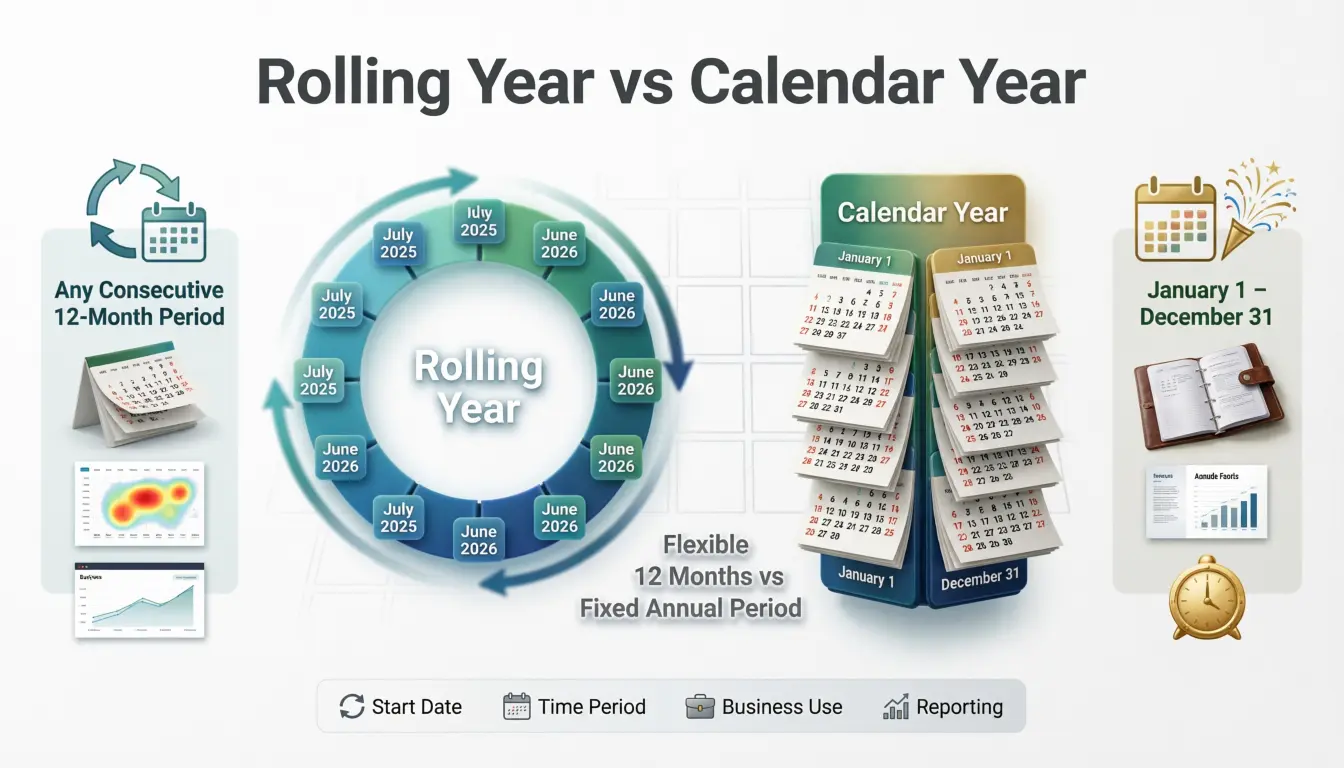
“Rolling year” and “calendar year” are both valid time periods, but they measure dates in different ways. A rolling year is a continuous 12-month period counted backward or forward from a specific date, while a calendar year runs from January 1 to December 31.
Have you ever looked at a financial report, employee benefit policy, or business performance review and seen the terms rolling year and calendar year? Many people assume they mean the same thing, but they are actually very different.
This confusion matters because using the wrong time period can affect budgeting, taxes, employee leave calculations, sales reports, and business planning. Companies, government agencies, and financial institutions often use one method over the other depending on their goals.
People search for rolling year vs calendar year because they want to understand which period applies to their situation. A calendar year follows fixed dates, while a rolling year constantly moves forward based on the current date or a specific reference point.
In this guide, you’ll learn the difference between a rolling year and a calendar year, see real-world examples, compare their advantages, avoid common mistakes, and discover which option is best for different situations.
Rolling Year vs Calendar Year – Quick Answer
A calendar year runs from January 1 to December 31 every year.
A rolling year covers the previous 12 months from any given date and continuously moves forward.
Examples
| Type | Example |
| Calendar Year | January 1, 2026 – December 31, 2026 |
| Rolling Year | July 1, 2025 – June 30, 2026 |
| Rolling Year | October 15, 2025 – October 14, 2026 |
Simple Explanation
- Calendar years use fixed dates.
- Rolling years use moving dates.
- Businesses often use rolling years for performance tracking.
- Governments and tax systems often use calendar years.
The Origin of Rolling Year vs Calendar Year
Calendar Year
The term calendar year comes from the word “calendar,” which originated from the Latin word calendarium. Ancient civilizations used calendars to track seasons, events, and taxes.
Over time, January 1 became the widely accepted start of the year in many countries.
Rolling Year
The term rolling year developed from the concept of a period that “rolls” forward continuously. Instead of resetting on January 1, the measurement always looks back over the most recent 12 months.
Unlike spelling comparisons such as “analysed vs analyzed,” there are no British and American spelling differences here. The distinction is based on time measurement rather than spelling.
British English vs American English Spelling
Unlike many English words, rolling year and calendar year are spelled the same in both British and American English.
Comparison Table
| Term | British English | American English |
| Rolling Year | Rolling Year | Rolling Year |
| Calendar Year | Calendar Year | Calendar Year |
Examples
British English
- The company reviews performance using a rolling year.
American English
- Employee leave is calculated on a rolling year basis.
The spelling remains identical across regions.
Which Term Should You Use?
The right choice depends on your purpose.
Use Calendar Year When:
- Filing taxes
- Creating annual reports
- Tracking yearly goals
- Following government reporting periods
Use Rolling Year When:
- Monitoring business performance
- Measuring employee attendance
- Tracking customer activity
- Evaluating recent trends
Global Advice
If you are discussing official yearly periods, use calendar year.
If you are discussing the most recent 12 months at any point in time, use rolling year.
Common Mistakes with Rolling Year vs Calendar Year
Many people mix these terms because both cover twelve months.
Mistake 1: Assuming They Start on January 1
❌ A rolling year always starts on January 1.
✅ A rolling year can start on any date.
Mistake 2: Using Them Interchangeably
❌ Calendar year and rolling year mean the same thing.
✅ They represent different ways of measuring time.
Mistake 3: Misreading Reports
❌ Last year’s data always means a calendar year.
✅ Sometimes reports use rolling-year data instead.
Mistake 4: Incorrect Leave Calculations
❌ Employee leave always resets January 1.
✅ Some employers use a rolling year system.
Rolling Year vs Calendar Year in Everyday Examples
Email Example
“Our annual budget is based on the 2026 calendar year.”
News Example
“The company reported a 12% increase over the rolling year.”
Social Media Example
“Our customer growth over the past rolling year has been amazing!”
Formal Business Writing
“Performance was evaluated using rolling-year metrics rather than calendar-year results.”
Rolling Year vs Calendar Year – Google Trends & Usage Data
Search interest for rolling year vs calendar year often increases around:
- Tax season
- Financial reporting periods
- HR policy reviews
- Business planning cycles
Where Calendar Year Is Popular
- Government reporting
- Tax documentation
- Public statistics
- Annual business reports
Where Rolling Year Is Popular
- Human resources
- Sales tracking
- Marketing analytics
- Financial forecasting
Usage Context Comparison
| Context | Calendar Year | Rolling Year |
| Taxes | Very Common | Rare |
| HR Leave Tracking | Sometimes | Very Common |
| Business Analytics | Common | Very Common |
| Government Reports | Very Common | Rare |
| Sales Analysis | Common | Very Common |
Rolling Year vs Calendar Year Comparison Table
| Feature | Calendar Year | Rolling Year |
| Time Period | Jan 1–Dec 31 | Any consecutive 12 months |
| Fixed Dates | Yes | No |
| Continuously Updates | No | Yes |
| Used for Taxes | Yes | Rarely |
| Used for Trend Analysis | Sometimes | Frequently |
| Easy to Compare Years | Yes | Moderate |
| Tracks Recent Performance | Limited | Excellent |
Rolling Year vs Calendar Year in Academic Writing
Academic researchers often prefer clearly defined time periods.
Calendar Year Example
“The data was collected during the 2025 calendar year.”
Rolling Year Example
“The study analyzed outcomes over a rolling 12-month period.”
Academic Recommendation
Always define the exact period being measured to avoid confusion.
Rolling Year vs Calendar Year in Business English
Businesses use both methods depending on reporting needs.
Calendar Year Uses
- Annual revenue reports
- Tax preparation
- Shareholder communications
Rolling Year Uses
- Sales monitoring
- Employee absence tracking
- Customer retention analysis
Example
“Rolling-year revenue increased 8% compared with the previous rolling-year period.”
Common Style Guide Recommendations
Most major style guides focus on clarity rather than choosing one term.
Best Practices
- Capitalize only when required by company style.
- State exact dates whenever possible.
- Avoid assuming readers understand which period is being used.
Example
Better:
“Sales increased during the rolling year ending June 30, 2026.”
Less Clear:
“Sales increased last year.”
Real Examples from Published Sources
Business Reporting
Companies frequently report:
- Revenue during the calendar year
- Growth during the trailing or rolling 12 months
Human Resources
Many organizations calculate:
- Sick leave using rolling years
- Vacation allocations using calendar years
Financial Analysis
Analysts often compare:
- Calendar-year earnings
- Rolling-year performance trends
Rolling Year vs Calendar Year Quiz
Choose the correct answer.
1. Which period always starts on January 1?
A. Rolling Year
B. Calendar Year
Answer: B
2. Which period moves forward continuously?
A. Rolling Year
B. Calendar Year
Answer: A
3. Which is commonly used for taxes?
A. Calendar Year
B. Rolling Year
Answer: A
4. Which is useful for tracking recent trends?
A. Calendar Year
B. Rolling Year
Answer: B
5. Does a rolling year always begin on the same date?
A. Yes
B. No
Answer: B
Fill in the Blanks Exercise
- A __________ year runs from January 1 to December 31.
Answer: calendar
- A __________ year covers the most recent 12 months.
Answer: rolling
- Tax reporting commonly uses the __________ year.
Answer: calendar
- Employee absence tracking often uses a __________ year.
Answer: rolling
- A rolling year continuously __________ forward.
Answer: moves
FAQs
What is the main difference between a rolling year and a calendar year?
A calendar year uses fixed dates, while a rolling year always covers the latest 12 months.
Is a rolling year always 12 months?
Yes. A rolling year generally consists of the most recent consecutive 12 months.
Why do companies use rolling years?
They provide a more current view of performance and trends.
Which is better for tax reporting?
Calendar years are usually preferred for tax reporting.
Can a rolling year start in any month?
Yes. It can start on any date.
Which is better for business analysis?
Rolling years are often better for tracking recent performance.
Do governments use rolling years?
Most government reporting uses calendar years.
Is a fiscal year the same as a rolling year?
No. A fiscal year is fixed, while a rolling year continuously changes.
Are rolling years more accurate?
They are not necessarily more accurate, but they often provide more current information.
Conclusion
Understanding the difference between rolling year vs calendar year is important for business, finance, human resources, and reporting. Although both cover twelve months, they serve different purposes.
A calendar year follows fixed dates from January 1 through December 31. It is simple, widely recognized, and commonly used for taxes, government reporting, and annual planning. Because everyone works from the same timeframe, comparisons are straightforward.
A rolling year, on the other hand, always measures the most recent twelve months. This approach helps businesses monitor current performance, identify trends, and make decisions based on up-to-date information. Since the period continuously moves forward, it often provides a clearer picture of what is happening right now.
When choosing between the two, consider your goal. If you need official reporting or yearly comparisons, a calendar year is usually the best option. If you need ongoing analysis and real-time insights, a rolling year is often more useful. Knowing when to use each method will help you interpret reports correctly and make better decisions.

I hold a degree in English Literature and Linguistics and have worked extensively on educational blogs, comparison websites, and digital learning platforms. My writing focuses on simplifying complex language rules, highlighting British vs American English differences, and providing practical examples for everyday usage.