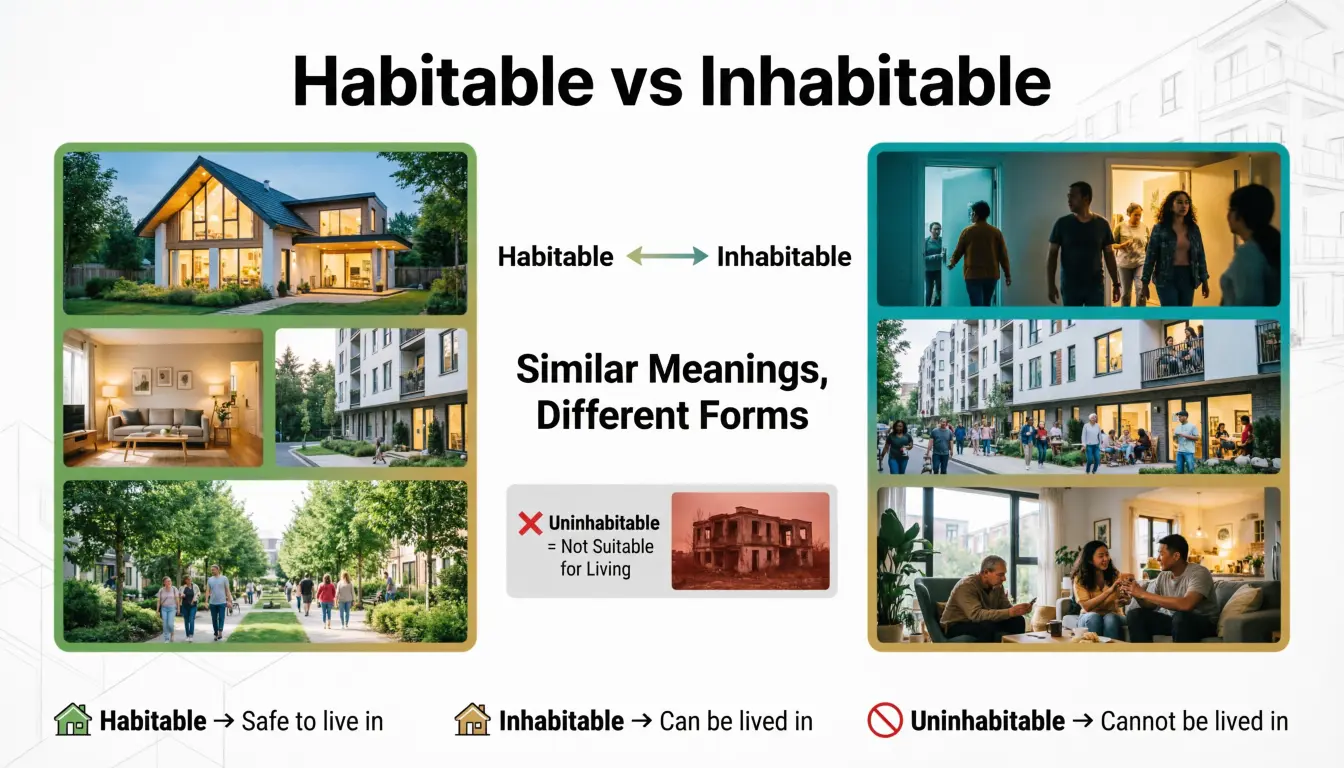
“Habitable” and “inhabitable” are tricky because they mean nearly the same thing, not opposites. “Habitable” means suitable for living in, while “inhabitable” traditionally means capable of being inhabited or lived in. In modern usage, however, many people mistakenly use “inhabitable” to mean the opposite. To avoid confusion, “uninhabitable” is the preferred word for not suitable for living in.
Have you ever read the words habitable and inhabitable and wondered if they mean the same thing or the opposite? You are not alone. These two words often confuse writers, students, editors, and even native English speakers because their spellings look very similar.
Many people search for habitable vs inhabitable because they want to know which word correctly describes a place where people can live. The confusion becomes even greater because the prefix in- usually means “not,” but in this case, the meaning is not always obvious.
Understanding the difference between these terms is important in academic writing, business communication, real estate descriptions, environmental studies, and everyday conversations. Using the wrong word can completely change the meaning of your sentence.
In this guide, you will learn the meanings, origins, usage rules, examples, style recommendations, common mistakes, and practical tips for using habitable and inhabitable correctly.
Habitable vs Inhabitable – Quick Answer
Habitable means a place is suitable for living.
Inhabitable also means capable of being lived in or occupied.
Examples
✅ The house is habitable after repairs.
✅ The island became inhabitable once fresh water was discovered.
Although both words technically mean nearly the same thing, habitable is far more common in modern English.
When writers want to express the opposite meaning, they usually use uninhabitable.
✅ The building became uninhabitable after the fire.
The Origin of Habitable vs Inhabitable
The word habitable comes from the Latin word habitare, meaning “to live” or “to dwell.”
The word inhabitable developed from the same Latin root through the verb inhabit, meaning “to live in.”
Historically:
- Habitable = fit to live in
- Inhabitable = capable of being inhabited
The confusion exists because the prefix in- in inhabitable does not mean “not.” Instead, it comes from the verb inhabit.
Over time, English speakers found the similarity confusing, so habitable became the preferred term.
Today, many style guides recommend avoiding inhabitable because readers may mistake it for the opposite meaning.
British English vs American English Spelling
Unlike words such as analysed and analyzed, habitable and inhabitable are spelled the same in both British and American English.
The difference is mainly about usage and preference rather than spelling.
Comparison Table
| Feature | British English | American English |
| Habitable | Preferred | Preferred |
| Inhabitable | Less common | Less common |
| Uninhabitable | Common opposite | Common opposite |
| Meaning of Habitable | Suitable for living | Suitable for living |
| Meaning of Inhabitable | Capable of being inhabited | Capable of being inhabited |
Example Sentences
| British Example | American Example |
| The cottage is habitable again. | The apartment is habitable again. |
| The region became inhabitable after development. | The valley became inhabitable after settlement. |
Which Spelling Should You Use?
For most audiences, use habitable.
Use Habitable When:
- Writing articles
- Academic papers
- Business reports
- News stories
- Real estate descriptions
- International communication
Use Inhabitable When:
- Quoting historical texts
- Discussing language history
- Referring to older usage
Global Recommendation
If your audience is international, choose habitable because it is clearer and widely understood.
Common Mistakes with Habitable vs Inhabitable
Mistake 1: Assuming Inhabitable Means “Not Habitable”
❌ The house is inhabitable after the flood.
If you mean people cannot live there, use:
✅ The house is uninhabitable after the flood.
Mistake 2: Using Inhabitable in Modern Writing
❌ The apartment became inhabitable.
✅ The apartment became habitable.
Mistake 3: Confusing Habitable and Uninhabitable
❌ The fire made the building habitable.
✅ The fire made the building uninhabitable.
Habitable vs Inhabitable in Everyday Examples
Habitable
“The property is now habitable following renovations.”
News
“The area became habitable after water and electricity were restored.”
Social Media
“After months of repairs, my house is finally habitable again!”
Formal Writing
“Researchers evaluated whether the environment was habitable for human settlement.”
Real Estate
“The structure is fully habitable and ready for occupancy.”
Habitable vs Inhabitable – Google Trends & Usage Data
Search interest shows that habitable is much more common than inhabitable.
Popular Countries
- United States
- United Kingdom
- Canada
- Australia
- New Zealand
Common Search Contexts
- Real estate
- Environmental science
- Astronomy
- Climate studies
- Property inspections
People often search:
- Habitable meaning
- Habitable planet
- Habitable house
- Inhabitable definition
- Habitable vs uninhabitable
The rise of discussions about climate change and space exploration has increased interest in the word habitable.
Comparison Table: Habitable vs Inhabitable
| Feature | Habitable | Inhabitable |
| Meaning | Suitable for living | Capable of being inhabited |
| Modern Usage | Very common | Rare |
| Reader Clarity | High | Lower |
| Recommended for General Writing | Yes | Usually No |
| Academic Acceptance | Yes | Limited |
| Business Writing | Yes | Rare |
| Risk of Confusion | Low | High |
Habitable vs Inhabitable in Academic Writing
Academic writing values clarity and precision.
Most universities, journals, and researchers prefer habitable because it avoids misunderstanding.
Academic Example
“The study examined whether Mars could become habitable in the future.”
Less Preferred
“The study examined whether Mars could become inhabitable in the future.”
Although technically correct, the second sentence may confuse readers.
Habitable vs Inhabitable in Business English
Business communication should be clear and direct.
Preferred Business Usage
- Habitable office space
- Habitable residential property
- Habitable accommodation
Example
“The building is habitable and meets all safety requirements.”
Most business professionals avoid inhabitable because clients may misunderstand it.
Common Style Guide Recommendations
Many editors and writing experts recommend:
- Use habitable for places suitable for living.
- Use uninhabitable for places unsuitable for living.
- Avoid inhabitable unless discussing language history.
Quick Style Guide Rule
| Meaning | Recommended Word |
| Fit to live in | Habitable |
| Not fit to live in | Uninhabitable |
| Historical discussion | Inhabitable |
Real Examples from Published Sources
Scientific Writing
“Scientists continue searching for habitable planets beyond our solar system.”
Real Estate Writing
“The property remains habitable despite minor damage.”
Environmental Reports
“Climate change may affect whether certain regions remain habitable.”
Government Reports
“Emergency teams worked to restore habitable conditions.”
These examples show that habitable dominates modern published English.
Quiz: Habitable vs Inhabitable
Choose the correct answer.
1. The apartment became ______ after repairs.
A. Habitable
B. Uninhabitable
Answer: A
2. The fire made the building ______.
A. Habitable
B. Uninhabitable
Answer: B
3. Scientists seek ______ planets.
A. Habitable
B. Uninhabitable
Answer: A
4. After the flood, the house was ______.
A. Uninhabitable
B. Habitable
Answer: A
5. Which word is most common today?
A. Habitable
B. Inhabitable
Answer: A
Fill in the Blanks Exercise
Fill in each blank.
- The house became ______ after renovations.
- The storm left the building ______.
- Researchers study whether Mars is ______.
- The apartment was declared ______ after the fire.
- The property is now fully ______.
Answers
- habitable
- uninhabitable
- habitable
- uninhabitable
- habitable
FAQs
1. Do habitable and inhabitable mean the same thing?
Yes. Both generally mean capable of being lived in.
2. Why is inhabitable confusing?
Many readers assume the prefix “in-” means “not,” creating confusion.
3. Which word is more common today?
Habitable is far more common in modern English.
4. What is the opposite of habitable?
The opposite is uninhabitable.
5. Should I use inhabitable in formal writing?
Usually no. Habitable is clearer.
6. Is inhabitable incorrect?
No. It is a valid English word, but it is uncommon.
7. Which word do scientists use?
Scientists usually prefer habitable.
8. Is there a spelling difference between British and American English?
No. Both varieties use the same spellings.
9. Which term is best for global audiences?
Habitable is the safest and clearest choice.
Conclusion
The debate around habitable vs inhabitable comes from the unusual history of the words. While both terms can mean that a place is suitable for human occupation, modern English strongly favors habitable because it is clearer and easier to understand. The word inhabitable remains technically correct, but many readers mistakenly think it means the opposite.
For everyday communication, academic papers, business documents, news articles, and online content, habitable is usually the best choice. When you need the opposite meaning, use uninhabitable rather than relying on readers to interpret inhabitable correctly.
Remember this simple rule: if people can comfortably live there, it is habitable. If they cannot live there, it is uninhabitable. Following this guideline will make your writing more accurate, professional, and reader-friendly. If you are discussing homes, cities, islands, or even distant planets, choosing the correct term helps ensure your message is understood immediately.

I am an Emily Carter Brooks U.S.A based linguistics writer known for my clear, reader-friendly explanations of English grammar and vocabulary differences. I have contributed to multiple online language resources and specializes in spelling variations, pronunciation confusion, and British vs American English comparisons. I’m passionate about helping learners improve their English through practical, everyday communication. engaging, and stress-free.